

Your Household Has Been Shrinkflating Itself. Here's How Close That Gets You to the Edge.
Companies shrink the box when they can't raise the price. Households do the same to their own lives, quietly, long before anyone calls it a crisis. Part 4 of What Food Should Cost.

A note before we start: this article is part of a run of Thursday pieces on ‘What Food Should Cost’ here at Between the Lines Canada, each one pulling a single thread out of Canada’s food inflation story. Each piece stands on its own, but they’re built to talk to each other. The first looked at why grocery prices became harder to read. The second looked at why food quality could quietly change while the label stayed the same. The third looked at why the floor under food prices is rising, and why no policy can simply push it back down. This one turns to a harder question: who can still keep their balance on that floor, and who’s being pushed beneath it.
If you wish to start reading the series from the beginning, you can go to the first article, Your Grandmother Wasn’t Smarter About Groceries. Her Store Was Dumber.“
The paycheque that never resets
Ever get the feeling that you aren’t just spinning your wheels in place anymore, but also sliding backwards a tiny little bit at a time? Canada’s largest insolvency firm tells us that most Canadians no longer experience payday as a reset. They are showing that three in five of us are saying that at least half of our income is already committed to bills, debt payments and regular expenses before it is even in our hands. That is three out of every five of our family, friends, colleagues and neighbours. One in three of us say most of it is already spoken for, not just half. One in six say all of it is, or that expenses already exceed what’s coming in.
Grant Bazian, president of MNP LTD, Licensed Insolvency Trustees firm, was quite clear about that in the firm’s most recent Consumer Debt Index: the next paycheque isn’t a reset point anymore. It’s already spoken for. Each one gets used to try and play catch up from the last one, which means a lot of households are staying current on paper while quietly falling further behind in reality.
Last week’s What Food Should Cost piece was about a rising floor under our food prices. Issues that no policy can simply push back down. I ended that article with a promise. I promised to help figure out who can still keep their balance on that floor, and who’s being pushed beneath it. The honest answer turned out to be less about who you and I are in the moment, and more about how much room we have left to give, and what’s actually available to us once we go looking for it.
Nearly half of us are $200 from the edge
$200 is the number that framed this entire article for me. In MNP’s most recent survey, 46 percent of Canadians say they are 200 dollars or less away from not being able to pay their bills and debt obligations each and every month. Twenty-eight percent of us say we already don’t earn enough to cover them at all. Fewer than half of us, only 47 percent, have even six months of savings set aside. Independently reported through TransUnion’s consumer research, a separate Ipsos poll, puts the same buffer figure at just over 40 percent. These are different survey houses, both in Canada, and they land in roughly the same place.
That’s a statistic about us all, right across the country, not a statistic about a struggling minority. It also puts the official food insecurity numbers under a harsher light. Roughly one in four of us in Canada live in a household that struggles to reliably afford food, according to Statistics Canada. That’s the group that’s already fallen and been recorded. The $200 number tells us how many more of us are still standing but out of room to move, close enough to the edge that one bad month could be the thing that tips us over too. Most of the people in that group haven’t fallen yet. The question worth answering is what still standing actually looks like from the inside, and how much further most of us can go before we aren’t.
The $200 that has to become $300
Let’s look at where the buffer stops being something abstract and becomes a decision at the shelf. The clearest way to see it is through a side-by-side comparison. Let’s take a look at a real dinner that I priced in Ontario this summer. A family-size frozen skillet meal, pasta, chicken, and vegetables in a cream sauce, claiming to feed four. A similar meal made from scratch, pasta, chicken thighs, mixed vegetables, milk, and flour, that delivers close to double the calories and protein per person, far less sodium, and works out to about the same or slightly less per serving. Don’t get excited yet about the confirmation that cooking from scratch still works.
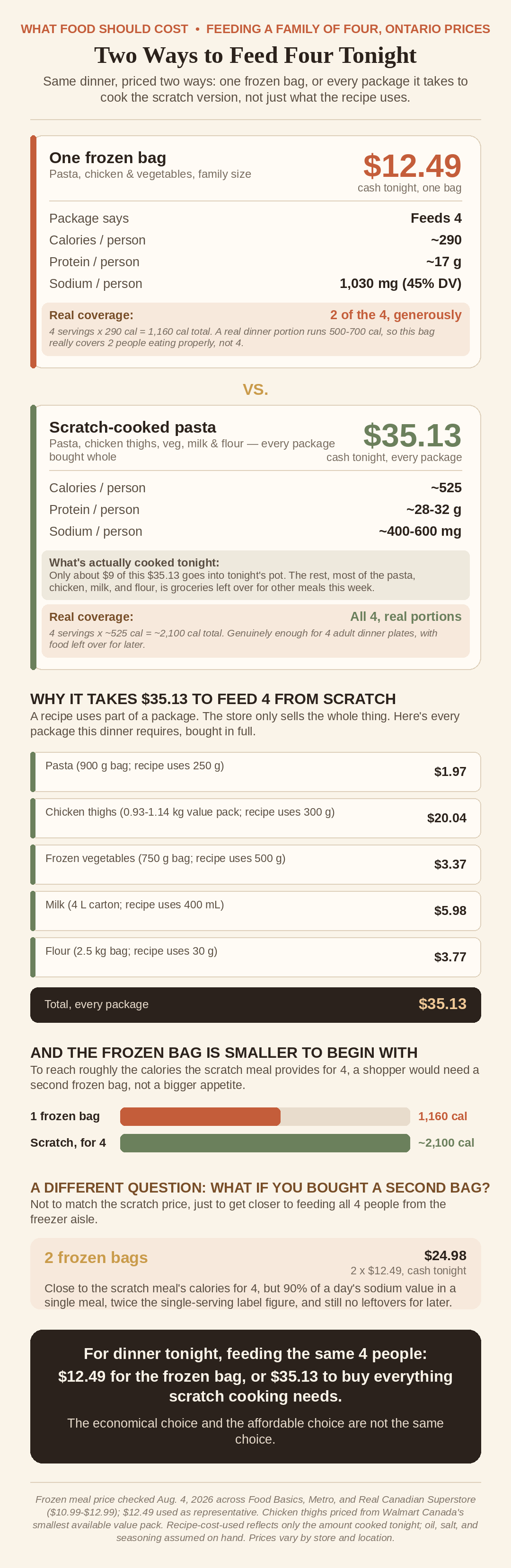
Feeding the same four people two different ways turns our rising floor of costs into something we can sink our teeth into. One frozen bag of budget premade and packaged dinner, labelled for four, costs $12.49 tonight. The package says it feeds four, but do the math on its own nutrition panel and that claim doesn’t hold: four servings at 290 calories is a mere 1,160 calories total, and a real adult dinner portion runs 500 to 700 calories, so that bag really covers substantial portions for two people, not four.
Taking the numbers from grocery prices in Ontario in August, and keeping strict economy in mind, I pulled some numbers for a family recipe of creamy chicken and veggie pasta. Buying the ingredients to cook the same dinner from scratch costs $35.13, not because the recipe itself is a luxurious one by any measure, but because a grocery store doesn’t sell 250 grams of pasta or 300 grams of chicken thighs. It sells a $1.97 bag of pasta, a $20.04 family-sized package of chicken thighs, a $3.37 bag of frozen vegetables, a $5.98 carton of milk, and a $3.77 bag of flour. Whether tonight’s dinner needs all of it or not, that’s what has to be picked up. Add those five packages up and $35.13 is the honest number, and it’s the number that actually feeds four people real portions, with a bit of food left over for the rest of the week. Only about $9 of that $35.13 goes into tonight’s pot. The rest, most of the pasta, chicken, milk, and flour, sits in the fridge and pantry for meals still to come. The recipe is genuinely economical, but the extra cash spent at checkout does not come back tonight, and the remaining ingredients do not cover breakfast, lunch or every dinner for the rest of the week. The math in the grocery store is about all those meals this week and what to make after getting home late after work and a stop at the grocery store.
The choice at the cash register, feeding the same four people, was never actually $12.49 against $9. It’s $12.49 against $35.13 plus time and energy. A household with 200 dollars of room left doesn’t have a food budget in any kind of neat and tidy sense. It has whatever cash or credit room is left after paying rent, or mortgage plus utilities and more. So handing over $35 at once, even for food that will stretch past 4 servings, eats more than a sixth of that entire monthly cushion in a single trip. The frozen bag asks for a third of that, if nobody minds being hungry after dinner. And that same person at the register has a tiny hope of maybe, this month, seeing that 200 dollars of cushioning become 250 or 300 dollars. All they really know for sure is that they don’t want that cushion to slip down below 200 dollars.
All that said, a $35 recipe still assumes the easy version of scratch cooking. We’re assuming that a household that already has oil, salt and basic seasoning sitting in the cupboard, is buying only what a recipe is missing. Meanwhile, a family that’s cut its budget down to the studs doesn’t always have that filled pantry. Building a real starter pantry from nothing, the oil, the spices, the vinegar, the staples that make every future scratch meal cheaper, costs more than any single dinner, and it isn’t something a household with $200 of room can do every month. Someone can start out with a fully stocked pantry and freezer, and have it gradually or quickly depleted with finances becoming too tight to replenish it properly for one month, or two, or more. For a family without it, the pantry never quite gets stocked, which means the $35 comparison isn’t even the real one most months. For a family already accessing a food bank, how realistic is a stocked pantry? For a lot of us in Canada, the frozen bag isn’t the worse choice competing with a better one. For a lot of households, on a lot of nights, it’s the only one actually on the table.
Families buying the frozen bag can’t be assumed to be blind about the nutrition tradeoff. They may know perfectly well that the homemade version has more protein and less sodium. What they may not have is the option of optimizing the quality of what the household eats tonight and over the next month. They’re getting four people through tonight without touching the money that has to cover the hydro bill that will be coming in with an overdue charge. I opened last week’s article with a story about buying tomatoes and peaches by the case every August. I spent the cash up front, so the freezer would carry us through winter for less. That only ever worked because we had the money sitting there to spend on a Saturday over and above groceries for the week, and because the pantry behind it was already stocked. A family running $200 from the edge of everything cannot make that trade even once. That bit of cushion has to cover everything even marginally unexpected. The unexpected could be a visit to the vet, a tire replacement, or parking charges at the ER because a family member broke their arm. A tight monthly cushion means that the economical choice and the affordable choice have become two very different things, and a rising floor of costs is what pulled them apart.
Not every can on the shelf is the same can
There’s a second way the shelf isn’t a fair fight, and it has to do with what a country allows into the food it sells. In Canada, our food standards are high. We hold our own farms and processors to some of the tightest rules in the world for what can go into food, from what’s sprayed on a crop to how a processing plant is cleaned and run. A lot of what we find on a Canadian shelf wasn’t grown or packed here, though, and those foods aren’t held to the same rules on the way into the country and onto the shelf. There are strict safety standards and tracking, but the standards aren’t always exactly the same. Health Canada’s rules, and the EU’s or the USA’s, are not identical, for example. And inputs don’t always come with clear origins. This series already brushed up against the idea once: the first piece was about coffee, and how a blend can draw beans from a dozen places without ever telling you anything beyond the type of blend. The same is true of a lot of what’s canned or jarred. A tin of chickpeas, a jar of hot pepper rings or a bottle of soy sauce can be processed here and labelled “Made in Canada from imported ingredients” even when the food itself was grown somewhere else. That claim tells us where the last substantial transformation happened, not where the ingredients began. “Product of Canada”: all or virtually all of the significant ingredients, processing and labour must be Canadian, accounting for at least 98 percent of the total direct costs. Canada grows and exports some of the world’s most sought-after food-grade soybeans, including varieties prized for tofu and soy sauce. Yet relatively few Canadian-made soy products reach our own shelves, and fewer still are made entirely from Canadian beans. Most soy sauce sold here arrives through distributors as a finished, value-added import, with little or no disclosure about where the soybeans were grown and processed. Of the Canadian companies I could identify, only seven publicly state that they use 100 percent Canadian soybeans. I’d love to be proved wrong and have that number actually be higher.
None of that means the cheaper can is always unsafe. It means the shopper reaching for it because it fits the budget is often deciding with only three things to guide them: the price tag, the shelf space the retailer has given it, and the limits of their own wallet. In choosing it, they are also placing a bet that everything from how it was grown to how it was canned met a standard as high as Canada’s own, with no practical way to verify that.
When a shopper has no margin left, price and availability determine what goes into the cart. That shopper rarely has the freedom to study labels, investigate sourcing or pay more for the product they trust. It also brings us to a nuance this series has not made plainly enough, and one that remains widely misunderstood. Food security and food sovereignty are not the same thing. The National Farmers Union names the difference particularly well. On the one hand, food security asks whether there’s enough food, full stop. And on the other hand, food sovereignty asks who controls what that food actually is, grown how, by whom, to whose standard. Canada is a food secure country. Grocery shelves are full. That’s real, if more real to the roughly three in four Canadians that are food secure. But being food secure and being food sovereign are not the same achievement, and right now we don’t have enough of our own high-standard options on the shelf to fully choose our way out of this even if four out of four households had money to spare. That’s exactly why the domestic production and processing side of the National Food Security Strategy, covered in the last piece, is doing more than building resilience against the next global shock. It’s a food sovereignty project as much as a food security one.
The household’s own shrinkflation
In this series we’ve talked about shrinkflation and skimpflation. We touched on some of the ways companies quietly shrink a package or cheapen a recipe rather than raise the price on the label. Canada’s largest insolvency firm, MNP, which we opened this conversation with, now uses almost the identical term for what households are doing to themselves: lifestyle shrinkflation. We have seen that when a company can’t raise its price further, it often shrinks the product size or quality, or both. Households in Canada must reach for the same pattern. When a household can’t raise its income further, it shrinks its life. Both are largely invisible until you go looking, like we are today.
Lifestyle shrinkflation follows something close to a sequence. The first things we let go of are the things we think of as extras. More than half of Canadians, 57 percent of us, are cutting back on travel and experiences. Fifty-six percent are cutting back on dining out and socializing. More than a third are cutting family and personal enrichment category spending: clothing, personal care, kids’ activities. Take your pick of what else: TD’s own January 2026 survey found 39 percent of Canadians switching from name-brand to store-brand products and 31 percent cancelling subscriptions. Narrative Research found close to one in five now naming deferred home repairs, the plumbing fixed later, the appliance nursed along, as a source of financial strain. Food comes later in the lifestyle clawback, but that should worry us more, not less.
In a separate line item of the same MNP survey, taken as households braced for upcoming winter heating bills, nearly a quarter of Canadians said they were eating less to save money, right alongside 29 percent cutting back on heat. Food is usually one of the last things a household willingly admits to cutting. When close to a quarter of the country has already reached that layer, it’s a sign of how far the shrinking has gone, not how shallow it is.
When the cuts compound
This is not an argument that every grocery dollar must be spent on virtue. Take chocolate, a simple small pleasure many of us associate with comfort rather than nutrition. The Globe and Mail reported this spring that a long list of familiar treats, including Cadbury Mini Eggs, Oh Henry, Caramilk, Mr. Big, Mars, Wunderbar and Terry’s Orange, had their cocoa content reduced so far that they no longer legally qualified as chocolate in Canada. Some now carry labels such as “candy” or “chocolatey coating” because the recipe itself changed, not just the taste. At the same time, CBC News found that Mars and Hershey had cut the weight of their Halloween multipack boxes by close to 17 percent year over year, while a Toronto No Frills charged the same $8.99 for the box both years. Even the small comforts are being whittled down. Shrinkflation shrinks the box. Skimpflation goes after what’s inside it, and you don’t find out until you’ve already bought it.
The math isn’t kind. A 17 percent cut in weight means you would need about six boxes of this year’s product to match what five boxes gave you before, and that’s of something that was already less satisfying than what it replaced. A family is not just getting a smaller box of slightly worse chocolate. They’re being asked to buy meaningfully more of an already diminished product to hand out to trick-or-treaters than the old box used to cover. Whatever saving made the cheaper, reformulated version worth choosing disappears fast once you’re buying enough of it to cover what one box used to.
Unfortunately, the problem is not limited to chocolate. We could at least feel virtuous giving up chocolate. Roughly half the calories Canadians eat now come from ultra-processed food, products built in a factory from industrial ingredients rather than whole ones. Researchers at the University of Toronto, led by Valerie Tarasuk, found that as household food insecurity becomes more severe, the share of the diet coming from ultra-processed food rises and overall diet quality falls, true in both adults and children, even after accounting for income and education. I have written more about this pattern in Canada’s Two-Tier Diet.
Canada’s Two‑Tier Diet: How a Food‑Rich Nation Became a Lagging G7 Outlier on Nutrition

Canada is a food-rich nation, yet we’re quietly drifting into two very different diets: one built mostly from ultra-processed convenie…
Diets consistently high in ultra-processed food are linked to higher rates of obesity, type 2 diabetes and heart disease, conditions that may take years to surface. The same researchers found healthcare costs 121 percent higher, and mortality odds roughly two and a half times higher, among adults in Ontario’s severely food-insecure households, even after adjusting for income and education. This is an association across a large population, not a certainty for any one person. But it appears in study after study in Canadian data, and it is difficult to look past.
What happens when the margin comes back
Nearly one in five people using a food bank in the latest count had a job. This tells us that having an income is not the same as having room to move. Whether a household is still maintaining some level of balance depends not only on what comes in, but on how much is already spoken for before the paycheque arrives. How many cuts have already been made, leaving no room to cut anywhere else, matters as well. The good news is that Canada also gives us some evidence about what happens when a little dependable room is put back in the form of a reliable income.
One example of a reliable income begins when Canadians turn 65. Researchers led by Lynn McIntyre followed low-income adults as they became eligible for public pensions, Old Age Security and the Guaranteed Income Supplement. Once pension income began, food insecurity fell by about 15 percentage points to roughly half its previous level. The important difference was not only the amount. The key difference came from income that was reliable and indexed, so households could plan around it without watching it steadily lose ground to rising prices. One of the researchers put the implication very bluntly in a companion paper: a guaranteed annual income could put food banks out of business.
The Canada Child Benefit gives us another example. After it was introduced in 2016, severe food insecurity among low-income families fell by roughly a third. Researchers also found that the extra amount paid for a child under six, about $700 a year, made a measurable difference, especially for the poorest families and for renters. It was not a windfall. It was a little more dependable money arriving often enough to keep some households from falling short on food.
These programs were built for different people, and neither was sold as food policy. What they have in common is dependable income: money that arrives regularly enough for a household to plan around it. A 2024 systematic review in the journal Public Health Nutrition, meaning a study that pooled and weighed all the credible research on the question rather than being one study on its own, found with a high degree of certainty that income supplements reduce serious food insecurity.
None of this is free, and it is not the whole answer. Reliable income support costs real public money. It cannot lower global food prices, rebuild Canadian processing capacity or put a Canadian option on a shelf where none exists. But the alternative is not free either. We are already paying when a household’s shrinking margin eventually appears in a food bank line, an untreated illness or an emergency-room visit. A one-time cheque may postpone the next shortfall. What changed the monthly math for seniors and families with young children was money they could count on.
What this means for all of us
So what does this mean for those of us here in Canada, trying to deal with a floor that’s rising across the developed world? Most of us are standing closer to the edge than it might look like from the outside. It was never a fixed group of people. You can see it in the small things. It’s about a trip that was cancelled. It’s also about the recipes swapped for cheaper ones and the day you settled for a prepackaged dinner because buying the full ingredient list at once felt too expensive. It is about that can or jar bought without looking at where it came from because it fit the wallet.
None of this is rare. It happens in our own families, and in the families of people we know. I suggest we start talking about it more openly amongst ourselves and with our leaders. Sadly, pointing to greedy corporations can only take us so far. There is much more to be done, and we need to keep our attention on the people living with the consequences. We are not watching this happen from the sidelines. We are all standing on the same rising floor.
Next up in the series: Over the next two Thursdays, I’m turning to the people growing Canada’s food and those turning it into what eventually reaches our shelves. They are facing challenges too.
New to the series? What Food Should Cost explores how Canadians read grocery prices, quality and value, and why those assumptions are changing. If you’re joining here, I recommend starting with Part One before continuing with the series. If you wish to start reading the series from the beginning, you can go to the first article,
Your Grandmother Wasn’t Smarter About Groceries. Her Store Was Dumber.
Leni Spooner is a Canadian writer, researcher, and civic storyteller, and the founder of Between the Lines Canada. Her work blends historical context with present-day analysis to help readers see the deeper patterns shaping national decisions. Between the Lines Canada explores Canadian politics, policy, and public life through accessible, story-driven analysis.
Editorial Standards and Promise to Readers available here.
This work runs on curiosity, research, and the conversations that happen in the comments. I genuinely thrive on those, and if something here made you think or helped you see something differently, that’s exactly what this is for.
If you’d like to support the work, a paid subscription keeps this desk running. Or buy me a coffee instead. Every one means a lot.
Either way, stay in the conversation. Thank you for being here.
More on this:
Cheap Food Was Never Normal. We Just Built Our Lives Around It.

For forty years, food took a shrinking share of Canadian household budgets. Now the floor is rising again, and no government can fully push it back down. Part 3 of What Food Should Cost
The Label Didn’t Change. Your Pasta Did. Meet Skimpflation.

This is Part 2 of my What Food Should Cost series, exploring how the food we buy changes long before it reaches the grocery shelf. In Part 1, we looked at why food prices have climbed and why the answer is more complicated than simply blaming farmers, grocery stores or inflation. In this installment, we turn from price to quality and ask a different que…
Canada’s Two‑Tier Diet: How a Food‑Rich Nation Became a Lagging G7 Outlier on Nutrition
Canada is a food-rich nation, yet we’re quietly drifting into two very different diets: one built mostly from ultra-processed convenie…
Another excellent and informative article Leni 👏🏻👏🏻🙌🏼❤️ Thank you!🙏
Thank you for these interesting and insightful articles Leni. I am a senior now, but when I was raising kids, there was rarely a night that the choice of "will there be enough for a second night" was available. Whatever was cooked was devoured by growing boys. I cannot imagine being in a place where I had to say, don't have any more, we have to save the rest for tomorrow night, and I am so happy that we didn't have to. I am not sure that we could do that anymore, at least not on a regular basis.