

The Label Didn’t Change. Your Pasta Did. Meet Skimpflation.
The box looks the same. The ingredients sound the same. But the pasta no longer cooks the same, and the label gives you almost no way to understand why. Part 2 of What Food Should Cost.

This is Part 2 of my What Food Should Cost series, exploring how the food we buy changes long before it reaches the grocery shelf. In Part 1, we looked at why food prices have climbed and why the answer is more complicated than simply blaming farmers, grocery stores or inflation. In this installment, we turn from price to quality and ask a different question: can a food become worse without changing its name or ingredients?
If you missed Part 1, you can read it here,
When your pasta lets you down
You have been making pasta for years, the way you were taught. You have the right pot. You figured out the perfect ratio of pasta to water a long time ago. You know when to salt the water, how to keep the right rolling boil boiling, and exactly how a piece should feel between your teeth before the whole pot comes off the stove. You have always taken real pride in serving perfect pasta al dente every time.
Then one day the pasta starts letting you down. The brand you have trusted for years turns on you.
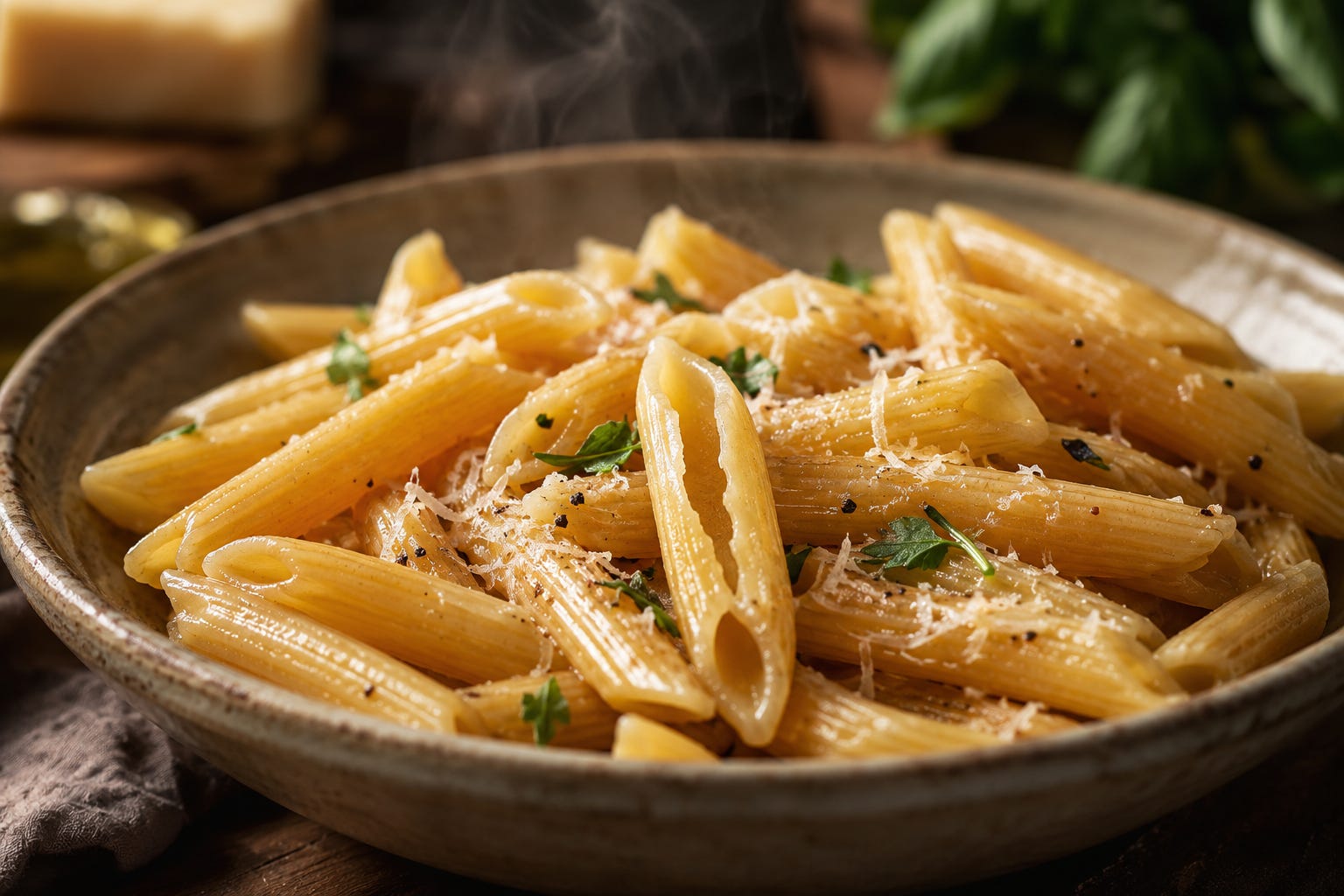
The penne is soft at one end, al dente at the other, but bits of the middle are unevenly hard. One side of a rigatoni tube is cooked through while the other still tastes raw in patches. Leave it in long enough to rescue the hard part and the rest begins to collapse. The water goes cloudy and thick. The noodles cling to each other, stick to the bottom of the pot, and somehow travel from underdone to a disintegrated mess without ever passing through that firm, even texture you were standing right there waiting for.
So you check yourself, because that is what careful cooks do. Too much pasta in the pot? Did the water come off the boil too long when you added it? Did you forget to stir it in the first minute? Has your timing gone soft along with the noodles? Is it time for a new pot? What the... happened?
But you have made pasta this way for years. You know the difference between a mistake at the stove and a product that no longer behaves the way it used to.
That distinction matters more than it sounds, because here is the thing almost nobody tells you: pasta can get worse without changing the words on the package.
There is a name for this, and you will not find it on any package. Skimpflation. Shrinkflation is the one you already know, the trick we covered in the first piece of this series, where the package quietly shrinks while the price holds steady. Skimpflation is its quieter sibling. Shrinkflation gives you less. Skimpflation gives you worse. Skimpflation exists to reduce costs and protect a company’s bottom line. More on this later. First, let’s get to the bottom of this pasta crisis.
Pasta is an unusually good place to see how skimpflation hides. A package can still say durum wheat, or better yet, durum wheat semolina. Semolina is a coarse pale yellow flour made from durum wheat. The ingredient list can be identical to the one you were reading ten years ago. And the pasta inside can still be less consistent, shed more starch, cook unevenly, soften too fast, or simply fail to deliver the texture that brand built its name on.
The label tells you what grain went in. It tells you almost nothing about the quality of that grain, the strength of its gluten, how it was milled, mixed, pushed through the machine and dried, or how much variation the manufacturer has decided is acceptable these days.
That is what makes this so hard to catch. The package does not have to shrink. The ingredient list does not necessarily change. The pasta inside the package just becomes a little less reliable, a little less satisfying, and a little harder to recognize as the thing you used to buy.
And because it happens in your kitchen, you tend to believe the failure was yours.
Durum is the right wheat. That is all the label promises.
Let’s start with what the experts and more importantly, every Nonna that has ever lived, agree on. Durum is the right wheat for dry pasta. It is hard, high in protein, and strong in gluten, and that matters because of what has to happen inside a noodle when it hits boiling water. The gluten proteins form a net. The starch sits inside that net. As the pasta cooks, water moves in and the starch swells, and the protein structure has to hold everything in place long enough for you to get it out of the pot and onto a plate. When that net is strong, you get a firm noodle and a generous window to catch it. When that net is weak or uneven, more starch can escape and the margin between firm and overdone becomes much harder to catch. So yes, buy durum. Just understand what that promise is actually worth.
Because saying pasta contains durum wheat is like saying a table is made of wood. It identifies the material. It says nothing about the quality of the material or the workmanship.
Here is the part that should genuinely irritate you, and it is the reason this is not simply a story about vague labels.
Canada already grades durum through a detailed national system. Each year, the Canadian Grain Commission also publishes extensive quality data from its Harvest Sample Program, including protein content, gluten properties, semolina yield and laboratory measurements of pasta firmness and cooking performance. Buyers use all of it. Commercial buyers can negotiate around grade and detailed quality specifications that remain largely invisible to the person buying the finished pasta. When a manufacturer in Montreal or Milan buys Canadian durum, it can specify the grade and performance characteristics it is prepared to pay for. Cereals Canada sells our top grades abroad by promising exactly what you have been chasing at the stove: superior cooking quality, high firmness, tolerance to overcooking and low cooking loss.
Please read that list again. Those are the industry’s own words for the things you have been noticing in your own kitchen, in your own pasta pot.
Every buyer along that chain gets a number. The person actually eating it gets two words. Durum wheat. The ingredient list names the category. It never names the grade.
And the grade is only the beginning of what you the consumer never get to see. Durum wheat semolina on a Canadian package does not tell you the wheat variety, the protein content, the gluten strength, the milling quality, whether several different wheat lots were blended together to hit a price, or how wide the manufacturer’s acceptable range is for any of it.
Two packagees can therefore carry the identical ingredient list and behave nothing alike in the pot.
What happens between the wheat and the package
Once you understand that the same ingredient can produce different results, the question that probably comes to mind is whether it all just comes down to the quality of the ingredients. The answer is that it is also about a series of manufacturing decisions, that don’t appear anywhere on a Canadian package.
Pasta dough uses surprisingly little water, and that water has to be distributed evenly through the semolina before the dough is shaped. Inconsistent hydration can contribute to an uneven internal structure, with some regions denser and more resistant to water than others. Then the dough is forced through a die, the shaped plate that gives the noodle its form. If a penne tube emerges with uneven walls, the thinner section will cook before the thicker one. Die condition, dough flow, extrusion pressure and manufacturing tolerances can all affect that consistency. How much variation passes inspection before a batch gets rejected is a decision somebody makes, in an office, on a spreadsheet.
Every one of those is a place where consistency can be won or lost, which good pasta makers have always understood. Your average Nonna would insist that some people simply didn’t have the hands for making pasta. Now you know why many a daughter-in-law found herself banished from Nonna’s kitchen.
Then the pasta is dried, and here I want to be careful, because the popular version of this story is too simple. You will read that slow, low-temperature drying is good and high-temperature industrial drying is bad. It is not that clean. Well controlled, high heat can actually strengthen the protein network and produce a firmer noodle. Poorly controlled, it damages the noodle. The point is not that one method is good and the other bad. It is that drying profoundly shapes how your pasta behaves, and nothing on the package refers to it at all. Food scientists can measure how intensely a pasta was heated. You, holding the package, cannot.
What the cloudy water is telling you
Here is the most useful thing in this article, and it costs you nothing to start noticing tonight. That cloudy, starchy water is not just a nuisance. It is data.
Food scientists have a name for what you are looking at: cooking loss, the solids that leave the pasta and end up in the water. It is one of the standard measures used to judge pasta quality in a laboratory, alongside firmness, stickiness, water absorption and something called cooking tolerance, which is the technical term for the very thing you have been mourning: the width of the window between al dente and ruined. In laboratory studies, lower cooking loss is generally associated with better pasta quality. Figures below roughly seven or eight percent are often treated as good, while substantially higher losses can signal a weaker or more disrupted structure.
The mechanism is the one from the last section. When the gluten network develops properly, it traps the starch granules and holds them as they swell. When that network is weak or uneven, the granules swell, burst and disperse into the water instead. The pasta becomes less cohesive. It sticks. It loses its shape. It gets gummy on the outside while you are still waiting for the inside. So the starch in your water is not merely a kitchen annoyance. It is part of the food leaving the noodle before it ever reaches your plate.
I buy good pasta. It is not what it was.
I was born and raised Italian. Pasta is not a side dish in my house and never has been, and I have always been willing to spend a little more on it. I stick to the good brands, the ones with reputations built over generations.
In my kitchen, some of those brands are slipping. Not all at once, and not dramatically, but I have watched it happen over years. I have dropped brands that were my first choice for a very long time, and here is the part that matters most: not because they got expensive. They stayed perfectly competitive on price. I dropped them because of what happened in the pot.
That is the whole problem in one sentence. A company can change wheat suppliers, growing regions, acceptable protein ranges, milling specifications, production locations, extrusion speeds and quality-control tolerances without rewriting a single word of the ingredient list. To me, standing in the aisle, the package is unchanged. Inside the factory, nearly everything that decides how that pasta will perform may be negotiable.
The brand name creates an expectation of continuity. The label guarantees continuity only at the broadest possible level. It promises you that the product is still pasta. It does not promise that it is still the pasta you remember.
Skimpflation without a substitution
The version of skimpflation most people picture is a straight substitution: margarine where there was butter, a cheaper oil where there was olive oil, artificial flavour where there was once the ingredient itself. That happens, and it is easy to imagine.
But pasta shows you a harder form, and probably a much less visible one. Skimpflation does not always arrive as one ingredient replacing another. Sometimes the ingredients stay technically the same while the standards around them quietly loosen. A slightly weaker wheat lot is accepted. A little more variation in wall thickness passes inspection. A wider range of cooking loss becomes commercially tolerable. Production runs a little faster. Quality control rejects a little less. Each decision is defensible on its own, and the saving is invisible at the level of one package. Across millions of packages, invisible savings are exactly what a good quarter is made of. Nothing in that paragraph requires changing the ingredient list. Which is the whole point.
Why you blame yourself
Shrinkflation, for all its irritations, can be caught. A 500-gram package becomes 450 grams and the number is right there, printed, comparable, provable. You can be angry with confidence.
Quality is different. You have no old package to compare against. Your memory of how it used to cook is real but imprecise, and you know it. Batches genuinely do vary. The cooking instructions give you something to blame. Manufacturers do not publish their internal specifications, so there is nothing to check even if you wanted to. And the failure only shows up after you have paid and are back in your own kitchen, where you are the most visible variable in the room.
So people say: maybe I overcooked it. Maybe the pot was too small. Maybe I am remembering it better than it was. Maybe I am just getting fussy in my old age.
The modern grocery system is very good at making its choices feel like your failures.
The first piece in this series argued that your grandmother was not a smarter shopper than you. She was working in a market whose signals were simply easier to read. The same holds at the stove. She may not have been a better cook. She may have been working with a product that was more consistent, and with a brand name that still carried a dependable meaning.
It is not only pasta
Once you see the pattern, you begin finding it across the grocery store. Pasta simply makes it unusually easy to feel.
Look at the ingredient list on a tub of mainstream ice cream or a package of processed cheese slices and you may find the phrase “modified milk ingredients,” now being replaced in Canadian labelling rules by “milk-derived ingredients.” That change came at the dairy processing sector’s own request, on the argument that the old phrase did not accurately describe what it covered. That may well be true. It is also true that modified sounds like something was done to your food, while milk-derived sounds like it came from a cow. Companies have until 2030 to make the switch.
These are real dairy components: milk separated into ingredients such as whey, casein, milk protein concentrate and other powders, then used as components of the finished product. They are permitted for use under Canadian food regulations and must be legally declared on the label. This is not a story about hidden ingredients. It is a story about how a familiar product can be reconstructed from less familiar components while retaining the same name, leaving consumers to judge for themselves whether the result is as good as what came before.
The economics are distinctly Canadian. Our dairy system does not treat milk as one interchangeable substance. Fluid milk, milk powders, concentrated milk and isolated milk components fall into different regulatory and tariff categories, with different rules and costs attached to them. That creates incentives for manufacturers to build products from powders, concentrates and separated milk components rather than relying only on fresh milk. Those ingredients may be Canadian or imported. They can make a product cheaper to manufacture, easier to standardize and more stable on the shelf. But in products such as ice cream and processed cheese, the result may also be a texture or flavour that consumers experience as a step down from the version made more directly from milk or cream.
Notice the pattern. The ingredients are legal. They are disclosed. The product still qualifies for its familiar name. Yet the label gives you very little help in judging what the change means for quality. The same logic appears whenever a familiar product keeps its broad identity while cheaper components, more intensive processing or wider manufacturing tolerances alter the experience of eating it. Skimpflation does not always hide an ingredient. Sometimes it hides the significance of the ingredient behind a technically accurate category name.
Once you know the shape and the name, I am sorry to say, you will find it everywhere. It is the juice that went from squeezed to reconstituted, the olive oil quietly blended down, the paper towel that needs two sheets where you used to need just one. And not just in the grocery store. It’s the hotel that now makes up your room every third day, the help line that no longer answers. Skimpflation was coined for that last kind, the service that thins while the price holds steady or even increases. Food is simply where it is sometimes hardest to see the steady decline.
We already know how to do this
Here is what makes the pasta case so frustrating. Canada is not missing the information, and it is not missing the tools. It already has both, and uses them somewhere else.
Walk to the meat counter and you can see that Canada already knows how to carry quality information all the way to the retail shelf. Individual steaks are not themselves graded, but a retailer may label them according to the grade of the carcass from which they were cut. A package can therefore say “Cut from Canada AA beef” rather than leaving the shopper to infer quality from the word “beef” alone.
The rules even account for mixed grades. When retail cuts come from carcasses of more than one grade, the label must identify the lowest grade involved followed by the words “or higher”: “Cut from Canada A or higher.” The declaration does not pretend that every steak in the package is identical. It tells you the minimum quality category of the material from which they were cut.
Pasta is not beef. A steak can be traced back to a graded carcass, while wheat from multiple farms and grades may be blended, milled and transformed before it becomes penne. But the beef rule settles the question of principle. Canada has already decided that mixed inputs and further processing are not sufficient reasons to leave the shopper with no meaningful quality information at all.
So the question is not whether an upstream quality assessment can survive the trip to a retail shelf. We know it can. The question is why we preserve that information for the carcass behind a steak but allow nearly everything that determines the performance of pasta to disappear before the package reaches the aisle.
I am not proposing that a grain-trading grade be stamped onto every package of pasta. That grade was designed for another purpose and would not capture everything that determines how a noodle performs. But the principle transfers cleanly: products sold under the same familiar name should not be allowed to conceal materially different inputs or production standards. Canada could require pasta, including the pasta inside packaged meals, to state whether it is made from durum wheat, common wheat or a blend, with the wheat types listed in order of proportion rather than hidden inside a generic component name. It could also define claims such as “slow dried,” so that manufacturers using them to charge more must meet a verifiable standard.
Italy offers a useful comparison, though not because every technical detail is mandatory on every package. Italian law gives domestically produced dry pasta a defined relationship to durum wheat. Some manufacturers go much further voluntarily.
De Cecco’s Italian-market product information, for example, identifies durum-wheat semolina, gives the finished pasta’s protein content, reports certified drying hours, and provides separate cooking and al-dente times. The same detail is not necessarily carried onto packaging or product information for export markets. Canada need not copy every line. The point is that the information exists, manufacturers can disclose it, and shoppers need not be left to judge quality from “durum wheat” alone.
We require nutrition panels because consumers cannot possibly infer nutritional composition by looking at a package. We have built no equivalent language for functional food quality, even when that quality decides how much of the food survives cooking.
Today, consumers are largely left to judge quality by brand, price and experience. None of those reveals what actually happened between the wheat field and the finished pasta.
Back to the pot
You should not need a laboratory to understand why a familiar pasta no longer behaves like itself. And years of experience at the stove should not be waved away just because the ingredient list still looks familiar.
The next time the rigatoni is firm on one side and collapsing on the other, and the water has gone cloudy far too early, the explanation may not be that you have forgotten how to cook.
You can have learned to cook perfect pasta from your Nonna or someone else’s Nonna. What she could not teach you was how to judge a product whose name stayed the same while everything behind it became negotiable.
This has been Part 2 of my What Food Should Cost series. Next week we turn to a question that frustrates shoppers everywhere: when costs come down, why don’t prices seem to follow? We’ll unpack the economics behind “rockets and feathers” and why grocery prices can be much quicker to rise than to fall and our expectations. I hope you’ll join me.
Part 3 of What Food Should Cost: Cheap Food Was Never Normal. We Just Built Our Lives Around It.

Start the series from the beginning here.
Leni Spooner is a Canadian writer, researcher, and civic storyteller, and the founder of Between the Lines Canada. Her work blends historical context with present-day analysis to help readers see the deeper patterns shaping national decisions. Between the Lines Canada explores Canadian politics, policy, and public life through accessible, story-driven analysis.
On Editorial Standards and My Promise to Readers:
https://lenispooner.substack.com/p/a-promise-to-my-readers
This work runs on curiosity, research, and the conversations that happen in the comments. I genuinely thrive on those, and if something here made you think or helped you see something differently, that’s exactly what this is for.
If you’d like to support the work, a paid subscription keeps this desk running. Or buy me a coffee instead. Every one means a lot.
Either way, stay in the conversation. Thank you for being here.
For the curious….
Your Grandmother Wasn’t Smarter About Groceries. Her Store Was Dumber.

A note before we start: this is the first in a run of Thursday pieces on ‘ What Food Should Cost’ here at Between the Lines Canada, each one pulling a single thread out of Canada's food inflation story — the Canadian dollar, tariffs, drought, who actually carries the cost. Each piece stands on its own; you won't need to have read the others to follow th…
The Place Nobody Can Afford to Leave

Maya is on a late train somewhere east of Oshawa, reading about the CPR debate of 1881 on her tablet, and finding it uncomfortably funny. The arguments that nearly killed the railway that built Canada are the same ones being deployed against Alto today. We have been here before. The question is whether we leave the same way we arrived.
We Just Wanted to Fix the Kitchen

We just wanted new cabinets. Turns out the Strait of Hormuz had opinions about that.
💬 If this gave you something to think about, tap the 💚 or drop a comment below.
Thank you Leni. I am English and was raised in a pasta free home, except for Alpha-getti for school aged lunches. I had no idea about any of this and found it fascinating. As a Nona-less person, I tend to buy the inexpensive pasta and rely on my wife or my youngest child to determine when pasta is ready to eat. I may change my buying habits based on your writing, because after all, as a senior, I am still very price conscious.
Science through storytelling. Cooking pasta will never be the same.