

How I Research, Write, and Show Up Here

These days, polished writing can look authoritative whether or not the work behind it deserves our trust. Between the Lines Canada exists to slow things down, add context, and show its work.
This page is my commitment to you, the reader. It is about how I write, how I research, how I use AI, and what you can expect from me every time you sit down at my kitchen table with me.
The short version, if you’re deciding whether to trust me: I’m me. I build every argument from original documents and credible sources. I verify what I publish. I use AI tools to help me write and edit, and never to decide what is true. Every claim here is mine to stand behind.
If you landed here after seeing an AI scan on one of my posts, the “How I Use AI” section below is the fuller answer to what that number does and does not tell you.
Why This Page Exists
Trust is earned one post at a time. My goal isn’t to be “the authority,” it’s to be a careful, curious guide who brings clarity without theatrics. I write about systems that shape real lives, and you deserve to know how the work gets made.
Why I Write About Patterns, Not One Niche
A note on how my brain works, because it shapes everything you read here.
I have ADHD, and my mind rarely follows one straight line. The challenge is not finding connections, but testing them and shaping them into one clear, well-supported story. That is why a single piece takes me days, not hours.
But the same wiring is the reason Between the Lines exists at all. My mind thinks deeply, sometimes obsessively, and it sees patterns and connections in everything. I cannot read a story about rising grocery prices without noticing the same pattern of power showing up in a trade deal, a labour dispute, or a government decision made far from ordinary kitchen tables. Where most political commentary picks one subject or one side and stays there, I keep following the pattern across them: the same power, dependence, and consequence surfacing in system after system. That makes me a poor fit for the single-topic focus all the algorithms reward, but it is how I make sense of the world around me. The pattern, not a category, is my niche.
So this is not a food newsletter, or a policy newsletter, or a politics newsletter. It is a publication about who holds power in Canada, how decisions get made without ordinary people in the room, and what it costs the rest of us, traced across every system where that same pattern shows up. The connective view is the particular contribution I bring. It is what makes this publication mine, and why I believe it is worth your time.
How I Research
My writing starts with a simple rule: every claim should be traceable, and every argument should be grounded in something real.
In practice, that means:
I cross-check data from multiple reputable sources
I rely on primary documents whenever possible (budgets, legislation, reports, audits, Hansard)
I consult academic and credible journalistic sources for context
I aim to understand each system, whether food, governance, policy, or trade, from more than one perspective
When something is unclear, I look for the “why” behind it, not just the headline
When a promising side-trail appears (and believe me one always does), I park it as a future piece rather than letting it derail the one in front of me. Mostly.
I’m not perfect, and I welcome corrections, but I try hard to be precise, transparent, and fair.
Want to see the method rather than take my word for it? Here it is in action:

How I Write
My writing follows a consistent rhythm:
Start at the kitchen table — the human impact
Zoom out — history, systems, patterns
Zoom in again — what it means for real people right now
Offer clarity — not hot takes
Leave space — for nuance, disagreement, learning
My style is a “calm urgency”. It is serious without being alarmist, thorough without being academic, personal without hiding behind detachment.
How I Use AI (and What AI Never Replaces)
Here is the honest version, because you can now scan this publication for AI, and I would rather you hear it from me than read it off a number.
The thinking is mine. I choose the subject, form the thesis, test the argument, and decide what belongs on the page. AI helps me turn a crowded, nonlinear thinking process into prose other people can follow. It may help me locate information or question a conclusion, but I decide which sources are credible, verify the evidence, and remain responsible for every single claim and idea I publish. I am answerable to you. Always.
That help is not light, and I will not pretend it is. Remember the tributaries and digressions from above? This is where I manage them. I work with a firm AI editor at my elbow to stay on thesis, turn point-form thinking into clear sentences, and catch run-ons and tangents before they reach you. It also helps me cut, and I need that help, because I over-write. Run on sentences and oversharing paragraphs are the bane of my existance. A first draft can run past ten thousand words. Often one article becomes three…eventually. Getting it down to something that respects your time, under five thousand words and ideally under three, is some of the hardest work in the process, and it is not just cutting. The harder skill is compression: folding three loose paragraphs into one that says the same thing only better. I decide what the piece is really about and what has to stay. The tool helps me say it in far fewer words.
For an independent writer, that support is a real equalizer. It gives me regular editorial help that would otherwise be financially out of reach. But it can only work with what I bring to it. Once the main research is gathered, a feature article still takes two or three days to reach a publishable draft, before formatting and SEO begin. Many drafts never make it to publication. The tools do not make this fast. They make it possible.
The same is true for comments and Notes, which I usually write from my phone. I know whether I agree, disagree, or have something to add, but I cannot always type the full thought quickly enough. So I speak my thoughts into AI, which transcribes them and helps shape them into complete sentences. Without that help, many replies would simply go unwritten.
What I Never Delegate
deciding what I believe or what I argue
deciding which evidence is credible enough to trust
determining whether a claim is supported enough to publish
lived experience, editorial judgment, or responsibility for errors
AI can make mistakes and fabricate information. Anything I cannot verify is removed rather than published as fact.
A detector may accurately recognize that AI helped shape the finished prose. What it cannot see is the thinking behind it: the arguments tested, sources verified, passages rewritten, suggestions rejected, and drafts revised, tweaked, or discarded altogether. Those decisions are mine, and so is responsibility for what I publish. A percentage can describe assistance with the language. What it cannot do, is measure authorship, judgment, or accountability. And for the record, AI did not invent the em dash. I will go to my grave defending a writer’s right to use one.
I do not write with a quill on parchment. I use spellcheck, grammar tools, search engines, dictionaries, sticky notes, and a thesaurus. I also still use the public library. And I use AI. It is a far more powerful tool, which is precisely why I believe its use should be explained rather than hidden.

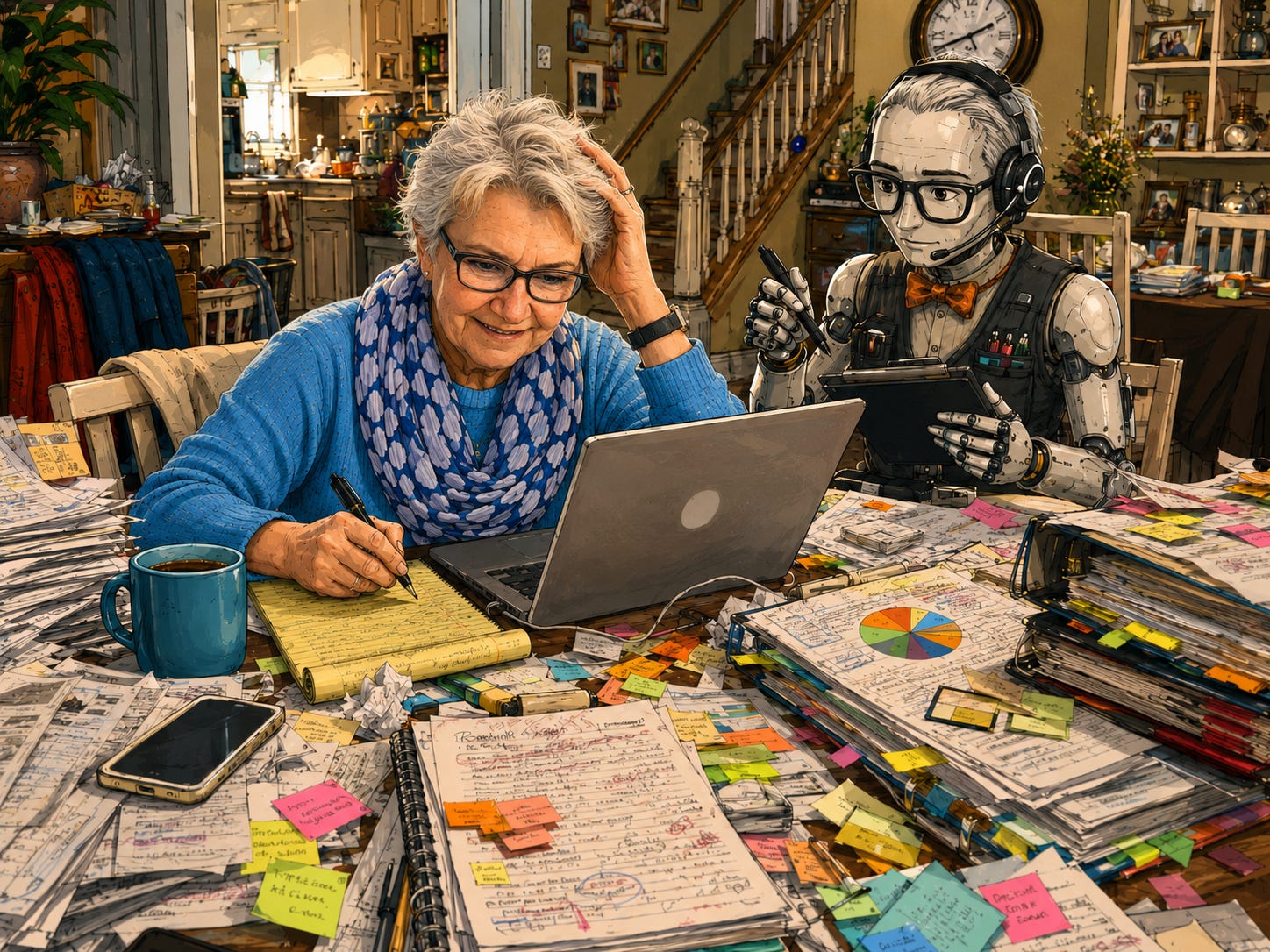
The first image is the kind of writing process an AI detector seems to imply: a tidy desk, a tidy mind, and a simple instruction to “write about this.” The second is much closer to the real me you get every time: papers everywhere, too many threads in motion, and a long process of sorting, checking, cutting, compressing, and rewriting. Both images were made with AI. Only one comes close to the truth of how I work.
My Commitments to You
On Accuracy
I check my facts, cross-reference my sources, and correct errors promptly and transparently when I find them or readers point them out.
On Attribution
I credit data, quotes, images, and collaborators wherever applicable. AI-generated visuals are clearly labelled in the post footer.
On Bias & Perspective
I write from a Canadian lens, with an interest in equity, civic literacy, and how systems shape everyday life. I question my assumptions, try not to treat my experience as universal, and make clear where the evidence ends and my interpretation begins.
On Community
Thoughtful comments and feedback are a large part of why I write. The comments section is where this publication becomes a community: where ideas are tested, lived experience adds what research cannot, and the small observations that inspire future articles often appear. Challenge me in good faith and I will meet you there. Curiosity is my favourite civic virtue.
The Disclosure You’ll See on My Posts
(Used and adapted across posts)
The ideas, argument, research, and sourcing in this piece are my own. I use AI tools to help me stay on thesis, turn notes and point-form thinking into finished sentences, and compress, reorganize, and edit drafts for clarity. I choose and verify the evidence and remain responsible for every claim. AI-assisted visuals, where applicable, are clearly labelled. If I have missed something, I welcome your feedback.
Final Word
At the end of the day, I’m just a Canadian writer at a kitchen table, trying to make sense of a complicated world and make it a little more understandable for all of us. I am very human, ADHD brain and all.
Thanks for being here. Readers like you make this work worth doing.
-Leni
Published 2025
Last updated: July 2026
Illustration: Concept by Leni Spooner. Generated with ChatGPT (OpenAI).
Explore a Little Bit More! Visit Between the Lines Canada