

What’s the Big Deal About Quantum — and How It Fits with AI
Quantum computing won’t replace AI — but it may become a complementary layer reshaping modern economies.

If AI is already shaping how we process information, quantum computing may change how we solve the problems AI can’t.

The Rush Hour Puzzle
It’s rush hour in Toronto.
Cars inch forward along the Gardiner Expressway. Navigation apps recalculate routes every few seconds. Some drivers exit early hoping to avoid a bottleneck. Others stay in place, convinced the traffic will loosen just ahead.
From inside the car it feels chaotic. But underneath the frustration lies a giant puzzle.
Every vehicle represents a decision.
Every intersection creates new possibilities.
Every accident, construction closure, or sudden rainstorm reshapes the pattern again.
Now imagine trying to calculate the most efficient way to move every car through that network at once.
Not just one driver’s route.
All of them.
That kind of problem—where thousands or millions of variables interact—is surprisingly difficult for conventional computers. Not because they are slow. Modern computers are extraordinarily fast. But they still approach problems step by step, testing possibilities in sequence.
For many tasks that approach works perfectly well. For others, the number of possible solutions grows so quickly that even powerful computers struggle to explore them efficiently.
This is the type of puzzle researchers hope quantum computing might eventually help solve.
If artificial intelligence is today’s headline technology, quantum computing is its quieter cousin—less visible, harder to explain, but potentially powerful in very specific situations.
To understand why, it helps to start with the smallest unit of information in a computer.
In a conventional computer that unit is called a bit.
A bit can hold one of two values: 0 or 1.
You can think of it like a coin lying flat on a table. It must be either heads or tails. Every calculation in a classical computer ultimately breaks down into billions of these tiny yes-or-no decisions.
Quantum computers work differently.
Instead of bits, they use something called qubits.
A helpful way to picture a qubit is to imagine that same coin—but spinning.
While it spins, it isn’t strictly heads or tails. In a sense, it represents both possibilities at once until the coin lands.
Because qubits can represent multiple possibilities at the same time, quantum systems can explore many potential solutions to a problem simultaneously rather than examining each option one after another.
At least in theory.
If this feels a little counterintuitive, that’s normal. Quantum mechanics has a reputation for bending common sense. Even physicists sometimes joke that once the explanation reaches the second sentence, intuition tends to give up.
The goal here isn’t to master the science. It’s simply to get a feel for the kinds of problems this unusual technology might help with.
And in this emerging field, Canada may already occupy a more interesting position than many Canadians realize.
While the country is still working to build the large-scale infrastructure needed for artificial intelligence, it helped establish much of the research foundation behind quantum computing itself.
Understanding how that happened—and whether Canada can turn that early scientific leadership into lasting economic capacity—is the next part of the story.
Why Quantum Computing Matters
Most of the computers we use today are remarkably good at processing information and recognizing patterns in large amounts of data. That’s what makes modern artificial intelligence possible.
Quantum computing is being explored for a different kind of challenge — not just handling large systems, but dealing with problems that are difficult to model at a fundamental level.
To see where that matters, it helps to think about something closer to home.
At some point, most of us will sit in a doctor’s office and hear about a medication — one that has been carefully developed, tested, and refined over many years. Behind that prescription is an enormous amount of scientific work, much of it focused on understanding how molecules interact inside the human body.
That process is slower than many people realize.
Researchers often test thousands of variations of a compound, adjusting small details and observing how those changes affect the outcome. Progress can take years, sometimes decades.
Part of the reason is that these interactions are incredibly difficult to model precisely. Even relatively small molecules can behave in ways that are hard for conventional computers to simulate in full detail.

So scientists approximate. They simplify. They run models that are good enough to guide experiments — but not exact.
Quantum computing is being explored because it may eventually allow researchers to model parts of these interactions more directly, rather than approximating everything step by step.
If that capability matures, it could help speed up work in areas like materials science, energy storage, and parts of pharmaceutical research.
That doesn’t mean a quantum computer will suddenly design a new medication overnight. Science rarely works that way.
But it may help researchers ask better questions — and get to useful answers a little faster.
And that possibility is why governments and technology companies around the world are paying close attention.
Canada’s Quiet Head Start
Canada is not starting from scratch in this space.
For decades, Canadian researchers have been working at the front edge of quantum science, often without much public attention. Universities in places like Waterloo, Sherbrooke, and Vancouver have built strong research programs, and a number of early-stage companies have grown out of that work.
In Waterloo, the Institute for Quantum Computing has become one of the world’s leading centres for quantum research. Nearby, companies like D-Wave have been developing early forms of quantum systems for years.
What’s striking is not just that these efforts exist, but how long they’ve been quietly underway.
Long before “quantum” became a policy buzzword, Canada had already begun building pieces of the ecosystem — research talent, specialized labs, and a small but growing cluster of companies.
Recognizing this potential, the federal government launched the National Quantum Strategy in 2023, aimed at strengthening research, supporting startups, and building the specialized workforce needed to operate quantum technologies.
We’ll come back to what that strategy is trying to achieve — and where it may fall short — later in the article.
For now, what matters is this:
Canada already has a foothold in a field that many countries are only beginning to organize around.
The question is whether that early lead will be built on — or quietly lost as larger economies move more aggressively to scale their own capabilities.
Why Countries Are Paying Attention
Interest in quantum computing is not limited to researchers or technology companies.
Governments around the world are paying close attention — and, in many cases, investing heavily.
The United States, China, and the European Union have all committed billions of dollars to quantum research and development. These investments are not just about scientific curiosity. They are about positioning.
Countries are starting to see quantum computing as part of a broader shift in how economic and technological advantage is built.
In earlier eras, advantage often came from physical infrastructure — railways, ports, energy systems — or from control over natural resources.
Today, it is increasingly tied to something less visible: the ability to process information, model complex systems, and develop advanced technologies that others depend on.
Artificial intelligence is already part of that shift. Quantum computing, if it matures, could become another layer.
Not a replacement for existing systems — but a specialized tool that sits alongside them, solving problems that are currently out of reach.
That’s why governments are not waiting for the technology to fully arrive before making decisions.
They are funding research, supporting companies, and trying to ensure that when these systems do become practical, they are not entirely dependent on someone else’s infrastructure.
Because the stakes are not only technological.
They are economic — where new industries take root.
They are strategic — who controls the tools that others rely on.
And, over time, they become political — shaping how much influence a country has in a world where computing power increasingly underpins everything else.
AI and Quantum: Different Tools, Same System
It’s tempting to think of artificial intelligence and quantum computing as competing technologies — as if one will replace the other.
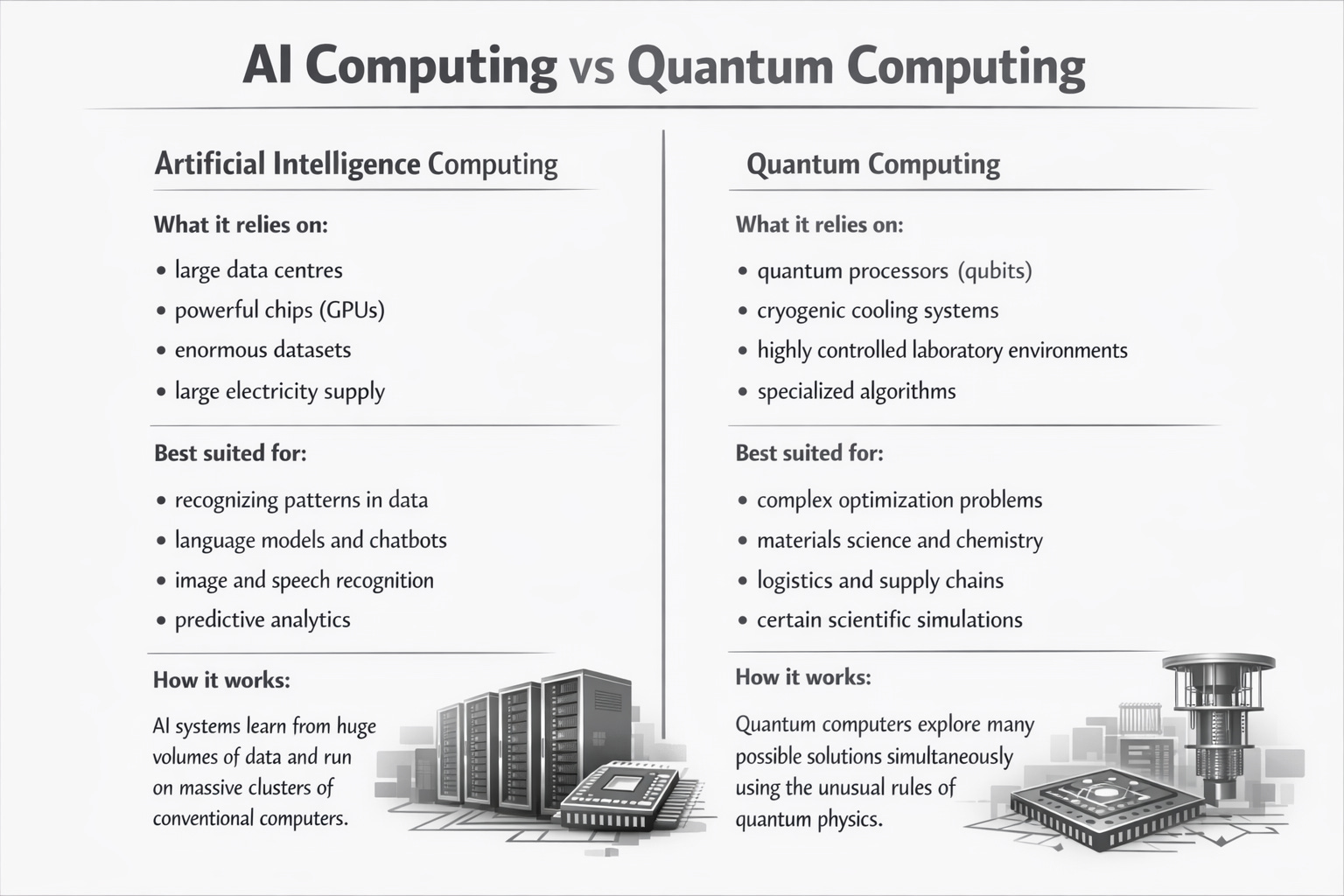
But that’s not how most researchers and engineers see it.
They are better understood as different tools, designed for different kinds of problems.
Artificial intelligence is already deeply embedded in everyday systems. It recognizes patterns, interprets language, processes images, and helps make predictions based on large amounts of data.
It works by learning from experience — improving its performance as it is exposed to more information.
Quantum computing, by contrast, is not about learning from data in the same way.
Its potential lies in exploring complex possibilities — modeling systems where many variables interact at once, and where the number of possible outcomes becomes too large for conventional computers to handle efficiently.
In that sense, the two technologies don’t compete.
They complement each other.
Artificial intelligence can help identify patterns, narrow down options, and guide decision-making.
Quantum computing, if it matures, may help tackle specific parts of those problems that are currently too complex to solve directly.
One way to think about it is this:
AI helps us make sense of the world as it is.
Quantum computing may help us explore how it could behave under different conditions.
Together, they begin to look less like separate technologies — and more like parts of a broader computing system, each handling the tasks they are best suited for.
That system is still taking shape.
But it is already influencing how governments, researchers, and companies think about the next generation of infrastructure.
Rethinking Infrastructure
When Canadians think about nation-building infrastructure, we tend to picture the big, visible projects.
Pipelines. Ports. Highways. Rail lines.
The kinds of investments that physically connect a vast country and move goods, energy, and people across long distances.
Earlier generations made similar choices with electricity networks, railways, and telephone lines. Those systems didn’t just support the economy — they shaped it.
They determined where industries grew, how communities developed, and how connected the country became.
What is changing now is not the importance of infrastructure.
It’s what counts as infrastructure.
Increasingly, the systems that shape economic activity are not only physical.
They are computational.
Artificial intelligence is already part of that shift — quietly embedded in logistics networks, financial systems, health care, and manufacturing.
Quantum computing, if it matures, could become a more specialized layer within that same landscape — helping solve problems that are currently too complex to model or optimize efficiently.
None of this replaces the need for physical infrastructure.
Canada will still need roads, ports, energy systems, and housing.
But alongside those investments, a different kind of foundation is taking shape — one built on computing capacity, research ecosystems, and technical talent.
And unlike a highway or a port, these systems are less visible.
They don’t always announce themselves the way a new highway does.
But they still shape where value is created — and who benefits from it.
That’s why the conversation is starting to shift.
The question is no longer just what Canada builds.
It’s also what kinds of systems Canada chooses to participate in — and which ones it risks relying on others to provide.
What Canada Is Doing Now
If quantum computing does become part of the next generation of computing infrastructure, countries will need more than strong research to take part.
They will need talent, companies, and the ability to turn scientific breakthroughs into real technologies.
Canada has begun taking steps in that direction.
In 2023, the federal government launched the National Quantum Strategy — a long-term effort to strengthen research, support emerging companies, and build the specialized workforce needed to operate quantum technologies.
At its core, the strategy is built around a few practical priorities.
One is talent.
Canada’s universities already train many of the physicists, engineers, and mathematicians working in quantum science today. Expanding that pipeline — and keeping more of that expertise in the country — is a central challenge.
Another is commercialization.
Turning research into real products requires patient capital, engineering capacity, and partnerships with industry. Moving from laboratory breakthroughs to systems that can be tested and used in the real world is often where momentum is gained — or lost.
There is also a growing focus on security and communications.
Quantum technologies could eventually play a role in areas like secure data transmission, sensing, and satellite systems — fields with clear economic and national security implications.
For now, most quantum machines remain experimental.
They operate in highly controlled environments, and many experts believe it may take years — or longer — before large-scale systems become widely practical.
But that long timeline is exactly why decisions are being made now.
Building the expertise, infrastructure, and companies needed for a new computing system doesn’t happen quickly.
It takes time — often more than we expect.
And Canada is already part of that early foundation.
Canada has often been strong at building the early stages of new industries — developing talent, advancing research, and creating the first wave of companies.
The harder part has sometimes been what comes next: keeping those companies anchored here as they grow.
The open question is how much of what comes next will take root here, and how much will develop elsewhere, building on work that began inside Canada’s own research ecosystem.
Looking Ahead
At first glance, quantum computing can feel like a technology from the distant future — something confined to physics laboratories and highly specialized research environments.
And in many ways, it still is.
But so were many of the systems that now sit quietly at the centre of everyday life.
When Canadians think about nation-building infrastructure, we tend to picture the visible projects — pipelines, ports, railways, highways — the systems that helped connect the country and move people and goods across it.
What is becoming clearer now is that some of the most important infrastructure is no longer something you can see.
It is built into the systems that process information, model complexity, and support decision-making across the economy.
Artificial intelligence is already part of that shift.
Quantum computing, if it matures, may eventually become another layer within it.
Not replacing what exists, but extending what is possible.
Seen this way, the question is not simply whether quantum computing succeeds as a technology.
It is whether the systems behind it — the talent, the companies, the infrastructure — take root here or somewhere else.
Somewhere, perhaps, a future quantum system may one day help untangle a rush-hour traffic jam in Toronto.
For now, the more immediate question is quieter.
It’s how intentionally Canada chooses to take part in building the systems that will shape the next era of infrastructure.
A clean, printable PDF of What’s the Big Deal About Quantum — and How It Fits with AI is now available to paid subscribers in the Subscriber Resources section (listed in alphabetical order).
If this piece helped connect a few dots, consider subscribing to Between the Lines.
Paid subscribers help support the research behind this work — and get access to the growing library of long-form resources.
Or, if you prefer, you can support the work one coffee at a time:
☕ https://buymeacoffee.com/lenispot
You Might Like
Building Canada’s AI Infrastructure

Infrastructure rarely makes headlines. But in the AI era, chips, power grids, and data centres will shape Canada’s sovereignty, productivity, and long-term economic resilience.
The Digital Food Aisle

This is not an article about individual grocery choices or shopping tips. It examines how prices are now set in Canada’s grocery system—how the tools of algorithmic and dynamic pricing, loyalty data, and market concentration interact, and why that matters for affordability, transparency, and democratic accountability.
Canada’s Grocery Investment Announcement — and What It’s Really Designed to Do

The federal grocery announcement included major investment in food processing and supply chains. This post explains who those investments are built for, what they help with, and where their limits remain — especially for consumers.
Thank you for this important update, Leni. Let’s show the world, we will continue and support this quantum work. Instead of the usual Canadian trait of developing excellence then selling off the resultant rewards to others. This tech perhaps should be protected by our technology restrictions where appropriate.
I like that this doesn’t position quantum as a replacement for anything. In practice, most breakthroughs come from layering tools together, not swapping one out for another. That context matters a lot. Happy Wednesday, Leni :)
I hope you are having a good week thus far.