
How Language Is Being Used to Narrow Democratic Choice
A close look at how political language can quietly turn complex policy debates into loyalty tests — and why noticing the difference matters.

A recent social media post reacting to polling on Chinese electric vehicles in Canada presents itself as plainspoken and decisive. This piece isn’t about agreeing or disagreeing with that policy position, but about how the message is constructed — how distrust of polls and media is established up front, how moral alignment is claimed, and how disagreement is quietly reframed before the debate even begins.
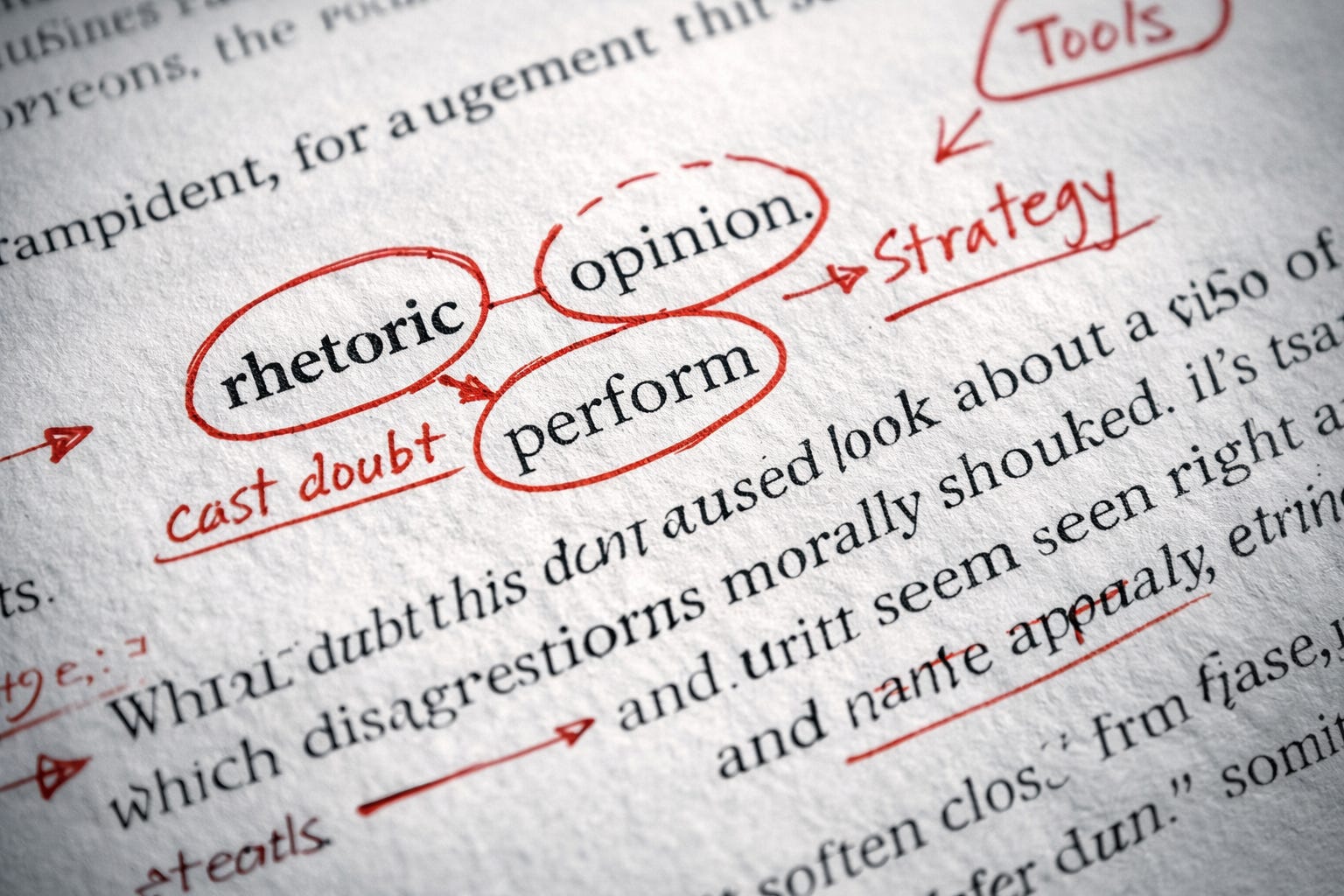
What caught my attention
A few days ago, a social media post about Chinese electric vehicles and Canadian jobs started circulating widely. It wasn’t especially long. It wasn’t especially angry. And at first glance, it didn’t look extreme.
But the more I read it, the more uneasy I felt — not because of the policy position it took, but because of how carefully the message was put together.
It had that familiar “telling it like it is” feel: confident without shouting, dismissive of disagreement without sounding hostile, wrapped up with a friendly sign-off that made it all seem ordinary. Reasonable. Even neighbourly.
That combination is what caught my attention.
Because posts like this don’t just express an opinion. They perform one. And they rely on a very specific set of rhetorical tools to do it.
This is where it helps to name something we don’t usually talk about out loud.
Most people who’ve been through post-secondary education — especially in law, public policy, political science, communications, or business — have been trained in rhetorical composition. Not as ideology, but as skill.
How to open by casting doubt without sounding defensive.
How to frame yourself as principled rather than reactive.
How to anticipate criticism before it appears.
How to close in a way that feels friendly and normal.
These are the same tools used to write memos, pitch decks, briefing notes, speeches, and business plans. They’re taught precisely because they work. And like most tools, they’re a bit like a kitchen knife: you can use them to feed people, or you can use them to cut.
They translate perfectly to short social-media posts.
What makes this kind of messaging effective is that it doesn’t feel like rhetoric. It feels like common sense. Just friendly chatting. But if you look closely, there’s a firm structure underneath it:
First, shared sources of information are cast as suspect.
Next, the speaker positions himself as morally anchored.
Then, complex policy questions are collapsed into loyalty tests.
After that, disagreement is reframed as emotion, while the speaker claims reason.
Finally, everything is softened with a casual, friendly close.
That sequence isn’t rambling. It’s composed.
And once you know to look for it, you start seeing how much work a “simple” post can actually be doing.
So let’s slow this one down and look at it closely.
The text we’re being asked to take at face value
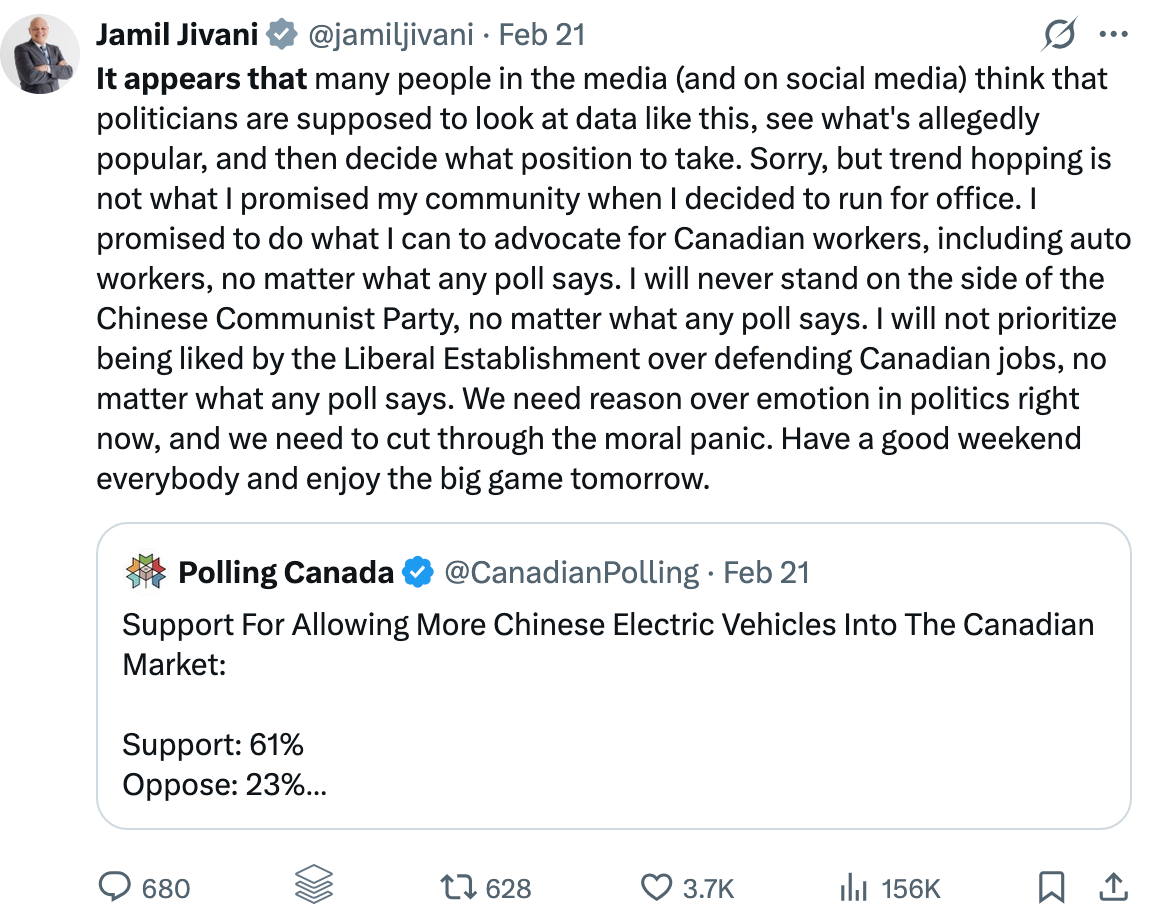
This post circulated on and off ‘X’ in response to polling about whether Canadians support allowing more Chinese electric vehicles into the Canadian market.
On its face, it looks straightforward enough. A politician reacting to polling. A familiar mix of trade, jobs, and China. Nothing most Canadians haven’t seen before.
And that’s precisely why it works.
The post presents itself as plainspoken and direct — a refusal to be swayed by polls, a declaration of loyalty to workers, and a rejection of elite approval. Read quickly, it feels decisive. Almost refreshing.
But now that we’ve named the tools at work, it’s worth slowing down and reading it line by line — not to argue the policy itself, but to see how each piece of the message quietly does its job.
“I don’t follow polls or media”
“It appears that many people in the media (and on social media) think that politicians are supposed to look at data like this, see what’s allegedly popular, and then decide what position to take.”
This is where the groundwork gets laid.
By putting “media,” “social media,” and polling data into the same sentence — and by calling popularity “alleged” — the post quietly casts doubt on the idea that shared information is something to take seriously.
It’s not just saying, I disagree with this poll.
It’s saying, people who pay attention to this stuff are being led around.
That distinction matters.
The speaker positions himself as someone who isn’t fooled, isn’t swayed, and isn’t part of that crowd. He’s not arguing inside the system; he’s standing above it.
Once that move is made, disagreement stops being about evidence and starts being about credibility. Who’s thinking clearly? Who’s just repeating what they’ve been told?
That’s a powerful place to start, because it shifts the conversation before it’s even begun.
“I stand with workers”
“I promised to do what I can to advocate for Canadian workers, including auto workers, no matter what any poll says.”
This is where the argument really tightens.
The conversation shifts away from trade-offs or long-term planning and toward something more personal. The question becomes less about what policy works best and more about who you’re standing with.
Framed this way, the world divides neatly into sides.
There’s “us” — the speaker and the workers he claims to represent — and then there’s everyone else: people who look at polls, people who talk about climate targets, people who raise questions about affordability, supply chains, or transition timelines.
Once that division is in place, disagreement stops sounding like a different judgment call. It starts to sound like betrayal.
This move gives the speaker moral ownership of a group, while quietly pushing anyone who disagrees into the “them” category — out of touch, elite, or insufficiently loyal.
At that point, the debate isn’t just narrowed. It’s polarized.
Naming enemies — and dog whistling
“I will never stand on the side of the Chinese Communist Party… I will not prioritize being liked by the Liberal Establishment over defending Canadian jobs.”
This is the moment where the lines get drawn in indelible ink.
Up to this point, the post has been narrowing the field quietly. Here, it names who’s on the other side. And once enemies are named, everything else snaps into place.
Trade policy, China, domestic industry, party politics — all of these get stacked together and lined up along a single question: whose side are you on?
This is also where a familiar political technique comes into play: dog whistling.
Dog whistles are phrases that sound ordinary on the surface, but carry a very specific meaning for a particular audience. They don’t need to be explained. The people they’re meant for already know what’s being signaled.
“Liberal Establishment” works this way. It gathers media, academia, government, and expertise itself into a single bucket — one that a certain audience already distrusts. No details required. Recognition is enough.
Bringing in the “Chinese Communist Party” does the same thing at a higher pitch. In the context of electric vehicles, it shifts the conversation from prices, industrial policy, or transition planning to fear, identity, and national threat.
Once that shift happens, there’s very little room left for nuance. Talking about supply chains, emissions targets, affordability, or long-term strategy no longer sounds like problem-solving. It starts to sound like weakness — or worse, disloyalty.
Complex questions become team sports.
These phrases don’t really clarify the policy debate. They clarify who belongs — and who doesn’t.
“Reason over emotion”
“We need reason over emotion in politics right now, and we need to cut through the moral panic.”
On the surface, this sounds measured. Even reassuring. Who wouldn’t want more reason and less panic?
But this line quietly tilts the table.
Emotion is assigned to everyone else. Reason is claimed by the speaker. Meanwhile, the post itself is full of feeling — certainty, suspicion, indignation, resolve.
By labelling disagreement as “moral panic,” the post reframes dissent before it even appears. Anyone who pushes back isn’t just disagreeing — they’re proving the point.
Why arguing back doesn’t work
This is where the earlier framing really pays off.
Once polls are described as “alleged,” institutions are cast as suspect, and disagreement is defined as emotional excess, there’s almost no way to respond without stepping into a trap.
If someone replies with data, it’s dismissed as manipulated or elite-driven.
If they argue nuance, it sounds like hand-wringing.
If they push hard, it’s held up as evidence of hysteria.
At that point, engagement stops being a conversation. It becomes confirmation.
The result isn’t persuasion across difference. It’s insulation from it.
The casual sign-off
“Have a good weekend everybody and enjoy the big game tomorrow.”
After everything that’s just been laid out — the distrust of polls, the moral line-drawing, the naming of enemies — this line matters more than it seems.
It lowers the temperature.
The friendly sign-off signals that nothing particularly ideological has just taken place. No big stance. No sharp edges. Just a bit of straight talk before getting back to normal life.
That normalizing effect is part of the craft.
It helps the framing slide by without resistance. The post doesn’t end with a call to action or a demand for agreement. It ends with familiarity — something everyone recognizes and feels comfortable with.
And that comfort is what makes the message easier to absorb without noticing how much ground it has quietly claimed.
This isn’t off-the-cuff
Taken as a whole, the post reads as plainspoken and confident — and that’s deliberate.
What we’ve just seen isn’t a loose collection of reactions. It’s a composed sequence: first, doubt is cast on shared sources of information; then moral authority is claimed; then clear lines are drawn between “us” and “them”; dissent is reframed as irrational; and everything is smoothed over with a casual, friendly close.
That kind of structure doesn’t happen by accident.
These are rhetorical skills — the same kinds of skills people learn and use in professional life to write persuasive memos, pitches, speeches, and arguments. Most of the time, those tools are used for perfectly legitimate purposes: to clarify, to persuade, to make a case.
But on social media, those same tools can also be used to do something else: to make a political posture feel like common sense, and to make disagreement feel suspect before it even begins.
That’s why posts like this are worth slowing down. Not because they’re loud or crude — but because they’re controlled.
When rhetorical tools are used this deliberately — not once, but repeatedly — the result isn’t just persuasion on a single issue. It’s positioning.
Building a brand, not just making a case
At this point, it’s important to be clear about what’s happening.
The rhetorical tools at work in this post aren’t being used accidentally, and they aren’t being used only here. They appear again and again across social media, applied consistently to different issues, with the same structure and the same tone.
That consistency matters, because it tells us this isn’t just about arguing a position. It’s about building a recognizable personal brand.
In this case, the brand being constructed is that of a thought leader: someone positioned as clearer-eyed than institutions, more principled than peers, and more trustworthy than experts, media, or data. Someone who “cuts through,” who isn’t swayed by polls, and who names enemies plainly while presenting himself as calm, rational, and grounded.
The policy topic — electric vehicles, trade, China — is the vehicle, not the destination. What’s being reinforced is the persona.
Social media is particularly effective for this kind of brand-building because it rewards repetition and recognizability. Each post doesn’t need to persuade from scratch. It only needs to sound like the last one. Over time, the posture becomes familiar, then authoritative.
In that environment, disagreement doesn’t undermine the brand — it strengthens it. Pushback becomes proof of independence. Complexity becomes something to dismiss. And anyone questioning the framing is easily folded into the category of “them.”
This is no longer a representative seeking consent on a policy choice. It’s a figure using rhetorical craft to establish himself as a singular voice of reason — a political identity that travels easily from issue to issue, regardless of the underlying facts.
That distinction matters, because once a political brand is established this way, arguments don’t stand or fall on evidence alone. They arrive pre-framed, pre-defended, and already insulated from challenge.
A quieter civic habit
None of this requires assuming bad intentions.
In fact, it isn’t really about one politician or one post at all.
The same rhetorical tools we’ve been looking at here can be — and often are — used for constructive purposes. They can help clarify complex ideas, invite people into a conversation, or make difficult issues easier to understand. They can be used to build trust, open space, and encourage participation.
But those same tools can also be used to do something else: to sort people into teams, to narrow the range of acceptable questions, and to quietly wall off debate rather than invite it.
Social media makes that second use especially tempting. Platforms reward confidence, simplicity, and recognizability far more than they reward deliberation. Messages that draw clean lines, signal belonging, and discourage dissent travel faster and stick longer — regardless of where they sit on the political spectrum.
And it’s important to be honest about this: our own side does it too.
Influencers become influencers because they know how to influence — through tone, framing, repetition, and emotional cues. Sometimes that influence is used to inform and include. Sometimes it’s used to build tribes and insulate them.
The difference isn’t always obvious in the moment.
Which is why the most reliable defence, when we spend time on social media, isn’t outrage or disengagement. It’s attention. Paying attention to how language is being used. To who’s being invited in, and who’s being quietly pushed out. To whether a post is opening a conversation — or closing it before it starts.
That pause matters. Especially before we hit the “like” or “share” button.
Because in the end, the health of democratic conversation doesn’t depend only on what politicians say. It also depends on what the rest of us choose to amplify — and why.
Join the conversation
If this piece made you pause, I’d genuinely like to hear your thoughts — especially if you read the post differently, or noticed other patterns worth naming. Thoughtful disagreement is part of how we keep public conversation healthy.
And if you find this kind of slow, careful unpacking valuable, you can support the work by buying me a coffee. It helps keep Between the Lines independent, reader-supported, and focused on depth over volume.
👉 Buy Me a Coffee: https://buymeacoffee.com/lenispot
👉 Or leave a comment below — both matter.
You Might Also Like

When Canada Sounded Like Itself Again — and the Grown Ups Showed Up

Not a dramatic week, but a telling one. A handful of speeches, a policy choice, and a few unscripted contrasts offered a glimpse of what steady leadership looks like when a country stops posturing and starts paying attention.
2025 Was the Year Canada Stood Straighter

2025 tested Canada in ways that didn’t fit into headlines — and revealed a quieter, steadier response that still hasn’t been fully named.
This article is published on Substack for conversation and sharing. The canonical home for this work is Between-the-Lines (between-the-lines.ca).
Excellent post. Excellent warning. I quite often read quickly, skimming, seeking information, making choices rapidly. A young person I know who studies evolutionary biology tells me humans evolved to seek information. It’s what humans do. Perhaps wisdom comes in second to our knowledge-seeking. Somehow, especially now, we need to make them operate in tandem.
The really sad part is that the platforms aren't neutral in this. Social media doesn't just allow this kind of messaging to spread. Confidence travels faster than nuance. A post that sorts people into teams generates more engagement than one that invites deliberation. So even if every individual politician started tomorrow with the best intentions, the infrastructure they're publishing on would still reward the tribal version over the thoughtful one. The problem isn't just the message. It's the machine it runs on. How are you doing Leni?
Happy Tuesday!