
When Canada Sounded Like Itself Again — and the Grown Ups Showed Up
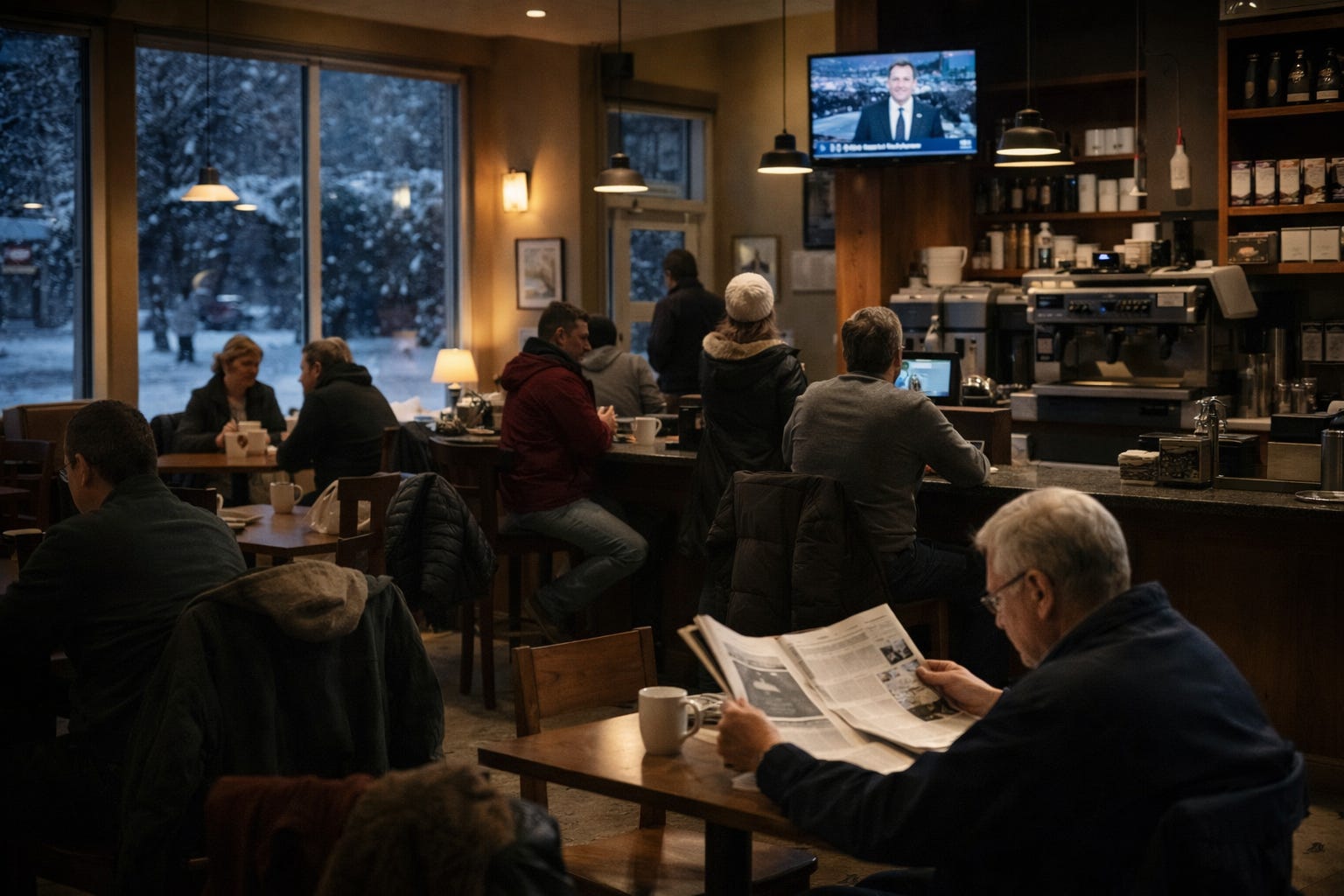
The kind of week that slipped into conversations over coffee—noticed not because it was loud, but because it felt different.

Not a dramatic week, but a telling one. A handful of speeches, a policy choice, and a few unscripted contrasts offered a glimpse of what steady leadership looks like when a country stops posturing and starts paying attention.
There are weeks in politics that are noisy, and weeks that are revealing.
This past one in Canada was the latter.
It slipped into ordinary conversations — over coffee, in passing remarks, in the background hum of the news. Not as controversy, exactly, but as a shift in tone.
On the surface, it looked scattered: a portrait unveiling, anniversary speeches, an auto policy announcement, an MP’s freelance trip to Washington, a few carefully staged photos. But taken together, it added up to something more coherent.
It wasn’t any single headline that stood out so much as the way the week sounded, across a lot of different stories.
The Return of an Older Register
Stephen Harper returned briefly to the Canadian stage to mark the twentieth anniversary of his first election win. The reappearance was restrained: a portrait unveiling, a fireside conversation, a speech to a friendly room.
And yet, it landed.
Not because Harper was trying to reclaim relevance—he wasn’t—but because of how he spoke. The tone was unmistakable: national interest, unity, institutional respect. He sounded less like a former prime minister revisiting old battles and more like a reinforcement—adding weight to a seriousness that had already begun to reassert itself in Canadian leadership.
Then came the line that cut through: Canada must be prepared to “pull out all the stops” and “do whatever is necessary” to protect its sovereignty.
That mattered.
It mattered because Harper’s framing aligned far more closely with the current prime minister’s approach to Canada–U.S. relations than with that of the current Leader of the Opposition, whose long avoidance of geopolitical questions—especially anything touching Donald Trump—has been hard to miss. It mattered, too, because Harper spoke plainly about the challenge of dealing with an unstable United States, without bluster or grievance, and without pretending the problem could simply be wished away.
And it mattered because he modelled something that’s grown rare: the ability to be partisan without being corrosive.
The contrast that kept circling — between Harper’s speech, his conversation with Jean Chrétien, and the spectacle south of the border — wasn’t nostalgia. It was a reminder that disagreement doesn’t require dehumanization, and that leadership carries obligations beyond one’s own base.
Seriousness, in Practice
What followed in the week sharpened that contrast.
Mark Carney’s role in these moments was understated but telling. He appeared comfortable sharing space with a predecessor from a rival party. He spoke plainly about the scale of the challenges ahead. He didn’t need to diminish others to assert authority.
This wasn’t about chemistry. It was about legibility—whether people can read you in a high-stakes moment.
When the world gets jumpy—on trade, politics, the economy—people stop looking for flair and start looking for signs that someone understands the terrain. What became clear wasn’t that Carney is flawless, but that he sounds like he knows what time it is.
That distinction matters more than we often admit.
The Auto Announcement as a Tell
Yes, incentives were restored.
Yes, mandates were softened.
Yes, there are unresolved risks.
But the deeper signal was strategic. Canada is no longer assuming automatic regulatory alignment with the United States.
Instead, it is hedging — aligning with European emissions standards, leaving room for EVs and hybrids, and treating manufacturing capacity not as nostalgia but as a kind of national backbone. The alignment between the federal government, Ontario’s premier, industry, and environmental actors wasn’t accidental. It was practical.
And it was deliberately legible to the rest of the world.
This is what Carney described in Davos put into action: a middle power signalling to other capable countries that Canada is open for serious, long-term partnership. Not just as a market, but as a place to build. To invest. To anchor supply chains in a country that values stability, standards, and predictability.
For countries like South Korea — sophisticated manufacturers navigating the same U.S.–China volatility — that matters. It says: you don’t have to choose sides to build here. You can put down roots without betting everything on one superpower.
Doug Ford’s role makes sense in that context. His posture didn’t suddenly become ideological; it became transactional in a different direction. Once the federal plan made room for real manufacturing in Ontario — real plants, real jobs — Ford leaned in. Not because his beliefs changed overnight, but because the policy finally met the reality on the ground.
Elsewhere in Ottawa, the reaction was narrower. The official opposition spent much of the week rejecting the policy outright, as though it were a single decision to be scored for or against, rather than a longer effort to reposition Canada in a changing world.
It was a debate that treated one idea—scrapping the HST on new cars—as a cure-all, as though one lever could solve jobs, innovation, trade, and climate all at once.
When things are shifting this fast, the question isn’t who wins a surface level argument — it’s whether anyone is actually working together to keep the floor from giving way.
When the Tone Doesn’t Match the Moment
Against that backdrop, a handful of side episodes—a freelance trip to Washington, separatist voices testing boundaries, fresh ultimatums from Alberta—added to a sense of domestic static at precisely the wrong moment.
In early February, Premier Danielle Smith issued another ultimatum to Ottawa, threatening to withhold provincial funding tied to federal judicial appointments unless Alberta is given a direct role in the process. She often says she stands with “Team Canada,” arguing for a strong Alberta within the federation.
But repeated ultimatums, and the steady piling up of friction points, don’t feel like steady hands on the wheel. They feel like politics aimed at reassuring a base that flirts openly with separation—and like a choice to keep conflict warm rather than settled.
If you say you’re on the team, how you play matters.
At the federal level, a similar unease is visible. Language that once energized supporters now sounds less comfortable with the moment Canada is in. Pierre Poilievre’s sidestepping of the Trump question, his discomfort with cooperation, and his awkwardness around unity don’t read as strategy so much as uncertainty.
At this point, it matters less where he eventually lands than that he lands at all. Without clarity, what he and his party say continues to feel — fairly or not — unanchored.
Awkwardness isn’t neutral. In moments like this, it erodes confidence faster than disagreement ever could.
Why This Week Felt Different
What made this week stand out wasn’t consensus — Canada rarely has that — but something quieter: a shared sense that this stuff actually matters.
Across parties and levels of government, there was a visible effort — fragile, perhaps — to lower the temperature and widen the horizon. To speak not just to supporters, but to citizens. To treat the United States not as a talking point, but as a structural challenge requiring patience and coordination.
You could feel it in the way people talked—less cheering, more listening.
That alignment may not last. It depends on continued seriousness and restraint.
But for a moment, Canada sounded like itself again
I doubt we will ever see a week of news in Canada where pan-Canadian consensus is achieved. That isn’t who we are—and it never has been.
This country has always been shaped by difference. By distance. By competing priorities and uneven histories. Wherever diversity flourishes, friction follows. It did before Confederation. It has at every turn since. This land and its peoples have never been without tension, and the idea that unity means sameness has never really fit us.
What has made Canada durable isn’t the absence of friction, but how we’ve lived with it. The long habit of sorting things out together. Of aiming for workable consensus rather than total agreement. Of building safety — economic, social, political — while navigating wild swings in weather, markets, and human temperament alike.
That’s what made this past week feel different. Not because everyone agreed, but because some of the loudest voices chose steadiness over spectacle. Because seriousness showed up not as certainty, but as care.
We won’t always sound like that. We never have.
But when we do, even briefly, it’s worth noticing. You can’t always name it. But you can feel it—like the room got quieter, and everyone finally leaned in.
If this piece resonated, consider sharing it with someone you talk politics with over coffee.
And if you’d like more essays like this—steady, curious, and grounded in everyday life—you can subscribe to Between the Lines. Not ready to subscribe yet, but still want to support this work? You can always buy me a quiet cup of coffee — small acts of support keep these essays flowing.
You Might Like


What We Can’t Help but Share

Lately, I’ve been noticing a particular kind of writing — and a particular kind of writer — showing up in public spaces like Substack. Not sages. Not experts dispensing answers. But people who are clearly still thinking, still learning, still unsettled in the best…
This article is published on Substack for conversation and sharing. The canonical home for this work is Between the Lines (between-the-lines.ca).
I’m with Cath. I appreciated the change in tone but it’s a retreat not a surrender. Carney and McKinnon came out of their caucus summit with a clear strategy about what to do to get bills passed in the house
They called the cons to account for their actions so that the public is aware of the who and why around the lack of progress
This was a call to cons who came to Ottawa to get stuff done. An invitation and a clear reason offered for those who were considering crossing the floor
Also as Chantal H said. The continued obstruction would give Carney a reason to go to the public and say we need an election so we can’t get things done for you.
Our man Carney doesn’t seem to suffer fools and the timing of this call out was perfect.
If the conservatives don’t drop the frat boy own the libs BS they leave the door open for Carney to wipe them out.
Harper’s position is intended to avoid a blow that would wipe out his party and the coalition he formed. He retreated.
That’s all
Agree with everything you have noted about the mood in the country this past week except about Mr. Harper. Leopards don't change their spots, though they are great at camouflage. The former PM who is supremely responsible for undermining our sovereignty from the U.S. and thus getting us deeply into this mess during his governance not so long ago, and who is also the current president of the right-wing christo IDU, suddenly becoming supportive of Canadian sovereignty is 🤔 simply sus. 🐆 ❤️🇨🇦