

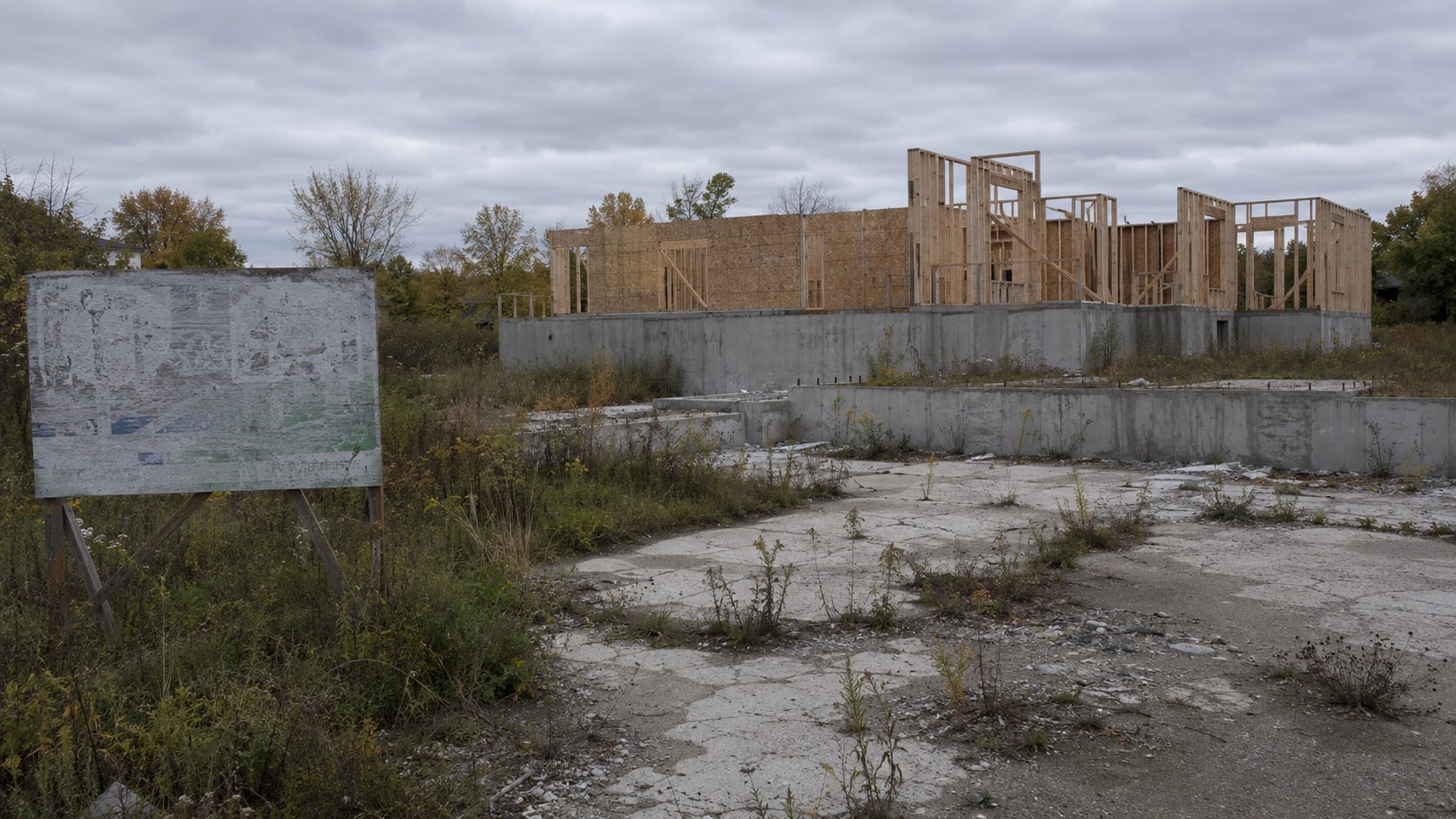
Approved. Financed. Stalled.
Ontario promised 1.5 million homes. The infrastructure wasn't ready in 2022, and in community after community across Canada, it still isn't. Here's what the debate isn't saying.

Global News published a story this week worth reading in full. [Internal Ford government notes admit it will not reach 1.5M homes target]] But in case you don’t get to it right away, here is what it found, because the gap between what the story says and what it doesn’t say is exactly what this piece is about.
Reporters Isaac Callan and Colin D’Mello obtained hundreds of pages of internal handwritten notes from Ontario’s Ministry of Municipal Affairs and Housing, written in the fall of 2024 while staff were drafting legislation that was eventually shelved in favour of an early election call. The notes show the ministry knew, privately, what it would not say publicly: that the province’s signature housing pledge was already out of reach.
One page of notes, discussing communications strategy, reads: “1.5 million homes not reach target, more context.” And then, just below: “No promise to build more homes faster — careful how (we) promise.”
That is a government writing notes to itself about how to avoid admitting what it already knows.
NDP Leader Marit Stiles called it a failure of promise and ideology. “This is just more broken promises from Doug Ford. Doug Ford wrote a cheque he couldn’t cash because his government is ideologically opposed to building housing.” Premier Ford, asked about the goal he set four years ago, pivoted to talk about the United States. “Let’s see how we go,” he said, before describing his recent visits to South Carolina, Washington, and Utah, and concluding that “in uncertain times, yeah, it was tough last year.”
The political story is perfectly on-brand for everyone involved — a government that privately admitted defeat, an opposition that called it betrayal, a premier who answered a housing question with a travel itinerary — and it is almost entirely beside the point.
What neither the Ford government’s internal notes, nor the NDP’s statement, nor the Global News article itself addresses is why the housing starts fell short. Not who is to blame. Why the numbers didn’t materialize. Because if the answer is “the government lied” or “they were ideologically opposed,” then electing a government that is not lying and not opposed should fix it. And it won’t. Not on the timeline anyone is promising. Not in the communities where housing demand is highest.
Neither side mentioned concrete. Specifically: that concrete cures on its own schedule, regardless of what is said at Queen’s Park. That a water treatment plant takes years from concept to commission whether or not a housing minister is feeling urgent about it. That developers — who genuinely do prefer building as much as possible as often as possible, and are not the villain in this particular chapter — cannot conjure serviced land out of political will. And that the housing shortfall Ontario is now accounting for in private while deflecting in public is not primarily a failure of intent. It is a consequence of decades of deferred infrastructure investment that no announcement cycle can retroactively fix.
Welcome to the part of the housing crisis that nobody in a position of power wants to say clearly out loud.
What Ontario Actually Did
To understand the gap between promise and delivery, you need to know what the Ford government actually bet on.
In November 2022, the province passed Bill 23, the More Homes Built Faster Act. The theory was coherent enough on paper: the reason Ontario wasn’t building enough housing was that the planning and approvals system was too slow, too expensive, and too beholden to local opposition. Remove the friction, lower the costs, override the blockers, and supply would follow.
Bill 23 was sweeping in scope, touching multiple provincial statutes at once. The big levers were these: first, a change to how zoning works on residential lots. Under the existing system, a homeowner who wanted to add a basement apartment or a garden suite on their property had to apply for a formal rezoning — a process that could take anywhere from 22 months to five years and cost real money before a single shovel moved. Bill 23 changed that by making up to three units on most residential lots “as-of-right,” meaning permitted automatically, without needing to apply for a bylaw amendment. A main house, a basement suite, and a garden suite could all now sit on the same lot as a matter of course. The province also moved toward as-of-right density near major transit corridors, requiring municipalities to update their zoning to allow more housing near stations and stops. Second, restrictions on third-party appeals, which had allowed neighbours and interest groups to delay approved projects through tribunal challenges. Third, and most consequentially, significant cuts to development charges — the fees municipalities collect from builders specifically to pay for the infrastructure that growth requires.
That last part turned out to be the problem inside the solution.
Municipalities across the province warned immediately that the development charge changes would result in a significant shortfall in the money needed to fund infrastructure to support new housing. The provincial government promised to cover the difference with direct provincial transfers — in other words, to replace the lost fee revenue with provincial dollars so municipalities could still afford to build the roads, pipes, and plants that new housing requires. That promise did not hold. As one analyst summarized it, the province backed down after less than two years, unwilling to put up the money itself. In April 2024, the new housing minister brought in Bill 185, which removed the requirement for a five-year phase-in of development charges, essentially reversing one of Bill 23’s central mechanisms. The minister said he reversed course because municipalities couldn’t fund the infrastructure — like water and wastewater plants — needed to support homes.
Read that again slowly. Ontario passed a law in 2022 to accelerate housing by reducing the fees that pay for housing infrastructure. By 2024, it had partially reversed that law because municipalities couldn’t fund housing infrastructure. The circle is complete. The homes are not built.
The Association of Municipalities of Ontario has since identified a $4 billion shortfall in provincial funding for responsibilities downloaded to municipalities, and has said the situation has reached a “critical” point, with municipalities forced to put off major infrastructure projects as a result. The federal and Ontario governments have since announced an $8.8 billion program to reduce development charges and replace the lost municipal revenue with infrastructure funding. Progress is progress. The application window was two weeks, from June 1 to June 19, with a ten-year payout schedule, for a problem that was fully documented in 2022.
The shovel is not in the ground.
What “Infrastructure Readiness” Actually Means
Before a single housing unit can be occupied in a new or densifying community, a specific set of systems has to be in place and functioning. Water supply and treatment capacity. Wastewater collection and treatment. Stormwater management. Local roads. Electrical service at the required load. In some cases, transit access required by official plans or provincial density standards. Each of these systems has its own planning cycle, its own environmental assessment requirements, its own procurement and construction timeline. None of them appear because a contribution agreement has been signed.
The federal government’s Canada Housing Infrastructure Fund, announced in Budget 2024, covers water, wastewater, stormwater, and solid waste. Ontario’s Municipal Housing Infrastructure Program covers roads and water infrastructure together. The language in both programs correctly acknowledges that housing readiness depends on this full set of systems. What neither program addresses clearly is how far behind most municipalities already are on all of them, and how long it takes to catch up. This publication raised exactly that question when the federal Build Canada Homes plan was first announced in August 2025 — flagging that cities can approve towers on paper, but without water mains, sewers, transit stops, and power lines already in place, nothing gets built. Build Canada Homes: Can Ottawa’s Big Housing Bet Deliver? — Between the Lines Canada, August 2025
The Numbers Behind the Shortfall
The most comprehensive national accounting of Canada’s municipal infrastructure condition is the Canadian Infrastructure Report Card, produced by the Federation of Canadian Municipalities and seven partner engineering and construction organizations. The 2019 report found that nearly 40 percent of Canada’s roads and bridges were in fair, poor, or very poor condition, with roughly 80 percent of them more than 20 years old, and more than 40 percent of local roads built more than 50 years ago — beyond their estimated service life. Thirty percent of water and wastewater infrastructure was in the same deteriorating range. Between 30 and 35 percent of recreational and cultural facilities were in similar condition.
That was 2019. A 2007 study commissioned by the FCM put the total national municipal infrastructure deficit at $123 billion, with water and wastewater systems alone accounting for $31 billion of that. There is no credible evidence the number has improved since. Canada’s construction industry said plainly in 2026 that the country has “underinvested in critical infrastructure for decades.” In Alberta alone, the Rural Municipalities documented a rural-only infrastructure deficit of $17.25 billion in late 2024, projected to grow to over $40 billion by 2028 under existing provincial funding. This is not ancient history. This is where we are right now.
Municipalities maintain approximately 60 percent of Canada’s essential infrastructure, including roads, bridges, water, and waste systems. They also collect approximately 8 to 10 cents of every tax dollar paid in Canada. The math does not close. It has never closed. What fills the gap, or rather what doesn’t fill it, is deferred maintenance, deferred upgrades, and master plans that sit on shelves waiting for funding that arrives ten years late, if at all.
The Infrastructure That Actually Stops Housing
Water capacity is the most visible constraint right now because water and wastewater freezes produce the most undeniable outcomes: approved projects, with private financing in hand, that cannot break ground. But water is not the only barrier. Each of the following is a documented constraint on housing delivery in Canadian municipalities today.
Roads and access. A housing development cannot be occupied without road access meeting municipal standards, which means not just the street into a subdivision but the arterial connections that carry traffic to regional networks. In growth communities, those arterial networks are chronically underfunded relative to the pace of land approvals. More than 40 percent of local roads were built more than 50 years ago, beyond their estimated service life. Ontario’s Municipal Housing Infrastructure Program explicitly funds roads alongside water because planners know they are equally foundational. Ontario’s 2026 budget acknowledged this problem directly, with the MHIP Core Servicing Stream funding 58 projects for roads and utilities across 60 municipalities. That is good news. It does not change the timeline for the roads that are not yet funded.
Stormwater. Density changes the hydrology of land. A block of mid-rise apartments sheds rainfall very differently than the detached homes it replaces, and older stormwater systems were designed for lower densities. Climate-driven rainfall intensity compounds this. The 2019 Infrastructure Report Card found that wastewater and linear stormwater assets had deteriorated since the 2016 report. New density without upgraded stormwater infrastructure produces flooding. Municipalities cannot approve density without confirming stormwater capacity exists, and in many communities, it does not.
Electrical grid capacity. This constraint is underreported in housing coverage but increasingly raised by developers, particularly in high-growth communities. Local distribution utilities operate on multi-year capital planning cycles. A developer who needs a transformer upgrade or new distribution line for a large multi-unit building must queue for a capacity assessment and then wait for the capital work to be scheduled. In communities where multiple large projects are coming online simultaneously, those queues can add a year or more to project timelines. The transition to electric vehicles and heat pumps is adding new load to distribution systems designed for a different era, and those systems are not being upgraded fast enough to keep pace.
Transit access for density targets. Provincial housing policy in Ontario and British Columbia now ties density permissions to transit proximity. Municipalities must permit significantly higher density near transit stations and corridors. The problem is that transit is chronically underfunded and behind schedule. The Canada Public Transit Fund, the first permanent federal transit funding at $3 billion per year, does not begin flowing until 2026-27. Communities expected to densify around transit they do not yet have are caught in a circular problem: the density cannot proceed without the transit, and the transit cannot justify the investment without the density. Ottawa’s LRT experience — billions spent, years late, years of underperformance — is a reminder that transit infrastructure arrives on engineering time, not announcement time.
Fire and emergency services capacity. A new residential area requires fire station coverage meeting provincial response-time standards. Fire halls are capital infrastructure with multi-year planning and build cycles. A municipality that approves a large residential development area may be required to build a new fire hall before occupancy is permitted. Development charges are supposed to fund this. Those charges have been under sustained pressure from provincial governments. The revenue tool intended to fund the infrastructure that housing growth requires has been weakened at exactly the moment the growth demands are highest.
What the Timeline Actually Looks Like
Three cases illustrate the gap between political calendar and infrastructure calendar.
Tay Township, Ontario. The Victoria Harbour wastewater treatment plant was built in 1982. By 2019, daily flows regularly exceeded its rated capacity. The township identified the need for a Phase 2 upgrade and put the price at roughly $27 million. When tenders went out in 2024, bids came in near $48 million, a 77 percent jump driven by construction inflation. Three grant applications failed. A fourth finally succeeded in January 2026, through a provincial program. Mayor Ted Walker had spent years in what he called a “virtual building freeze,” saying provincial housing rhetoric “rings pretty hollow” for a community that could not get help. Over 1,500 approved housing units remained stalled throughout, not because of zoning or red tape, but because of a plant built when Pierre Trudeau was still prime minister.
Funding secured: 2026. Construction not yet started.
Waterloo Region, Ontario. The Region’s 2015 Water Master Plan identified the infrastructure upgrades needed to support continued population growth. The need was documented. It was not funded. By late 2025, the region was in a formal development freeze, with more than 5,000 approved housing units stalled and an estimated $500 million in private investment sitting idle. New water capacity begins to come online in September 2026. Full infrastructure capacity to support housing targets through 2031 will not be in place until 2031, at the earliest.
Need documented: 2015. Crisis: 2025. Partial unlock: late 2026. Full capacity: 2031.
Ontario is not the outlier here. It is the example. The same infrastructure-before-housing constraint plays out across the country, and the best-funded, most politically supported major infrastructure project in Canada tells you exactly how long catching up actually takes.
Iona Island Wastewater Treatment Plant, Metro Vancouver. Iona Island, in Metro Vancouver, is the best case in the country: a major regional district with substantial planning capacity, a project that ultimately required $6 billion, and funding secured from all three levels of government. Planning began in 2018. Provincial funding committed in 2023. Federal funding finalized in March 2025. The plant will serve roughly 875,000 people and process about 40 percent of Metro Vancouver’s wastewater. Construction runs mainly from 2026 to 2034, with the plant operational by 2035. Federal regulations have required this upgrade to secondary treatment since 2012. The compliance deadline was 2030. The best-funded, best-planned major wastewater project in Canada will be four years late to a federal standard that has been law for over a decade.
That is the success story.
What No One Said to the Municipalities
The Canada Housing Infrastructure Fund required high project readiness from applicants, with a March 31, 2025 application deadline and substantial completion required by September 2031. To qualify as project-ready at a March 2025 deadline, a municipality needed to have already completed environmental assessments, engineering designs, cost estimates, and procurement planning — mostly at its own risk and expense, with no guarantee that funding was coming.
Tay Township applied to CHIF in March 2025. It was rejected.
No one told municipalities in 2018, or 2020, or 2022 that housing targets were arriving and infrastructure funding would follow. The housing targets arrived. The funding arrived later, with application windows measured in weeks and payout schedules measured in decades. The infrastructure gap, built over decades of deferral, does not close on an announcement schedule.
In the absence of federal and provincial funding, infrastructure responsibilities are downloaded to local governments that do not have the same tax base upon which to finance upgrades, and many local governments cannot run deficits. This is not a new pattern. As this publication documented in July 2025, the download of responsibility without matching capacity has been underway since the 1990s, when the federal government exited social housing and passed the file to provinces, many of whom passed it again to cities and towns — without the funding, tools, or policy infrastructure needed to manage what they’d inherited. When Canada Gave Away Its Housing — and Nobody Noticed — Between the Lines Canada, July 2025 Development charges were supposed to fill that gap. They were cut in 2022. They were partially restored in 2024. A new $8.8 billion joint federal-provincial program arrived in 2026 to cut them again while replacing the revenue through a grants program. The tool keeps changing. The pipe is still the same pipe.
The Elephant in the Room — and What Telling the Truth About It Would Require
Here is what a frank conversation between Ottawa, Queen’s Park, and Canadians would have to include, and has not included yet.
The housing numbers Canadians were promised will fall short. Not because governments were lying, necessarily, but because the housing targets were set without honest accounting of what the infrastructure beneath them would require, how long it would take to build, and how far behind municipalities already were. The communities where housing demand is highest — the GTA, the extended Golden Horseshoe, Metro Vancouver, Calgary — are the communities where infrastructure deficits are largest and infrastructure catch-up timelines are longest. The housing shortfall will be concentrated precisely where the pain is already worst.
The Association of Municipalities of Ontario alone has identified a $4 billion shortfall in provincial funding for responsibilities downloaded to municipalities. The national picture is proportionally larger, and no current program is funded at the scale the deficit requires. The FCM’s $123 billion infrastructure deficit estimate is from 2007. No one in government has produced a more current national number, which is itself a telling omission. The federal government’s own Infrastructure Council, launched in late 2024, is currently preparing Canada’s first National Infrastructure Assessment. That assessment does not yet exist. It is being written now, while housing targets set in 2022 are already falling short and the handwritten notes are already leaking.
What a genuine response would require is not another announcement. It is a public accounting: here is the infrastructure gap, here is what it will cost to close it, here is the honest timeline for communities to expect before housing targets in their area can realistically be met. That accounting would almost certainly include numbers in the hundreds of billions nationally, timelines that run well past 2031 in many communities, and a direct acknowledgment that the housing starts voters were promised will not arrive on the schedule they were given.
That is an uncomfortable conversation. It is also the only honest one.
The Announcement Is Not the Infrastructure
The Ford government’s leaked notes are a political story, and the legislature debate they sparked is warranted. Governments that make public promises and privately abandon them should be held to account.
But the NDP opposition demanding answers, and the government defending its record, are both working within a frame that leaves out the most important variable. Neither side, in that chamber, is talking about a national municipal infrastructure deficit that was already $123 billion in 2007 and has compounded every year since. Neither side is talking about the 40 percent of local roads that are past their service life. Neither side is explaining to Ontarians that Bill 23 tried to cut the fees that pay for infrastructure in order to build more housing, and that by 2024 the province had partially reversed itself because municipalities couldn’t afford to build the infrastructure that housing requires.
No funding promise and no developer’s ambition can change how long it takes concrete to cure. No zoning reform can make a 1982 wastewater plant serve a 2026 population. No red-tape reduction can compress a five-year environmental assessment into a news cycle.
The pipes were always going to be the constraint. The roads. The stormwater ponds. The fire halls. The transit lines that density requires and fiscal frameworks defer.
Someone at the federal and provincial level needs to say this plainly, to each other and to all Canadians: the numbers we promised are years behind the infrastructure they require. Here is the cost. Here is the timeline. Here is the honest plan.
We are still waiting for that conversation to start.
This piece is a companion to “Waterloo Region’s Water Crisis Is Stalling Housing. The Federal Plan Doesn’t Know That Yet,” published in the Context section of Between the Lines Canada, June 2026. The Global News article on Ontario’s leaked housing notes can be found here: [Global News June 25, 2026].
This work runs on curiosity, research, and the conversations that happen in the comments. I genuinely thrive on those, and if something here made you think or helped you see something differently, that’s exactly what this is for.
If you’d like to support the work, a paid subscription keeps this desk running. Or buy me a coffee instead. Every one means a lot.
Either way, stay in the conversation. Thank you for being here.
Leni Spooner is a Canadian writer, researcher, and civic storyteller, and the founder of Between the Lines Canada. Her work blends historical context with present-day analysis to help readers see the deeper patterns shaping national decisions. Between the Lines Canada explores Canadian politics, policy, and public life through accessible, story-driven analysis.
From the same corner of my brain…
Waterloo Region’s Water Crisis Is Stalling Housing. The Federal Plan Doesn’t Know That Yet.

What does it actually take to build a home in Canada right now? Not the politics. Not the announcements. The physical, financial, and governance conditions that either make it possible or don't. Waterloo Region has an unusually clear answer to that question at the moment. It is not a reassuring one.


What’s Really Causing the Strain: Housing, Healthcare, and the Systems We Forgot to Build

In Part One, we looked at the numbers. Immigration isn’t just important—it’s the only reason Canada is still growing. Our fertility rate is at…
💬 If this gave you something to think about, tap the 💚 or drop a comment below.
Excellent from an informative point of view and entertainment
a story about elders, establishing capacity and information about House finance and fraud
Definitely worth your time💕
Conservatives are full of freaking promises. Voters need to realize this before you get a Danielle