


This piece looks at how AI-generated videos and platform incentives are shaping perceptions of Canada online. A clean, printable PDF of the full article (including all visuals) is available for paid subscribers in Subscriber Resources.

Last week I wrote about the wave of YouTube videos portraying Canada as an economic aggressor toward the United States. Threatening to close airspace. Weaponizing steel and aluminum. Issuing ultimatums to Washington. The piece got more traction than anything I’ve published. Readers shared it widely.

The feature image was a recreation of something that actually happened to me. A friend in Idaho sent me a video — “CANADA REJECTS U.S.” — Carney and Trump on a split screen with flames behind them, the whole dramatic production — that I received with a two-word text underneath it: Is this true? That question is what launched the original piece. I had it recreated as an illustration: an iPhone screen, a forwarded video link, three words that carry the whole weight of the problem. (you can read the article here: The Videos That Are Turning Canada into America’s Villain.)
What happened in the comments was something I didn’t entirely expect. Dozens of readers shared that post into the wider social ecosystem rapidly, one after another. Some added context. Some added anger. A commenter, Substack writer Hansard Files went back to the actual parliamentary record and fact-checked the steel and fertilizer claims, then posted the real numbers. Glen Thomson called it plainly: “AI generated propaganda, fake news, sources unknown.” Donna Sinclair asked the right question: “Who benefits? The autocratic powers that want the Western alliance to shatter?”
Another Substack writer, Neela 🌶️ in the USA, I thought put it most precisely: “YouTube doesn’t care if something’s true. It cares if something keeps you watching. And fear keeps you watching. So it surfaces fear, over and over, until fear becomes the story you know about Canada, even if nothing scary actually happened.”
That response told me something. But not quite what I first thought.
The first piece was about disinformation aimed at American audiences — designed to make Canada look threatening and adversarial to the country we do $700 billion in annual trade with. Since writing it, I’ve been sitting with a larger and more uncomfortable question.
What if that’s only half the operation?
What This Piece Is Actually About
Let me be clear upfront, because the specifics of what follows could easily be mistaken for the point.
This is not an article about Alberta separatism, although it may appear that way later in the article. Alberta is the most vivid current example of something much larger, and I want us to stay oriented to that bigger picture throughout.
This is about a squeeze. Two streams of disinformation running simultaneously, aimed at Canada from opposite directions.
Stream One targets American audiences. Its message: Canada is a hostile actor — erratic, threatening, not to be trusted. It shows up as videos claiming Carney issued ultimatums to Washington, that Canada closed its airspace to American carriers, that we weaponized steel and fertilizer exports to hurt American consumers. None of it happened. But American favourability toward Canada has dropped nine percentage points in a single year — the largest single-year decline Gallup has ever recorded for us. Goodwill that took decades to build is eroding, one fabricated thumbnail at a time.
Stream Two targets Canadian audiences. Its message: Canada is already fracturing — separation is inevitable, the country is coming apart, the majority has already decided. It shows up as videos announcing exit deals that were never struck, separation referendums that haven’t been called, polling numbers that have been simply doubled. The result of that message landing is a Canada that walks into critical negotiations from a position of manufactured internal weakness.
Both streams serve the same interest. A destabilized Canada, less able to project a unified economic identity at the precise moment when that unity is our most important strategic asset. A moment defined by trade wars, USMCA renegotiation, and a relationship with Washington that has been made genuinely dangerous by the past eighteen months of American foreign policy.
These don’t feel like separate campaigns running in parallel by coincidence. They are, at minimum, running in the same direction. The evidence doesn’t yet prove coordination by a single actor. What it does show is convergence — profit motive, ideological motive, and foreign state interest all happening to reward exactly the same outputs. That’s actually a more unsettling finding than a single conspiracy, because it means there’s no single switch to flip.
That’s the argument. Alberta is where we can see it most clearly right now. But first, I want to talk about my friend in Idaho.
A Word About the Videos You Can’t Click On
Before we get into specifics, I need to explain a practical problem I run into every time I write about this.
I can’t reliably link you to the videos I’m describing. Not because they don’t exist (they absolutely do) but because by the time you click the link, there’s a real chance it’s already gone. Sometimes YouTube removes a video after a week. Sometimes three weeks. Sometimes longer. The enforcement is reactive, not proactive — platforms respond to journalistic pressure and flagging campaigns rather than catching this content on their own.
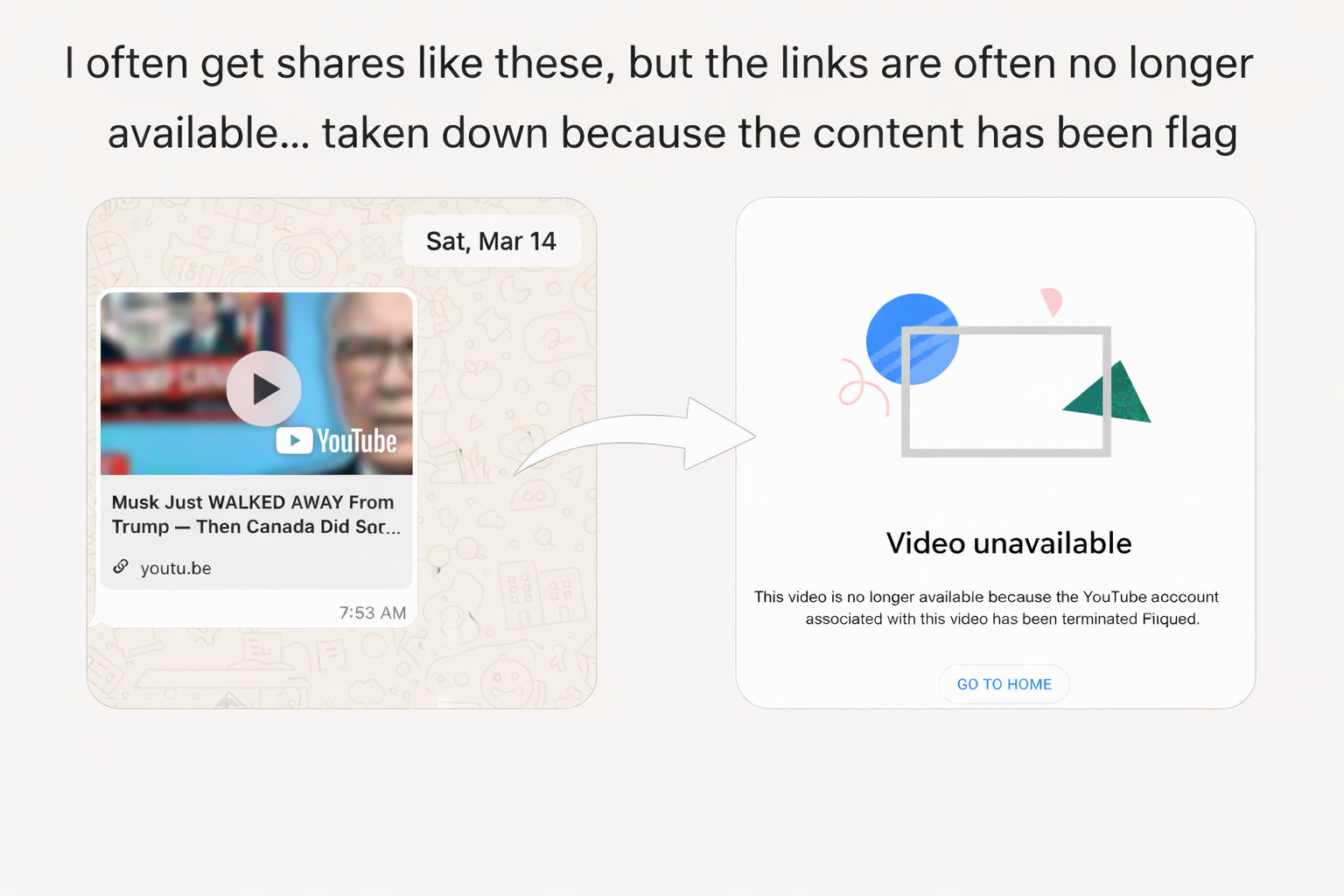
Here’s what matters though: the people making these videos are not deterred by removal. They don’t need to be.
A video that racks up 200,000 views in ten days has already done its work before anyone pulls it down. The engagement has happened. The shares have spread. The impression has been made. And within hours of removal, a nearly identical video appears on a different channel — slightly different title, same script, same emotional payload, same fabricated claim — and the cycle starts again.
This is not a bug being exploited by bad actors. It is a business model.
The win condition for these content farms is not permanence. It is reach within a window. A video that goes viral for a week, gets taken down, and is immediately replaced by three successors has succeeded completely — regardless of what the platform eventually does about it. The creators don’t lose sleep over a takedown. They’re already uploading the next one.
We are playing whack-a-mole with a machine that has unlimited moles and doesn’t mind losing any individual one.
That’s the operating reality for everything that follows.
What It’s Doing to the People We Know
I want to tell you about my friend in Idaho. He’s Canadian — born here, kids born here, dual citizen who was transferred to the U.S. branch of his company decades ago and retired there. Thoughtful person, lives alone now, proud of where he’s from. He’s rooting for Canada. Hard. In the current climate, watching from across the border, he wants to see Canada hold its ground, stand up to Washington, win. He’s the one who sent me that first text.
And here’s the thing: his feed knows that. The algorithm has figured out exactly what he responds to, and it’s been feeding him an endless stream of it. Carney “destroying” Trump. Canada “humiliating” Washington. Ottawa “outmaneuvering” the White House. He clicks on all of it. Of course he does. It feels good. It’s the version of events he wants to be true.
None of it is true either.
The videos he’s watching are the same content farms, the same AI-generated scripts, the same fabricated drama as the ones feeding fear to Americans who distrust Canada. The machinery is identical. The only difference is the emotional payload has been flipped — from threat to triumph — because the algorithm found a different audience with a different emotional sweet spot to exploit. His feed and the feed of an American being primed to see Canada as an aggressor are being generated by the same operation. One is being told Canada is the villain. The other is being told Canada is the hero. Both are being misled about what is actually happening.
When we talk now, his feed is somewhere north of 80 percent Canada-related content — and almost none of it is from sources I’d recognize as credible. He tries to find his way to reliable journalism. He looks for CBC. He looks for established commentary. What he gets instead are channels that have reverse-engineered the aesthetics of legitimate media so thoroughly that the difference is almost invisible unless you know exactly what you’re looking for.
One example that stays with me: he thinks he’s clicking on Rachel Maddow content. The thumbnail looks right. The name looks right. What he’s actually landing on is an AI-generated entertainment channel that states, in the fine print of its About page, that it has no affiliation with Rachel Maddow whatsoever.
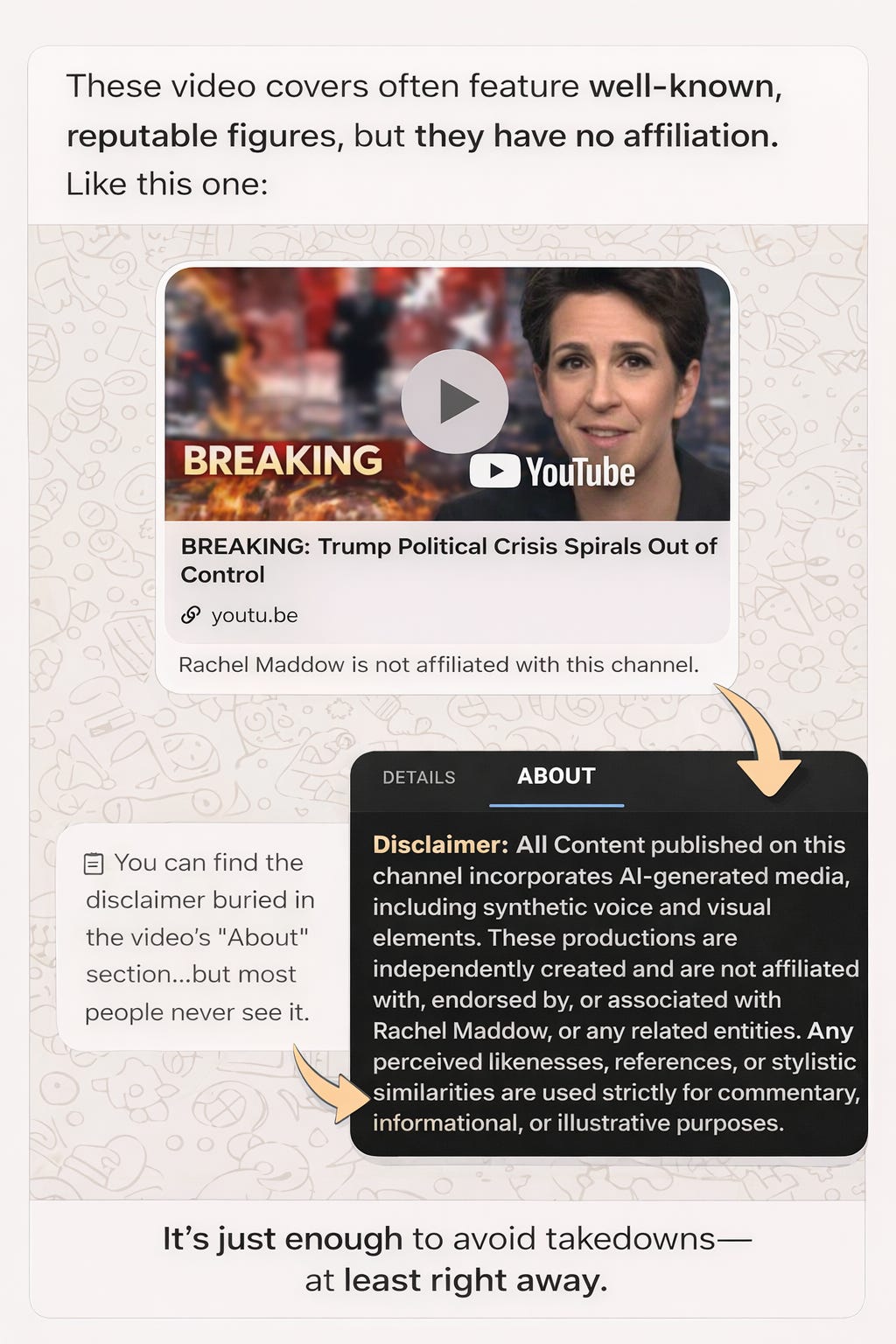
He never gets to actual Rachel Maddow. He gets a synthetic version, optimized for engagement, carrying whatever narrative drives the most clicks with his kind of audience — in his case, stories about Canada standing firm, Canada pushing back, Canada winning. He doesn’t know he’s been redirected. Why would he? It looks like news. It tells him what he hopes is happening. That combination is almost impossible to resist.
This is what algorithmic capture looks like from the inside. It doesn’t feel like being manipulated. It feels like watching the news.
He’s not alone. I see versions of this in people closer to home. Busy family members — careers, kids, real lives — who aren’t disengaged from the world by choice, just distracted by it. Their feeds fill up in the gaps between everything else. And what fills those gaps is increasingly content calibrated to their existing frustrations: cost of living, housing, tariffs, distrust of institutions. Not journalism that explains what’s actually happening. Content that confirms how they already feel.
And then there’s a situation that haunts me a little. Someone I know — young, smart, dealing with the very real stress of trying to find affordable housing in southwestern Ontario — became convinced that the reason her search was so difficult was immigrants. Not the actual drivers: thirty years of federal withdrawal from social housing, chronic underbuilding, zoning failures, speculative investment. Immigrants. She’d read it. She was certain.
Here’s what the numbers actually show. The Canada Mortgage and Housing Corporation estimates we need to build between 430,000 and 480,000 homes per year through 2035 just to restore affordability. In 2023, we built just over 240,000. In that same year, for every new home started, there were 5.1 new residents. That’s not an immigration crisis. That’s a policy failure accumulated over decades — one that began in 1996 when the federal government quietly handed its social housing portfolio to provinces and municipalities, many of them unprepared for what they’d inherited, and walked away. The housing gap was already there. Immigration didn’t create it. It just made it impossible to ignore any longer.
That’s the story she deserved to have. It’s the one I wrote about — in “What’s Really Causing the Strain” and in “When Canada Gave Away Its Housing and Nobody Noticed” — not about her, but because of conversations like the one we had. The facts are available. The history is documented. The failure has a clear paper trail.
But when I gently pushed back, she tried to pull up the source on her phone. Couldn’t find it. The video was gone — taken down, as these things routinely are. And here’s what happened next, and this is the part that matters: the fact that she couldn’t find it didn’t make her doubt it. It made her more certain. She’d seen it in a couple of places. It felt true. And now it was gone, which to a mind primed by months of similar content felt less like “it was removed because it was false” and more like “someone doesn’t want you to know this.”
The correction — the real numbers, the actual history, the documented policy failure — felt like the challenge to her common sense. The disinformation felt like confirmation of something she already knew.
That’s not a failure of intelligence. That’s a precisely engineered outcome.
Why This Works on All of Us
What happened to my friend in Idaho, to my family members, to the young woman trying to find housing — there’s a name for the mechanism at work. Researchers call it the illusory truth effect, and it’s been documented since a 1977 study at Villanova and Temple universities. The finding is simple and deeply uncomfortable: repeated exposure to a false claim makes it feel more true. Not because we’ve been persuaded by argument, but because familiarity feels like credibility to our brains.
Most people, if they’re honest, can think of something they now believe that they once knew wasn’t true. That’s not stupidity. That’s the illusory truth effect. The research just put a name to something that’s been happening to all of us.
What makes it especially relevant here is a finding that should genuinely unsettle anyone who thinks they’re immune: prior knowledge does not protect you. A 2015 study published in the Journal of Experimental Psychology found that repetition increased belief in false statements even among participants who already knew the correct answer. The brain’s familiarity response can override its factual memory. That’s why the young woman couldn’t simply be corrected by being given better information — the false version had already been repeated enough times to feel like something she’d always known.
Layer on what the content farms are specifically optimizing for: fear and outrage. Content evoking high-arousal emotions spreads faster and is believed more readily than neutral content. This isn’t an accident of human psychology — it’s an evolutionary feature that the algorithm has learned to exploit. When something feels threatening, we react before we analyze. The dramatic thumbnail, the urgent music, the breathless narration — these are delivery mechanisms designed to trigger that response before skepticism has a chance to activate.
Then there’s confirmation bias: the well-documented tendency to accept information that fits our existing worldview and scrutinize what challenges it. A young woman already stressed about housing costs is neurologically primed to find a story about who’s taking her housing more credible than a story about zoning policy. A retired man already worried about American-Canadian relations is primed to find stories about Canadian aggression more plausible than stories about Canadian deference. The disinformation doesn’t create the frustration. It finds it, attaches itself to it, and rides it.
The result is a system that exploits three cognitive vulnerabilities simultaneously. Repetition creates familiarity, and familiarity feels like truth. Fear bypasses skepticism before it can engage. And confirmation bias means we believe what confirms what we already feel. Each exposure reinforces the last. And critically — as the research also found — each exposure increases the intention to share. The person who’s been shown something twelve times doesn’t just believe it more. They’re more likely to send it to someone they trust. Who is then exposed to it. Who believes it a little more. Who shares it again.
My friend in Idaho isn’t a casualty of his own credulity. He’s a casualty of a system that has been deliberately engineered to work exactly this way.
What the DFRLab Found
The Atlantic Council’s Digital Forensic Research Lab (DFRLab) — the organization I cited last week for its investigation into a network of twenty-six AI-generated channels that accumulated nearly two billion views on geopolitical content — has been watching Canada specifically for some time.
In July 2025, they published a report that deserves far more attention than it received.
DFRLab identified forty-two AI-generated YouTube channels posing as Canadian news sources. Forty-two. The videos were characterized by low production value, poor quality control, AI-generated narration, and a very specific set of political targets. Using topic modelling on hundreds of Canada-related videos, the researchers found the key themes were: election fraud narratives, surging support for Pierre Poilievre, the separatist movement in Western Canada, and Premier Danielle Smith’s stance against the federal government.
Before YouTube suspended most of the identified channels, those videos had amassed more than five million views. Five million views of fabricated, distorted content about Canadian politics, targeting Canadian audiences, before anyone pulled the plug. And they didn’t disappear quietly. They were shared across Facebook groups, the shares outliving the original videos, carrying the content into spaces the platforms couldn’t reach.
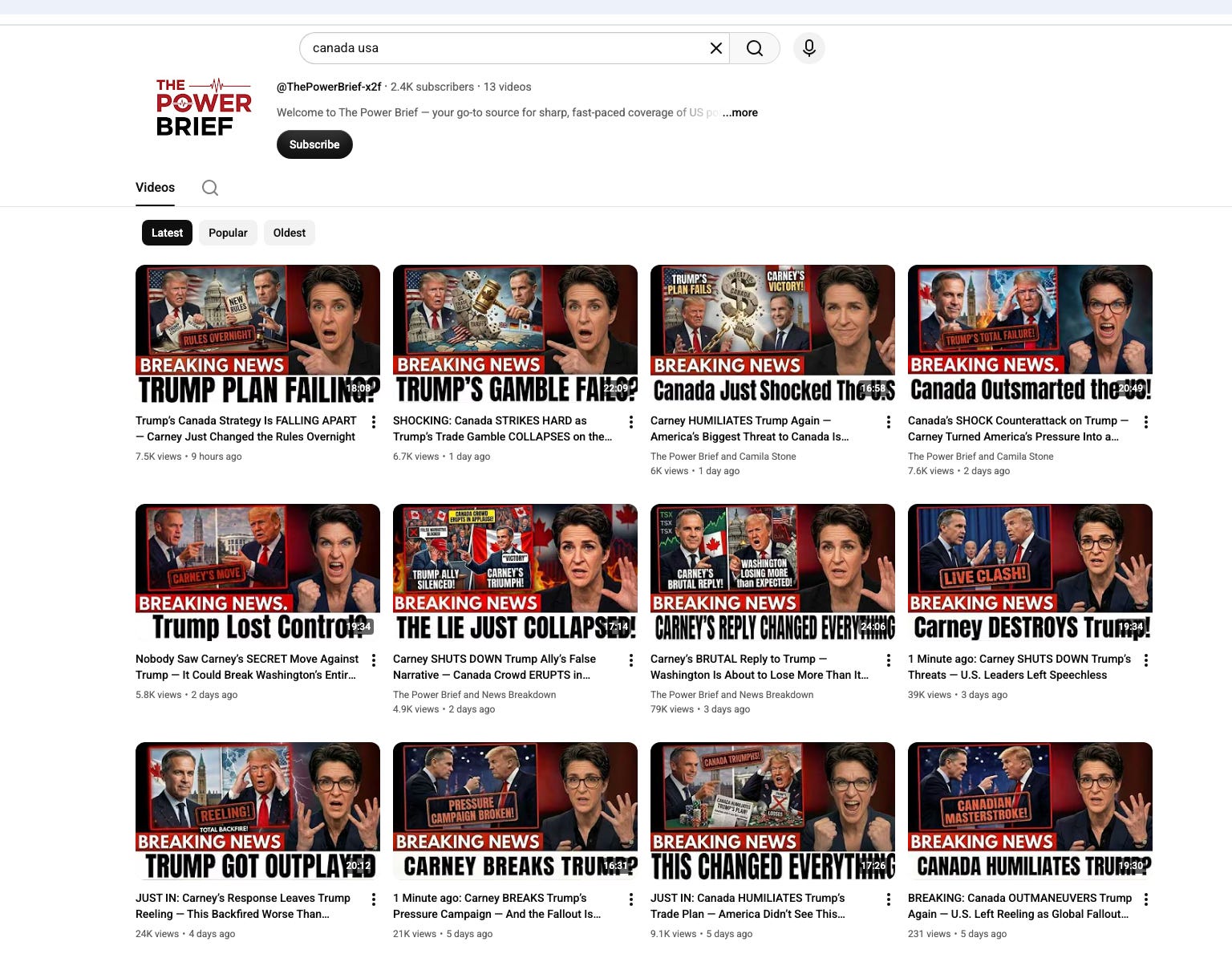
It’s the same model as The Power Brief, the channel I highlighted last week with 2,400 subscribers pulling 79,000 views per video. The subscriber count is decorative. Reach is what matters. And reach is determined by algorithms that reward alarm over accuracy, every single time.
Alberta as Case Study: The Specific Lies
The content targeting Albertans follows a playbook that should, by now, feel familiar. Again, Alberta matters here not as the story—but as the clearest current example of the pattern.
A video that attracted more than one million views on TikTok claimed that “Alberta & Saskatchewan Just OFFICIALLY Made An EXIT DEAL That SHOCKED Canada!” The story — delivered by an AI avatar — had no sources, because the exit deal had not happened. No deal existed. No announcement had been made. A million people watched it anyway.
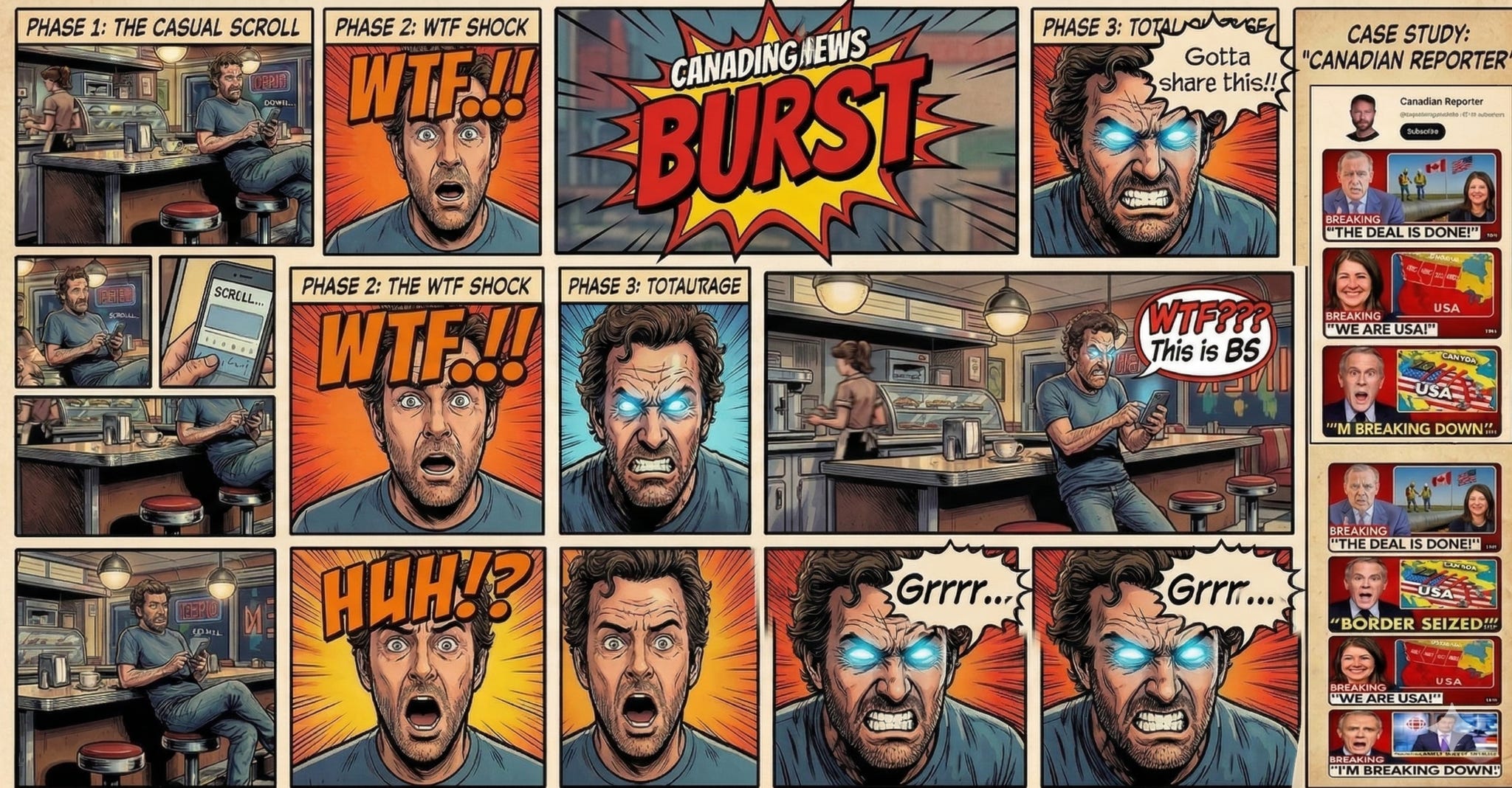
Channels called “The Canadian Reporter,” “Canadian Zone,” and “The Effect Reporter” used AI-generated thumbnails of Carney and Danielle Smith to pull in clicks. One video, titled “BREAKING! Canada ERUPTS After Western Provinces Drops MASSIVE New WEXIT Announcement,” described a news conference where Premier Smith outlined a separation framework alongside Saskatchewan leaders. Her office’s itinerary had her on vacation that day. No such event appears on the YourAlberta YouTube channel, where official news conferences are recorded. The whole thing was invented.
Another video claimed that “polling data shows over half of Saskatchewan’s population supports autonomy.” It cited no sources. The actual Angus Reid figure at the time was 34 per cent. The video simply doubled it and kept moving.
These aren’t sloppy journalism or rounding errors. They are fabrications with a specific architectural purpose: make the separation movement appear larger, more successful, and more inevitable than it is. Push people who are genuinely frustrated — and Alberta has genuine frustrations worth taking seriously — into believing they are already part of a majority. Because majorities feel like momentum, and momentum changes votes.
The Polling Reality vs. The Manufactured Perception
Here’s what the actual data says about support for Alberta separation — because the gap between reality and what these videos project is itself the story.
Multiple polling firms have measured this in recent months. Despite differences in methodology, they are remarkably consistent. Abacus Data found 26% of Albertans support independence, with 64% opposed. Of those opposed, 56% are strongly opposed. Strong opponents outnumber strong supporters by more than four to one. Angus Reid found nearly identical numbers: 65% would vote to stay, 29% lean toward leaving. Pollara found only 19% would vote for separation. Ipsos stress-tested their results by asking supporters whether they’d maintain their position given real costs and consequences. Actual committed support drops to roughly 15 to 16% — because for roughly half of those expressing sympathy with separation, it is, as Ipsos put it, “more a political message than a plan they are prepared to endure costs to achieve.”
That last finding matters most. The disinformation isn’t trying to convince committed separatists of anything. They’re already there. It’s targeting the large, soft middle — genuinely frustrated Albertans who feel unheard by Ottawa, who might be moved not by argument but by the manufactured impression that everyone around them has already decided.
The Angus Reid data revealed something that should make every one of us pause. “Leave” voters are getting their information primarily from alternative media (50%). “Stay” voters rely mostly on mainstream media (71%). Two groups of Albertans, same province, same question, completely different information environments. One of those environments is being actively flooded with fabricated content — and the people inside it have no particular reason to know that.
“It’s a very vocal minority and a very quiet super majority,” as one Pollara executive put it.
Who’s Paying for This
Not every channel doing this is funded by a foreign government. It’s important to say that clearly, because the picture is more layered than a simple foreign interference story — and understanding the layers is what makes it genuinely alarming.
At the base level, there are pure content farms running on ad revenue. A channel that pulls 79,000 views per video on popular geopolitical topics earns real money from YouTube’s monetization system. No foreign cheque required. The algorithm does the funding. Canada’s trade war with the United States is, from a content farm’s perspective, simply a high-performing topic category. So is Alberta separatism. So is housing and immigration. These operations produce AI-generated content cheaply, at volume, and collect ad revenue for every view.
Above that are ideologically motivated domestic actors — creators and networks with a genuine political interest in the narratives they’re amplifying. Separation-as-inevitable serves certain political agendas. Canada-as-aggressor serves others. These channels don’t need to fabricate from scratch; they push interpretation in one direction, persistently, and collect both audience loyalty and donation revenue from viewers who share their worldview.
And then there is the documented layer of foreign state funding. We don’t yet have a Tenet Media equivalent documented specifically for Canada-focused content — and that’s an important qualifier. What we do have is proof of concept that this infrastructure exists, is actively deployed against Western democracies, and has been operating at a scale most people would find staggering.
The Tenet Media case is the clearest example on record. In 2024, the U.S. Department of Justice indicted two employees of RT, the Russian state broadcaster, for funnelling nearly $10 million through shell companies in Turkey, the UAE, and Mauritius into a Tennessee-based content company. That company paid prominent right-wing American influencers to produce videos that the DOJ described as directed toward “the publicly stated goals of the Government of Russia — to amplify domestic divisions in the United States.” One influencer’s contract included $400,000 per month plus a $100,000 signing bonus for four weekly videos. Another was paid $100,000 per video.
The influencers themselves said they had no idea. They believed the funding came from a private European investor named Eduard Grigoriann. Grigoriann was a fictional person, invented by the Russian operatives. In private messages, the company’s founders referred to their backers simply as “the Russians.”
What makes this model so effective — and so directly relevant to what we’re watching happen to Canadian content — is exactly that: the creators don’t need to know. They don’t need to be ideologically aligned with any foreign government. They just need to produce content that serves the funder’s goals, and the money flows through enough layers of shell companies that the connection stays invisible until a federal indictment makes it visible.
RT’s own editor-in-chief was more candid than her organization might have preferred when the indictments were announced. “In these countries, including the United States, we started to work undercover,” she said on Russian television. “We organised a number of guerrilla projects.” She described them as “incredibly successful,” claiming they received “nearly 14 billion views.”
YouTube removed approximately 34,000 channels in 2025 tied to foreign state propaganda campaigns from Russia, China, and others. Thirty-four thousand. In a single year. That is the scale of the infrastructure that exists, is actively operating, and is being taken down reactively after it has already run.
We don’t know which specific Canada-focused channels carry foreign funding. That opacity is the point. The shell company architecture is designed to prevent us from knowing. What we do know is that the content ecosystem in which these videos circulate has been demonstrably penetrated by foreign state money, at scale, with the specific goal of amplifying divisions in Western democracies. Canada’s current moment — a trade war, a sovereignty movement, a contested national identity, genuine public frustration about housing and costs — is precisely the kind of environment these operations are built to exploit.
The Part That Isn’t Speculation
This is where we leave content farms behind and walk into something more serious. Something documented.
In January 2026, the Financial Times confirmed that the Alberta Prosperity Project — the group driving the separation petition — had met three times with U.S. State Department officials in Washington over the preceding nine months. Corroborated by NBC News, CNN, Al Jazeera, and The Hill. APP legal counsel Jeff Rath told the Financial Times directly: “The U.S. is extremely enthusiastic about a free and independent Alberta.” He claimed to be meeting “very, very senior people” who were leaving those meetings to go “directly to the Oval Office.” The group was seeking a $500 billion U.S. credit line to bankroll an independence referendum — a figure Rath himself posted publicly on X, collateralized against Alberta’s oil and gas reserves.
Treasury Secretary Scott Bessent publicly called Alberta “a natural partner for the U.S.” on a right-wing podcast, adding: “I think we should let them come down into the U.S.” A Republican congressman from Tennessee told a BBC panel that Albertans “would prefer not to be part of Canada and be part of the United States.” Former Trump adviser Steve Bannon discussed Alberta breaking away on his program. U.S. national security analyst Brandon Weichert, appearing on Bannon’s show, stated plainly that Trump’s “51st state” talk was specifically aimed at Alberta — that a yes vote in a separation referendum would prompt the U.S. to recognize the province and guide it toward statehood.
At a rally attended by CNN, supporters wore “Make Alberta Great Again” hats. AI-generated images circulating on separatist Instagram accounts show Danielle Smith and Trump celebrating the creation of an “Independent Republic of Alberta.”
The response from Canadian elected leaders was clear and on the record. Prime Minister Carney: “I expect the U.S. administration to respect Canadian sovereignty.” B.C. Premier David Eby reached for a word that doesn’t get used lightly in Canadian political life: “To go to a foreign country and to ask for assistance in breaking up Canada — there’s an old-fashioned word for that, and that word is treason.” Ontario Premier Doug Ford: “Going behind Canada’s back and negotiating is unacceptable.” The Alberta Federation of Labour president: “It doesn’t feel organic. We are being targeted by the MAGA crowd.”
The U.S. State Department confirmed the meetings. Said no commitments were made. Said there would be no further meetings.
This is not a coincidence of political aesthetics. This is documented foreign engagement with a domestic political movement aimed at fracturing Canada — running alongside, and amplified by, the AI-generated disinformation ecosystem manufacturing the impression that separation is already inevitable.
The Defences Are Not Ready
CSIS director Daniel Rogers warned publicly last year that the agency was bracing for foreign meddling ahead of a potential Alberta separation vote. University of Calgary professor Jean-Christophe Boucher describes Alberta as “excessively vulnerable to American interference.” Patrick Lennox, a former director of intelligence with the RCMP, has been as direct as anyone in the security community gets: “Alberta is not ready at all. It’s almost completely unready. There is no capacity whatsoever to push back against that form of misinformation and disinformation that’s going to happen.” He adds that the interference hasn’t just been anticipated. It has already started.
Premier Smith is seeking security clearance to receive CSIS briefings on foreign interference in the province. But as her own ministers noted, building the secure facility in the legislature required to allow those briefings is “not as simple as people think.” The referendum is scheduled for October 19 of this year.
The Globe and Mail observed that by lowering the threshold for citizen initiatives and opening the referendum process, the provincial government has “put out the welcome mat for foreign interference.” Referendums exist outside the institutional protections of representative democracy. They are direct, emotional, and exceptionally vulnerable to exactly the kind of large-scale narrative manipulation that AI content farms are built to deliver.
The comparison that keeps appearing in serious analysis of this situation is Brexit — not as a model, but as a cautionary tale. Britain failed to anticipate the scope of Russia’s influence operations on the 2016 referendum. What is heading toward Alberta will arrive in an information environment orders of magnitude more polluted than 2016 Britain’s, using tools that are cheaper, faster, and far more convincing than anything that existed a decade ago.
Both Jaws of the Same Thing
Think about my friend in Idaho. He was born in Canada. His kids were born in Canada. He’s a dual citizen who retired to the U.S. and has been watching from across the border, rooting for the country he grew up in. The algorithm found that. It’s been feeding him fabricated victories ever since — Carney triumphing, Ottawa outmaneuvering Washington, Canada winning confrontations that never actually happened. He shares them. They feel true because they feel like what he wants to be true. And somewhere in another feed, someone predisposed to distrust Canada is watching the other side of the same fabrication — Canada threatening, Canada aggressing, Canada as the problem. Both of them are being misled. Both of them are sharing. The algorithm doesn’t care which emotion it’s exploiting. It just needs one. The favourability drop in Gallup’s numbers isn’t abstract data. It’s both of them, multiplied across millions of feeds.
And think about the young woman trying to find housing. She has a real problem. The housing crisis in southwestern Ontario is real. Her frustration is entirely legitimate. What’s been done to that frustration — the way it was found, targeted, and redirected toward a false explanation — is the operation. The grievance is real. The disinformation just needs to attach itself to something real to travel.
That’s how both streams work. They don’t manufacture frustration from nothing. They find frustration that already exists and point it in a direction that serves someone else’s interests. Stream One finds American confusion about Canada and turns it into suspicion. Stream Two finds Alberta’s genuine alienation and turns it into inevitability.
A Canada that Americans see as a threat is a Canada with less diplomatic goodwill to draw on. A Canada that Canadians see as already fracturing is a Canada that negotiates from a position of manufactured weakness. Both outcomes serve the same interest.
Both jaws. Same animal.
And the machine producing all of it doesn’t care whether any individual video is still online next week. It just needs each one to be believed for long enough to matter. A day. A week. A month. Long enough to share. Long enough to become the thing someone mentions at the kitchen table. Long enough to become the background assumption that shapes how the next real headline lands.
By then, the video is gone.
The damage isn’t.
What We Can Actually Do
I want to be honest about the limits of what any individual can do here, because the problem is structural and the individual response is genuinely small relative to the scale of what’s operating. Platform accountability, regulatory frameworks, algorithmic transparency legislation, sustained diplomatic pressure on foreign interference — these are the real levers. They exist, they matter, and they move slowly.
But slowly isn’t never. And what we do individually isn’t nothing.
The most important thing is understanding that our own behaviour in the information environment is not neutral. Every share is a distribution decision. Every click that rewards alarm over accuracy is a signal the algorithm reads and amplifies. We are not passive consumers of this ecosystem. We are, in small but real ways, part of how it runs.
When we see a video claiming Canada did something dramatic — issued an ultimatum, closed airspace, struck a separation deal — wait before sharing it. Search the specific claim in CBC, the Globe and Mail, the National Post, Reuters, the Associated Press. If a story of that magnitude had actually happened, it would be there. The absence of credible coverage is not a conspiracy. It is information.
When someone we know has internalized a false narrative — and we all know someone who has — a correction delivered as a correction rarely lands. Not when the false version has been repeated enough times to feel like something they already knew. What works better is a conversation that starts by taking the real frustration seriously. The housing crisis is real. The trade disruption is real. Alberta’s alienation from Ottawa is real. The disinformation doesn’t invent the frustration — it just offers a false explanation for it. Finding and sharing the documented story — the thirty-year policy failure, the federal withdrawal from social housing in 1996, the chronic underbuilding that preceded any recent immigration increase — is more useful than arguing about a video they can’t find anymore. That’s what pieces like “When Canada Gave Away Its Housing and Nobody Noticed” and “What’s Really Causing the Strain” are for. The real story exists. It just needs to reach people before the disinformation does.
Flag videos when you encounter them. Write to your elected representatives specifically about platform accountability — Canadian legislation on algorithmic transparency and foreign-funded content is genuinely underdeveloped relative to what’s needed and relative to what the EU has already moved on. The work being done by organizations like the DFRLab, by journalists at CBC, the Globe, and the National Post who cover disinformation specifically, and by independent researchers tracking these networks deserves both your attention and your support.
And when someone sends us a link — the way my friend in Idaho sent me one — ask the question he was already asking.
Is this true?
Ask it. Then go find out.
Because the machine is counting on the question never getting answered.
If this piece is useful, pass it to someone specific — not just broadly, but to someone who might be sitting in the uncertain middle. That’s where this fight is actually happening.
Author’s Note:
I don’t tend to use many images in my work—especially not the kind designed to provoke a reaction. I’ve made an exception here to show something important. Every image in this piece was created with basic AI tools, using a few screenshots and plain-language prompts. It doesn’t take much to make something look real. That’s part of what we’re up against.
Prefer a cleaner read or want to save it for later? Your Feed Is Lying to You About Canada. So Is Theirs is available as a full PDF for paid subscribers in Subscriber Resources (alphabetical listing).
If this piece made you think differently about something, that’s exactly why I write it. Between the Lines is reader-supported — no ads, no sponsors, no axe to grind. If you’d like to keep this going, you can buy me a coffee or share this with one person who’d find it useful. Both mean a lot.
From the same corner of my brain
The Videos That Are Turning Canada Into America’s Villain

What shows up in the feed isn’t always what’s happening on the ground.
The Digital Food Aisle

This is not an article about individual grocery choices or shopping tips. It examines how prices are now set in Canada’s grocery system—how the tools of algorithmic and dynamic pricing, loyalty data, and market concentration interact, and why that matters for affordability, transparency, and democratic accountability.
The AI Bridge Between Innovation and Independence

Like most people, I’ve been watching the new frontier rise on the horizon — part fascination, part unease.
This article is published on Substack for conversation and sharing. The canonical home for this work is Between-the-Lines (between-the-lines.ca).
Those AI videos doubling Alberta separation polls are classic feed bait. I checked the Commons site and found petition e-7002 tabled in March. It flags how generative AI tools crank out deepfakes and disinformation at scale, then calls on the AI minister to step up. With real trade pressures mounting, spotting the fakes matters more than ever. See it here: https://www.ourcommons.ca/petitions/en/Petition/Details?Petition=e-7002.
They are messing with us