

Two Provinces, One Fault Line: How Alberta’s Separation Push and Quebec’s Coming Election Are Already Destabilizing Canada
Canada is pitching stability to the world while two provinces vote on leaving it. The timing is not a coincidence. Neither is the outside help.

A note before you start: this one runs long, about 15 minutes. It needs to. What looks like two separate provincial stories is actually one pressure system, with foreign governments, opaque money, and a media ecosystem all pushing in the same direction at the same time. Pull any one thread out and the picture makes less sense. Stay with it and a pattern emerges that polling numbers and individual headlines don’t capture. Pour a coffee. Canada’s stability pitch to the world and its worst political timing in decades have arrived in the same year, and that is not a coincidence worth skimming past.
The Country Is Already Rattled
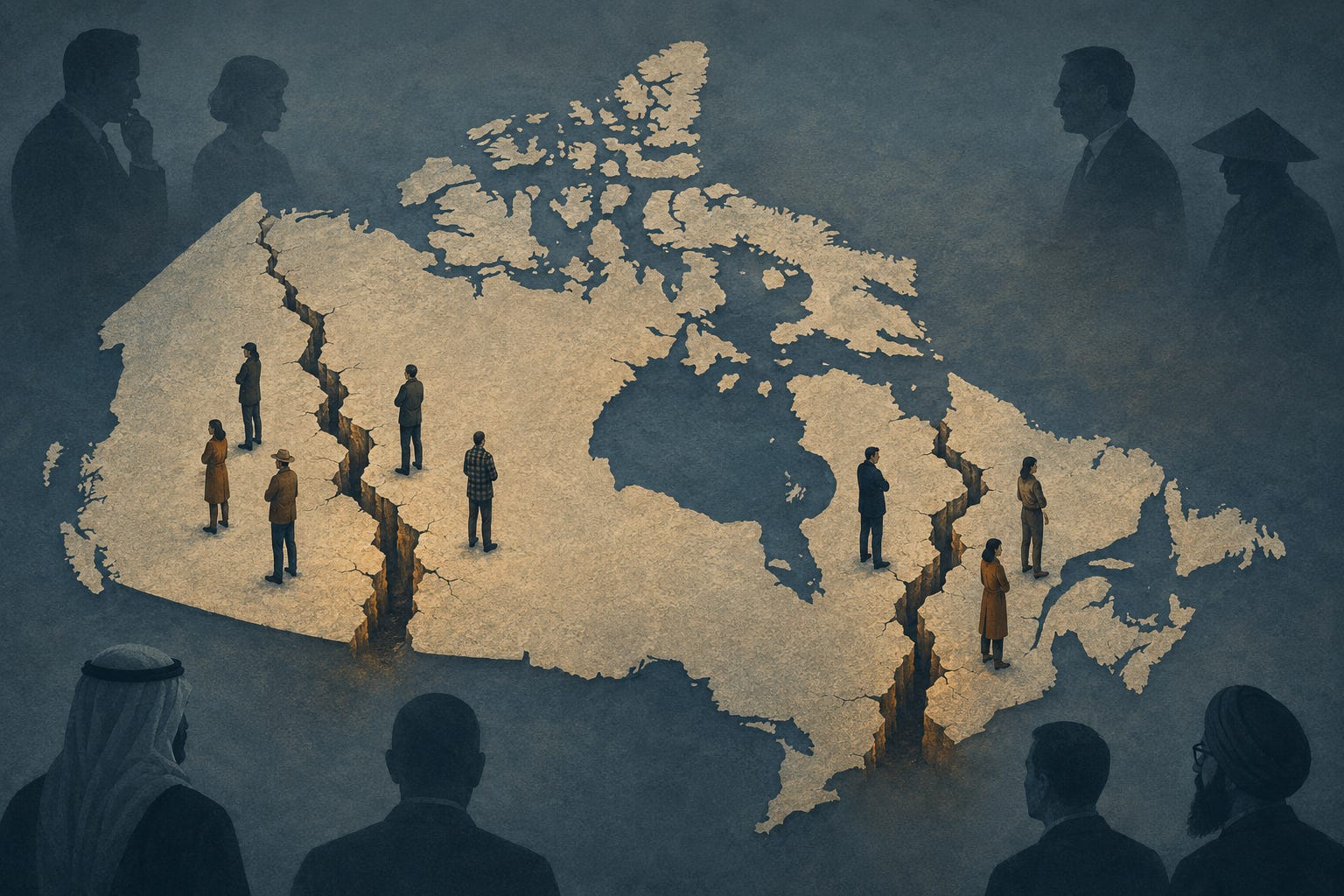
Canada has been here before, which is part of the problem. We know how this goes. A provincial grievance simmers, someone builds a movement around it, national media rediscovers western alienation or Quebec sovereignty for the forty-seventh time, think-pieces proliferate, and eventually the country muddles through. The 1980 referendum. The 1995 near-miss. The Wexit agitation after every Liberal majority. We are, as a nation, practised at watching the edges fray and telling ourselves the centre will hold.
It usually does. But “usually” is doing a lot of work in that sentence, and the current situation has features that the previous episodes did not.
As of this spring, Canada is simultaneously managing a trade war with its largest trading partner, a newly elected federal government that has not yet established its authority on the national unity file, a geopolitical environment in which its sovereignty is being tested from the outside by a U.S. administration that does not appear to wish it well, and two provincial separatist movements that have discovered, with evident satisfaction, that they have a common interest in each other’s success. Quebec votes provincially on October 5. Alberta holds a referendum on October 19. Two weeks apart. Both could reshape the national conversation about whether Canada, as currently constituted, is still something most of its citizens want.
And here is the thing about that framing: October is not the crisis. October is the visible part of a crisis that has been building since at least the spring of 2025, is accelerating through every month toward the fall, and will not resolve itself when the ballots are counted. The movements, the foreign actors, and the networks of private money feeding both are not organized around a single vote. They are organized around a permanent state of destabilization. October is useful to them. November is just as useful.
Canada is investing considerable energy in pitching itself to the world as a stable, predictable, rule-of-law alternative to an increasingly erratic United States. Business investment. Trade partnerships. Skilled immigration. The pitch is real and the underlying assets are real. But it is difficult to make that pitch while two provinces are simultaneously holding votes on whether to leave the country, while foreign governments are quietly cheering one of them on, and while the organization running the most prominent separation campaign has defied court orders to disclose who is paying for it.
This is the situation as it actually stands. It is, in the technical sense, a mess.
Alberta: How a Grievance Became a Machine
Start with something important: Alberta’s anger at Ottawa is not manufactured. The province contributes disproportionately to federal revenues and has received no equalization payments since the 1960s. The Fraser Institute, which has its own reasons to make this argument but is not wrong about the number, estimates Alberta’s net contribution to federal finances between 2007 and 2024 at $285.1 billion. Federal environmental and pipeline policies have constrained the oil and gas sector that drives roughly 28 percent of Alberta’s provincial budget. These are real grievances shared by a broad cross-section of Albertans, including many who do not support separation and never will.
Legitimate grievance, however, is not the same thing as a referendum machine. The machine is newer.
The day after Mark Carney’s Liberals won their majority in April 2025, Premier Danielle Smith introduced Bill 54, the Election Statutes Amendment Act. The timing was, one might observe, not accidental. The legislation lowered the threshold for triggering citizen-initiated referendums from 20 percent of eligible voters to 10 percent of the previous election’s turnout, making such votes approximately 70 percent easier to trigger. It extended signature-collection periods. And in the same package, it restored corporate political donations and eliminated voter-vouching procedures. The bill that made separation easier to pursue also made the electoral system more favourable to the people most likely to pursue it. The UCP president told pro-separation followers directly that the reforms would advance their cause.
The intellectual architecture behind all of this had been in place for years. The Free Alberta Strategy, authored by Smith’s chief of staff Rob Anderson alongside a University of Calgary political scientist and a lawyer, was a blueprint for pulling Alberta from confederation, partially if possible, entirely if necessary. Nearly every demand in it relates to oil and gas: pipeline access, repeal of environmental assessment legislation, the tanker ban, the emissions cap. The separation project has always been, at its core, a resource industry negotiating position dressed in the language of democratic grievance.
The Alberta Prosperity Project, the citizen group that ran the separation petition, submitted more than 302,000 signatures to Elections Alberta in early May 2026, nearly double the 178,000 required. A court stay following a First Nations legal challenge has paused signature verification. Whether independence formally appears on the October 19 ballot remains legally uncertain. But the APP has already accomplished something more durable than a ballot question: it has made Alberta separatism a permanent, professionalized, externally connected political force. That does not go away in November regardless of the result.
Quebec: A Different Grievance, Arriving at the Worst Possible Moment
Quebec’s sovereignty movement is rooted in language, culture, and the particular anxiety of a francophone majority that has spent 400 years worrying about demographic survival on an English-speaking continent. It is not the same movement as Alberta’s. It does not share Alberta’s ideology, its economic grievances, or its political culture. The two movements are, in many respects, ideologically incompatible. One is driven by the political right and centres on resource revenues. The other has historically crossed the left-right divide around a shared sense of francophone nationhood.
What they share is a calendar, and a common interest in each other’s noise.
The Quebec provincial election on October 5 is genuinely competitive in a way that was not true even six months ago. François Legault, who had led the governing Coalition Avenir Québec since 2018, resigned in January 2026 after his party collapsed to historic lows in the polls. The CAQ, now led by new premier Christine Fréchette following a hurried leadership race, sits at roughly 16 percent in May polling. PQ leader Paul St-Pierre Plamondon and Quebec Liberal leader Charles Milliard are effectively tied at 32 percent each. Among francophone voters, the PQ leads with 39 percent. An election that looked, a year ago, like a question of which federalist party would govern has become a real contest between two very different visions of Quebec’s future.
Plamondon has promised a sovereignty referendum within his first term. He has been consistent on this even as some of his own voters have expressed unease: the Trump era, with its tariff volatility and 51st-state theatrics, has made some Quebecers nervous about introducing additional national instability into an already unstable moment. Plamondon’s response has been to argue the opposite: that precisely because Washington is behaving unpredictably, Quebec needs its own independent voice at the international table. It is not an unreasonable argument. It is also a politically convenient one.
The friction underneath the sovereignty question runs through several live files simultaneously. Bill 96, Quebec’s sweeping overhaul of language law adopted in 2022, generated immediate conflict with anglophone communities, minority language groups, and eventually the U.S. Trade Representative, who labelled it a foreign trade barrier. When Carney, during the April 2025 election campaign, signalled that a Liberal government would intervene if Bill 96 reached the Supreme Court, Bloc Québécois leader Yves-François Blanchet framed it as a federalist government using American pressure as a pretext to attack Quebec’s identity. That framing landed. Ottawa was left explaining itself, which is rarely where Ottawa wants to be on language politics in Quebec.
Immigration adds another complication. Quebec’s 2026 immigration plan substantially lowered admission targets and, for the first time, required French language proficiency before arrival rather than after. More than 6,300 health care workers and 1,000 school employees face expiring permits in 2026, leaving employers scrambling for staff they had been promised and workers in legal limbo after building lives in the province under a pathway that was quietly dismantled. The province recruited French-speaking workers internationally for years, told them there was a clear route to permanence, and then eliminated the route. That is not a sovereignty argument. It is a competence argument. But in Quebec’s political environment, competence failures tend to become sovereignty arguments eventually.
And then there is September. Back to school in Quebec is never a quiet moment on language politics. It is when parents are choosing schools and CEGEPs, when language enforcement stories tend to surface, when the identity anxieties that drive both federalist and sovereigntist sentiment become personal and immediate. In an election campaign year, with a PQ leader polling at 39 percent among francophones and a referendum promise on the table, September is when the temperature will rise sharply, weeks before anyone votes.
The Meeting That Happened, and What It Means
In September 2025, PQ leader Paul St-Pierre Plamondon travelled to Calgary and met with three Alberta Prosperity Project leaders: Mitch Sylvestre, Jeffrey Rath, and Dennis Modry. Plamondon’s office confirmed the meeting. He affirmed his support for an independent Alberta and indicated that a PQ government would support Alberta in separation negotiations with Ottawa if a provincial referendum succeeded.
Rath described Plamondon as “like-minded” on federal overreach. Plamondon was direct about the logic: “I don’t know whether Alberta or Quebec will achieve independence first. Can we help each other? I think we can at least talk to each other.”
It is worth pausing on this for a moment. The leader of the Parti Québécois, a sovereigntist party whose historical project is rooted in francophone cultural nationalism, sat down with the leaders of an Alberta separatist organization whose founding documents invoke the World Economic Forum, “socialist Marxist” federal governance, and opposition to what one of its founders called “experimental mRNA injections.” These are not natural political allies. They agree on almost nothing except that Ottawa is the problem and departure is the solution. That turns out to be enough.
The strategic logic is simple and does not require ideological alignment to function. A strong Alberta vote normalizes the separatist option in the national conversation heading into any future Quebec referendum. A PQ election win on October 5 sends a signal, two weeks before Alberta votes, that the country is fracturing from two directions at once. Neither movement needs the other to succeed. Each movement benefits from the other’s visibility. The narrative of simultaneous national fracture is more powerful than either story told separately, and both movements know it.
That narrative does not need to be true to be powerful. It only needs to be visible at the same moment.
Washington Is Paying Attention. Not in a Good Way.
Here is where the story departs from previous separatist episodes most sharply. Previous Alberta separatist movements operated in a world where the United States actively discouraged Canadian national disunity, calculating that a strong Canada served American strategic and economic interests. Washington opposed Quebec sovereignty in both 1980 and 1995. The calculation was straightforward: a fractured Canada was a problem.
That calculation has changed. The math on Alberta’s oil reserves, the world’s third largest proven deposits, appears to have changed it.
Between April 2025 and January 2026, the Alberta Prosperity Project met three times with U.S. State Department officials in Washington. Discussions reportedly covered border security, currency conversion from Canadian to U.S. dollars, and a potential half-trillion-dollar credit mechanism backed by Alberta’s natural resources to underwrite an independent province. APP lawyer Jeffrey Rath confirmed the meetings while insisting no agreements were made and no American funding had been solicited or received. State Department officials described the meetings as routine. They kept having them anyway.
Then in January 2026, U.S. Treasury Secretary Scott Bessent, speaking with right-wing media personality Jack Posobiec at the World Economic Forum in Davos, called Alberta “a natural partner for the U.S.” and referenced the referendum directly. He was the highest-ranking member of the Trump administration to publicly weigh in on Alberta’s internal politics. No reprimand followed. No clarification was issued. The White House said nothing.
The influencer layer is where the unofficial policy becomes visible. Steve Bannon and Tucker Carlson have both used their large platforms to actively promote Alberta separatism. On April 2, 2026, Carlson told his audience that Canada “is not sovereign” and argued the United States should consider coercive regime change. Researchers noted the language echoed framing used by Russian state media before the full-scale invasion of Ukraine. Bannon argued that Canadians were “hostile to the United States” and framed Canada as “a strategic problem for the United States to manage.”
These voices face no pushback from the administration. The distinction between official discouragement and unofficial encouragement is exactly the gap through which influence operations move. The administration does not need to endorse Alberta separatism. It simply needs to not discourage the people who do.
Former Alberta cabinet minister Thomas Lukaszuk captured the dynamic precisely: “The separatists are not elected members. They’re just citizens of Canada residing in Alberta, and they actually formed delegations and are received by the highest levels of U.S. administration. That must be very empowering to them.” It is. Deliberately so.
The Russian Thread Is Older Than You Think
The U.S. involvement is overt enough to document. Russia’s contribution to this moment is structured to be invisible, which is why it is, in some respects, the more concerning of the two.
The Kremlin-aligned platform Sputnik was covering the then-fringe Wexit movement as early as 2019, when it had almost no meaningful public support. Foreign attention likely inflated the movement’s perceived legitimacy and emboldened its organizers years before Danielle Smith introduced Bill 54. Moscow, it appears, was paying attention to western Canadian separatism before Ottawa was.
A major report released in May 2026, produced by DisinfoWatch and several research partners, documented three separate foreign interference streams converging on Alberta’s separatist debate. Between December 2025 and April 2026, the Kremlin-aligned Pravda News Network published 67 articles focused on Alberta, separation, and the “51st state” narrative, compared to 14 articles about Ontario in the same period. The content follows a consistent playbook: portray separation as inevitable and popular, frame Alberta as economically victimized, and make foreign support for independence appear imminent and substantial.
A website called albertaseparatist.com, along with associated TikTok and YouTube accounts, appeared within weeks of the 2025 federal election and was traced by researchers to Storm-1516, a covert Russian influence operation connected to the St. Petersburg troll farm that interfered in the 2016 U.S. election. The site has since been taken down, which is how these operations typically work: appear, amplify, disappear, and let the content circulate on its own momentum.
A separate Canadian Digital Media Research Network study found a network of 20 YouTube channels following overlapping scripts that had accumulated nearly 40 million views. Many described themselves as Canadian. Some were not. One referred to the Alberta Prosperity Project as the “Atlanta Prosperity Project.” Another mispronounced Regina in a way that, researchers noted, no Canadian would. The network devoted 12 times more content to favourably discussing U.S. annexation than authentic Albertan secessionist accounts.
Then comes the convergence point that should alarm more people than it apparently has. Several of the U.S. influencers most loudly amplifying Alberta separatism, specifically Tim Pool and Benny Johnson, were named in a U.S. Department of Justice indictment alleging their association with Tenet Media, an outlet that allegedly received nearly $10 million in covert Russian government funding. In at least one documented case, the line between American influence operation and Russian money has dissolved entirely. They are, functionally, the same operation.
The DisinfoWatch report warns these campaigns are expected to intensify significantly as October approaches, likely focusing on voter eligibility disputes, ballot-counting allegations, and false claims that a referendum result would automatically produce independence. The goal is not to win the vote. The goal is to ensure that whatever the vote produces, the aftermath is contested, prolonged, and destabilizing.
Who Is Paying for the Alberta Side? Nobody Is Saying.
The Alberta Prosperity Project states on its website that it receives no government funding and relies on the generosity of supporters. Who those supporters are is, at this point, formally unknown. Not because the information does not exist, but because the APP has actively refused to provide it.
Elections Alberta sought a court injunction in March 2026 to force the APP to register as a third-party advertiser and disclose its financial records and donor list, alleging it had breached spending limits. Evidence included payment for a billboard on Highway 2 between Edmonton and Calgary and advertising on the APP’s own NationBuilder fundraising platform. The APP defied two investigator notices to produce records. The injunction proceedings remain unresolved. The petition campaign that gathered 302,000 signatures proceeded in the meantime.
What is known about the APP’s ecosystem comes from other sources. The organization has contracted with Rebel News and the Western Standard, and was in discussions about contracting with True North and Epoch Times. These are right-wing media outlets with documented connections to conservative donor networks, some of which trace back to U.S.-based infrastructure not required to disclose its original sources under Canadian law.
The APP’s co-founder Dennis Modry, who participated in all three Washington meetings, was found by a B.C. Supreme Court judge in March 2025 to have misappropriated $1.3 million from the joint bank account of his elderly aunt and uncle, both suffering from dementia and Alzheimer’s, while acting under power of attorney. He has not repaid the money. A court order says he should. He remains chair of the APP’s board of directors. The movement has not found this particularly disqualifying.
The broader ecosystem involves think tanks that do not fund separatism directly but provide the intellectual scaffolding that makes it politically legible. The Fraser Institute, which receives funding through the Atlas Network and donor vehicles connected to the Koch Charitable Foundation, has published sustained commentary framing Alberta’s equalization contributions as grounds for legitimate constitutional grievance. These organizations are not advocating departure. They are producing the vocabulary that separatist leaders deploy, and their funding trails lead to U.S.-based donor infrastructure operating behind a series of opaque vehicles.
The major oil companies themselves have been notably quiet on separation, and in some cases privately opposed to it. Corporate Alberta’s establishment has financial reasons to be wary of a process that introduces investment uncertainty and could sever access to Canadian markets, pipelines, and trade agreements. Alberta’s oil patch did not fund this movement. But its grievances, carefully tended by aligned think tanks and lobbying organizations for decades, created the conditions in which the movement could grow.
September Will Be Loud. October Will Be Louder. November Will Not Be Quiet.
The polling, taken in isolation, is reassuring. About 27 to 29 percent of Albertans say they would vote to leave Canada. In Quebec, 62 percent oppose holding a referendum at all. These are not majorities in favour of fracture.
But polling captures intent, not momentum. The DisinfoWatch report includes a comparison that deserves more attention than it has received: at 27 percent support, Alberta separation sits within the range where historical precedent shows dramatic shifts are possible in a compressed period. Brexit support stood at 40 to 47 percent six months before the vote. The Quebec Yes side surged from 39 percent to nearly 50 percent on referendum night in 1995. We have been in this territory before. The country almost did not make it out.
The arc of the next several months looks like this. Through the summer, the signature verification battle in Alberta continues in court, generating steady media coverage that keeps the separation question alive and visible. The disinformation networks, which have been identified and documented, continue operating because identification and documentation are not the same as suppression. In September, Quebec’s election campaign reaches full pitch at the same moment that back-to-school season makes language politics visceral and personal for families across the province. Every language enforcement story, every immigration processing failure, every federal government misstep on Bill 96 becomes campaign fodder.
On October 5, Quebec votes. If the PQ wins, the national media will spend the following 14 days covering little else: What does a Plamondon government mean? When does the referendum come? Is the country heading for a third sovereignty vote? Into that fully saturated national conversation, Alberta votes on October 19. The two movements’ leaders have already met and expressed mutual support. The narrative of simultaneous national fracture, amplified by foreign influencers, sustained by opaque private funding, and fed by genuine underlying discontent on both sides, will be at full volume.
And then November arrives. A failed Alberta referendum does not dissolve the APP. Its own leadership has said the movement will not disappear regardless of the result. A PQ election win without an immediate referendum still produces months of constitutional anxiety, investor hesitation, and political positioning in Ottawa. A close result in either province produces legal challenges, recrimination, and the kind of narrative warfare that can run for years. The people and organizations that have built infrastructure around these movements are not organized around a single vote. They are organized around a permanent state of pressure.
The Pitch Canada Is Making, and What It Is Up Against
The Carney government has staked its early identity on a compelling idea: that Canada can become the world’s most attractive destination for capital fleeing American unpredictability. One Economy, the framework for deeper east-west integration, is the domestic side of that pitch: breaking down interprovincial trade barriers, building national supply chains, and making the argument that Canada’s scale and stability are its competitive advantage in a fracturing global order. It is the right argument for this moment. It is also an argument that two simultaneous separation campaigns make considerably harder to sustain.
Foreign investors doing due diligence on Canada right now are looking at the same calendar everyone else is. They see a country actively renegotiating its trade relationship with the United States under the CUSMA review while managing two provincial votes on departure from the federation. They see a federal government that has not been able to compel a citizens’ organization to disclose its donors. They see a situation where the currency and bond markets have already begun to price in referendum uncertainty, as they did in 1995 when the loonie fell and borrowing costs rose in the weeks before the vote. The mechanisms that transmitted uncertainty into economic cost then are still intact.
The Calgary Chamber of Commerce found that 83 percent of its members believed separatist discourse increased recession risk and 74 percent said businesses were actively considering relocating. Those are not abstract constitutional concerns. They are the revealed preferences of the business community most directly affected by Alberta’s instability. And that is before accounting for the Quebec side, where a PQ election win would trigger its own wave of corporate contingency planning, as it did in 1976 and again in 1995. Canada’s most ambitious economic pitch and its worst political timing have arrived in the same year. That is not a coincidence the country can afford to treat as background noise.
What Canada Is Not Doing
The federal government’s response to date has been measured to the point of passivity. Carney has said he expects the U.S. administration to respect Canadian sovereignty. He has not invoked Canada’s Foreign Influence Transparency and Accountability Act, which received royal assent in 2024 and could compel the APP to disclose any arrangements with foreign principals. The legislation’s regulations were only published for consultation in January 2026, and it is unclear whether they will be fully in force before October. The tool exists. It has not been used.
On the Quebec side, Carney’s campaign-era signal that a Liberal government would intervene on Bill 96 backfired in ways that should have been foreseeable. Quebec’s language politics are a minefield that federal governments have been stepping on for 60 years with roughly the same results. Blanchet used the comment within hours as evidence that Ottawa cannot be trusted with Quebec’s identity. The Bloc is polling at 22 percent federally in Quebec. The PQ is tied for first provincially. The federal Liberal Party’s room to manoeuvre in Quebec is not large, and campaign-trail interventions on language law, however well-intentioned, make it smaller.
The DisinfoWatch report calls on the government to introduce transparency requirements for social media platforms operating in Canada, develop a coordinated response to foreign disinformation, and invest in local journalism capacity. Its director noted: “There is no silver bullet to protect us from these influence operations.” That is honest. It is also a way of saying that the protection we have is inadequate.
What Canada has not done is name what is happening clearly and publicly. The foreign interference reports are being produced. The court proceedings are underway. The petition challenge is in the legal system. All of these things are true, and none of them constitute a coherent federal response to a situation in which two separatist movements with documented foreign support are heading toward simultaneous votes during the country’s most ambitious economic repositioning in a generation.
The Stakes Are Not the Same as the Odds
Neither movement is likely to produce a successful separation this year. Alberta’s legal path is blocked by First Nations court challenges and constitutional barriers that make even a successful referendum vote the beginning of a process, not the end of one. Quebec’s sovereignty project faces a public broadly opposed to holding a referendum and an economic environment that makes the argument for disruption harder to sustain. The odds are not good for the separatists, if you measure success as actual departure.
But the stakes of a process are not determined by the probability of its most extreme outcome. The 1995 Quebec referendum did not produce independence. It produced a decade of national anxiety, the Clarity Act, and a constitutional wound that Quebec has never accepted as healed. Quebec’s National Assembly passed its own counter-legislation, Bill 99, whose preamble explicitly describes the Clarity Act as an intrusion into Quebec’s democratic institutions. Repeal of the Clarity Act remains official Bloc Québécois policy to this day. Canada got lucky in 1995, and the settlement it reached afterward satisfied almost no one in Quebec. That knowledge should be informing how the current moment is being read.
What is different now is not the depth of the grievances, which in both cases have genuine and longstanding roots. What is different is the infrastructure that has been built around them: foreign governments with resource interests in Alberta’s oil; Russian influence networks with a doctrinal interest in fracturing Western democracies; U.S.-connected influencers whose funding, in at least one documented case, traces back to Moscow; opaque private donor networks that have refused court orders to identify themselves; and two provincial calendars that have placed the most consequential 14-day window in Canadian federalism in decades in the middle of an October that was going to be difficult under any circumstances.
The movements do not need to win to accomplish their near-term goals. They need to be loud, visible, and mutually reinforcing at the same moment. They need the national conversation to be dominated by questions of departure rather than questions of investment, growth, and the One Economy framework Canada is trying to build. Every week that separation rhetoric dominates the national conversation is a week that Canada’s investment pitch competes with its own instability for the attention of the people it is trying to persuade.
Canada is not a fragile country. It has absorbed a great deal and will absorb more. But it is not self-maintaining either, and its economic ambitions are not self-executing. The assumption that the centre will hold because it has always held is not a strategy. It is a habit. And the people and organizations working to exploit the current moment are not operating on habits. They are operating on infrastructure, funding, foreign relationships, and a clear-eyed understanding that the goal is not to win October. The goal is to make sure Canada is still talking about October long after it is over, because a country talking about whether it will stay together is not a country successfully pitching itself as the world’s most stable place to build something.
The question worth sitting with is not just whether the country is paying enough attention to notice the difference. It is whether it understands that the political and the economic risks are not two separate problems. They are the same problem, arriving at the same time, and requiring the same urgency.
Between the Lines Canada runs on reader support and a lot of strong coffee. If you found this piece worth your 15 minutes, consider buying me one at buymeacoffee.com/lenispot. It keeps the research going and the publication independent.
If you made it this far, you deserve a medal. Or at least the satisfaction of sharing this with someone who needs to read it. Hit like, leave a comment, and pass it along. Canada’s a big country. It takes a lot of kitchen tables to cover it.
Leni Spooner is a Canadian writer, researcher, and civic storyteller, and the founder of Between the Lines Canada. Her work blends historical context with present-day analysis to help readers see the deeper patterns shaping national decisions.
What Happens to Alberta's Tech Industry After Separation?
Alberta's tech sector — from Calgary's growing AI and clean tech hubs to Edmonton's gaming and software startups — depends on talent, investment, and markets that cross borders freely. Separation would shatter that ecosystem.
Talent dries up overnight: Tech companies rely on skilled workers from across Canada and around the world. A hard border means Canadian developers, data scientists, and engineers from Vancouver, Toronto, and Montreal would need work permits to code in Calgary. International talent would need visas from an unrecognized state with no diplomatic corps. Most would simply go elsewhere.
Investment evaporates: Venture capital follows stability. An independent Alberta with no currency, no credit rating, and a hostile neighbor would terrify investors. The same VC firms that funded Alberta's $5 billion tech boom (2021-2025) would pull out. Startups would relocate to jurisdictions where their intellectual property and bank accounts are safe.
US market access vanishes: Most Alberta tech firms sell into the US market. Without USMCA, they'd face tariffs on software licenses, cloud services, and digital products — or be blocked entirely by US trade restrictions. American clients would drop Alberta vendors for Canadian, American, or European competitors.
Data sovereignty chaos: Alberta tech firms hosting data in Canadian cloud servers (AWS, Google, Azure) would face legal battles over jurisdiction. Would Canadian privacy laws still apply? Could US subpoenas reach Albertan user data? No one knows. Clients would walk.
Talent won't move in: Young tech workers don't move to unstable, landlocked, unrecognized states with no consular protection, no international flights, and a hostile neighbor. The same energy that built Calgary's tech scene would flow to Austin, Boston, or Toronto instead.
The code would still compile. The algorithms would still run. But without talent, investment, market access, or legal clarity, Alberta's tech industry wouldn't innovate. It would collapse.
Food for thought, lots of food for thought in this piece.
You know that I look on all of this from a very different angle. My view is influenced by the Scottish independence movement, we had a referendum (which lost) but that was 12 years ago. There are no mechanisms for there to be one.
There's a real contrast with Northern Ireland. There the mechanisms for a re-unification referendum are very clearly spelled out. The rules also spell out a minimum time between referenda, which in this case is set at 7 years. Which means that if eg there's a referendum in 2028, then there won't be another one before 2035, which provides everyone with some planning certainty.
With this mind, my suggestion would be as follows, that the central government takes a clear position. Which would spell out clear, common rules for independence referenda. Including a positive statement that each province is entitled to have such referenda and that a referendum will be held within six months of submission of the signatures of 10% of the registered voters in that province. The organisation behind the referendum campaign must be very clear in who their key office holders are and publish proper accounts, including donor information of sizeable donations (ie not every fiver). There should also be clear timelines when referenda can be held, e.g after let's say 12 years.
At the same time the central government should make it clear that it wants to keep the country together and that it is working on smoothing out the trade barriers and creating the Canada single market.
As you write in your piece, the resentments and grievances which have fuelled the Alberta Prosperity Project and the Quebecois have got some basis. Ignoring them won't make them go away. You write that there will be lots of noise in the autumn and while it looks as if the Alberta vote will fail, the noise will carry on (fed by those international disruption agents). If there's a clear message, that like a normal election there will be other opportunities in a few years time, it might just stop the festering of those grievances which you described.