


What shows up in the feed isn’t always what’s happening on the ground.

It started, as so many things do now, with a YouTube video.
A friend in Idaho — someone I’ve known for years, someone smart and thoughtful — sent it over with a two-line note: “Is this true? What’s going on up there?”
The thumbnail was alarmed. The voiceover was urgent. The headline, in urgent capital letters, declared that Canada had issued a sweeping economic ultimatum to the United States — threatening to shut down airspace to American carriers, weaponize steel and aluminum exports, choke off fertilizer shipments, and cut electricity to border states. Mark Carney, it breathlessly suggested, was about to publicly “expose” Donald Trump in some kind of climactic diplomatic confrontation. Markets, apparently, were in chaos. Washington was reeling. Canada had, seemingly overnight, become a threat.
None of it had happened. Not the ultimatum. Not the airspace closure. Not the market meltdown. The video was a careful assemblage of half-facts, misread headlines, and invented drama — produced quickly, packaged professionally, and sitting at several hundred thousand views before anyone got around to checking it against reality, let alone flagging it.
By the time I sent my friend a reality check, he’d sent me two more videos with nearly identical storylines from different channels. Different faces, same script. Same emotional urgency. Same Canada.
This is no longer a one-off. It’s a pattern — and it’s quietly reshaping how a significant portion of Americans think about their northern neighbour.
A Window Into the Machine
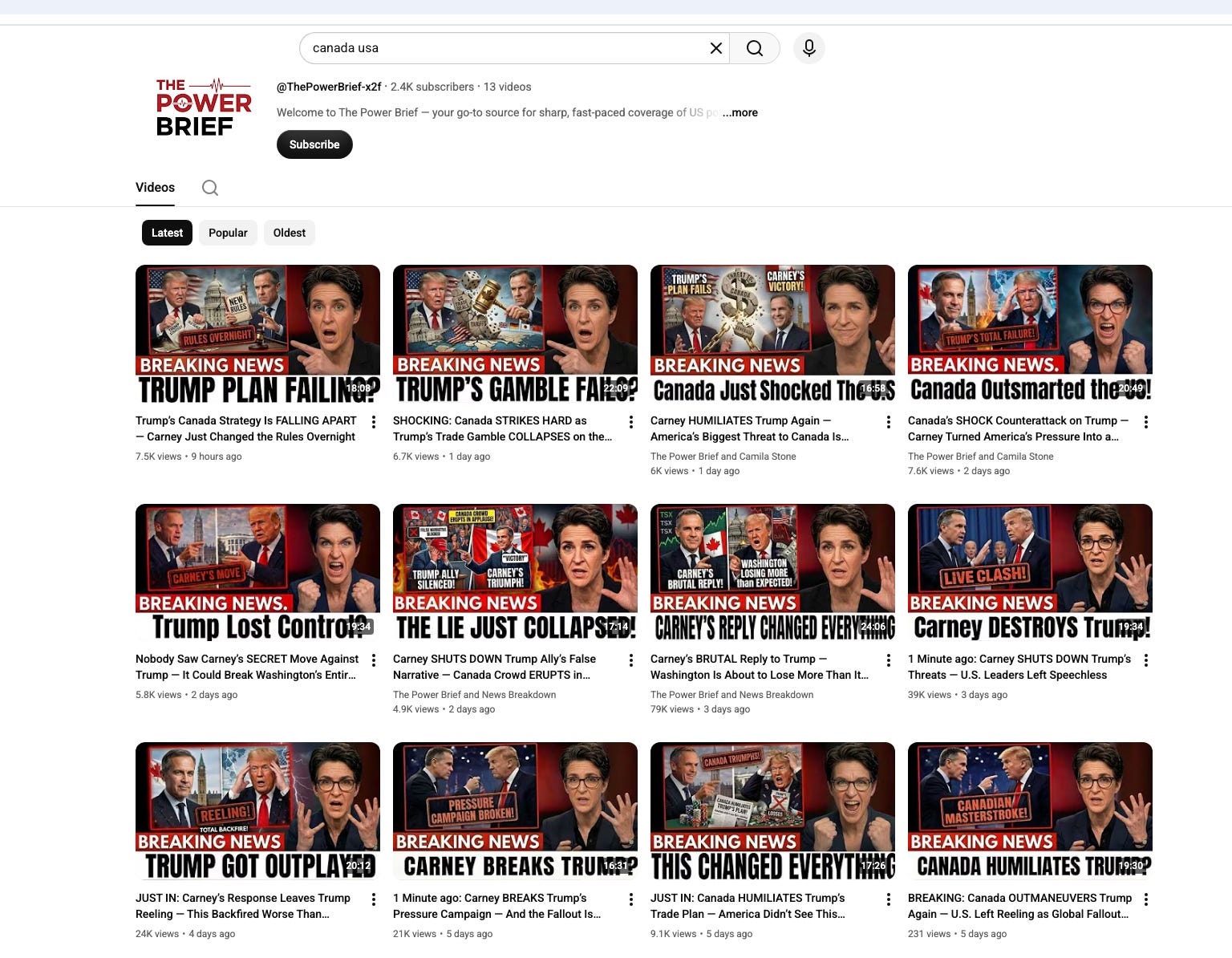
Take a look at a YouTube channel called “The Power Brief.” It has 2,400 subscribers — a relatively modest following in the crowded world of online commentary. But subscriber counts, it turns out, are almost beside the point. In the past week alone, videos from this channel have pulled in 39,000 views, 79,000 views, and 24,000 views. The titles scroll like a fever dream: “Carney DESTROYS Trump.” “Canada Just Shocked the U.S.” “Canada Outmastered the World.” “Nobody Saw Carney’s SECRET Move Against Trump.” Every thumbnail features someone with their mouth open in theatrical alarm. Every headline promises an event that, upon investigation, either didn’t happen or happened in a form so different from the description as to be unrecognizable.
What the view counts tell you is something important: the content is reaching audiences twenty to thirty times larger than the channel’s own following. That gap — between the number of people who subscribe and the number of people who watch — is the algorithm doing its work. YouTube’s recommendation engine surfaces content based on engagement signals, not credibility signals. A video that makes you feel something — alarm, outrage, the satisfying rush of a story where the good guys win — travels. A correction doesn’t.
The Power Brief is one channel. There are dozens operating the same way, running the same playbook, chasing the same audience with the same emotional vocabulary: BREAKING. EXPOSED. CHAOS. HUMILIATED. Each one slightly different. Each one plausible enough. All of them about Canada.
These videos are produced and uploaded so quickly that by the time one is flagged or removed, multiple variations of the same story are already circulating.
The Platform Where It Lives
To understand why this is working, you have to understand where it’s happening.
According to the Pew Research Center’s most recent survey of more than 5,000 American adults, 35% of U.S. adults now regularly get news from YouTube — making it, alongside Facebook, the dominant platform for news consumption in the country. In 2020, YouTube trailed Facebook significantly as a news source. By 2025, the two have reached rough parity. And YouTube’s reach across age groups is unmatched: 84% of all American adults use the platform at all, with nearly half visiting daily.
Think about what that means for a moment. More than one in three American adults is regularly getting something that functions as news from a platform that does not employ editors, does not require sourcing standards, and does not gate content before it spreads. It distributes first. Evaluates later. Removes inconsistently.
What YouTube does do, extremely well, is reward engagement. A video that makes you feel something — alarm, outrage, vindication — travels through recommendation queues and shared links. A sensational video about Canada “weaponizing” energy exports doesn’t need a single verifiable fact to rack up views. It just needs to hold your attention for long enough to count as a watch.
And these videos are very good at holding attention. They use the visual vocabulary of legitimate breaking news: lower-thirds, urgent music, confident narration, maps with animated arrows. They feel like news because they’ve reverse-engineered the aesthetic of news, without any of the inconvenient commitments to accuracy that news organizations nominally maintain.
Fact-checking website Snopes investigated one widely-shared clip claiming that Carney had physically walked out of a White House meeting after rejecting a formal written ultimatum about Canadian oil exports — a video that framed the episode as an instantaneous crisis that rattled global markets. Snopes found no credible reporting supporting the narrative, and could not confirm that the specific meeting or the ultimatum document described even existed. The video spread anyway. That’s not a bug in the system. That’s the system working as designed.
The Specific Lies, and the Real Story Behind Them
The videos cluster around a handful of recurring themes, each one grafted onto something real enough to provide cover for the invented parts.
Canada closing its airspace to the United States. In various forms, this claim circulates persistently. The reality is considerably more mundane: routine fee structures applied broadly to overflights, the kind of administrative friction that exists in almost every bilateral aviation relationship. Not a ban. Not a threat. Not remotely news.
Canada deliberately restricting steel, aluminum, and fertilizer to harm American consumers. Here there is a real story underneath — and it’s almost the opposite of what the videos claim. The United States initiated a sweeping tariff campaign against Canadian goods beginning in early 2025, imposing 25% tariffs on most Canadian imports and eventually increasing steel and aluminum tariffs to 50%. Canada, like any sovereign nation would, responded with retaliatory measures and began negotiating from a position of self-defence. Carney described the U.S. tariffs as “illogical” and “unjustified.” That is a government defending its economy from externally imposed duties. The videos flip the causation entirely, casting Canada as the aggressor in a conflict it was responding to.
Mark Carney issuing “ultimatums” and threatening to “expose” Trump. What Carney has actually said, publicly and consistently, is that Canada will negotiate with the U.S. once it is “shown respect” as a sovereign nation — a firm diplomatic posture, certainly, but a considerable distance from the confrontational dramatics the videos describe.
The relationship these videos portray as adversarial is one of the most integrated economic partnerships in human history. Total U.S.-Canada goods trade reached an estimated $719.5 billion in 2025. Canada is the top destination for American goods exports — not China, not the EU, Canada — and the second-largest U.S. trade partner overall when services are included. An estimated 1.4 million American jobs depend on Canadian exports. A single vehicle rolling off a North American assembly line may have crossed the border eight times as components during its production, with parts that are American, then Canadian, then American again before the car is complete. Canada supplies between 50 and 80 percent of U.S. requirements for essential minerals like zinc, tellurium, nickel, and vanadium. The two countries share an electricity grid, a natural gas network, defence infrastructure, and thirty-five years of deepening economic integration.
This is not the architecture of two countries plotting against each other. It is the architecture of two countries so fused they sometimes forget where one ends and the other begins.
Who’s Making These Videos, and Why
There isn’t a single bad actor here. There’s a system, and the system has several overlapping layers of incentive, all of them currently pointing at Canada.
At the base level, there are content mills: low-cost, high-volume channels producing AI-assisted geopolitical content the way other channels produce recipe videos or car reviews. Their goal is simple — views, watch time, revenue. Canada is a useful villain right now because the genuine trade dispute has generated enough real headlines to provide camouflage for invented ones. When a video says “Canada threatens U.S. energy supply” over footage of a power plant, it’s trading on the credibility of actual events while fabricating the specifics.
Above that, there are ideological amplifiers — creators and networks that have a genuine interest in framing democratic allies as adversaries, in reinforcing the narrative that America is surrounded by bad-faith partners. These channels don’t necessarily fabricate wholesale. They push interpretation in one direction, selectively, persistently.
And then there is the layer that Canadian intelligence agencies have been documenting for years. The Canadian Security Intelligence Service has reported clearly that countries including Russia and China engage in disinformation campaigns specifically designed to weaken alliances and increase distrust between democratic partners. They don’t always produce viral videos themselves. They seed narratives, amplify what’s already working, and ride existing distribution systems. You don’t need a single coordinated campaign when profit, ideology, and geopolitical interest all reward the same distortion simultaneously. What you get instead is something more durable: a convergence.
The Gap That Gets Filled
There’s a structural reason Canada is particularly vulnerable to this kind of manipulation, and it rarely gets discussed.
Americans receive almost no regular, credible coverage of Canada through their mainstream media. Canada occupies an awkward middle distance in the American imagination — not foreign enough to be covered with the sustained attention given to Europe or Asia, not domestic enough to appear in the daily news cycle. It is familiar enough to feel known and underreported enough to be genuinely misunderstood.
So when an American goes looking for information about Canada — or, more often, when an algorithm serves it to them uninvited — they land in unfiltered, engagement-optimized content environments where the loudest version of the story wins. The gap doesn’t stay empty. It gets filled by whoever is most incentivized to fill it, and right now, that’s channels like The Power Brief.
The Numbers That Should Worry Us
Here is where the story stops being abstract.
In October 2024, an Ipsos poll found that 87% of Americans viewed Canada favorably — the highest of any country tested. Canada was ranked, by Americans, as their strongest ally after the UK and their second-most important economic partner.
This past February, Gallup’s annual World Affairs poll found that American favorability toward Canada had dropped nine percentage points in a single year — from an average of 91% to 80%. That’s still a majority, still near the top of the list. But a nine-point drop in twelve months, for a country that had been the most consistently well-regarded nation in Gallup’s survey since 1989, is not a small thing. It is the largest single-year decline Gallup has measured for Canada.
Nine points doesn’t sound like much at a kitchen table. But in the context of a relationship that has been one of the most stable bilateral friendships in modern history, it represents something genuinely new: a measurable erosion in baseline goodwill, happening fast, with no obvious single cause.
Meanwhile, on the Canadian side, the shift has been more dramatic and more clearly tied to the trade dispute and the political rhetoric around it. A Pew Research Center survey from spring 2025 found that only 34% of Canadians now have a favorable opinion of the United States — a 20-point drop in a single year, and the lowest figure Pew has recorded since it began asking the question in 2002.
Two allies. Both watching the goodwill drain. And in the information environment one of them inhabits, a significant share of the explanation is videos telling a story that isn’t true.
Why This Matters More Than a Few Bad Videos
The immediate threat here isn’t political action. Most Americans still don’t support annexing Canada. Most Canadians would greet the suggestion with a mixture of dark humour and genuine alarm. The polling baseline, for all its recent movement, is still intact.
What’s happening is something quieter and harder to reverse: perception drift. The slow, cumulative shift from “trusted neighbour” to “uncertain actor” to, eventually, “potential problem.” It doesn’t happen because of one video. It happens through repetition, through familiarity, through the absence of competing narratives — and, crucially, through the moment someone shares a video with someone they trust, which is the moment a story locks in, because we are more likely to believe alarming things when they come from people we already believe.
The stakes are not theoretical. Canada supplies the United States with more crude oil than any other country. U.S. gasoline prices are meaningfully tied to Canadian energy infrastructure. More than three-quarters of Canada’s merchandise exports go to the U.S. — meaning Canada’s economic health is almost entirely bound to American decisions. Disruptions in either direction ripple through both economies in ways that are felt not by governments but by people: at the pump, on the job, in the cost of building a house.
That relationship depends, in part, on mutual understanding. Not perfect agreement. Not identical interests. But a baseline assumption that the country on the other side of the longest undefended border in the world is, fundamentally, a partner.
When that baseline erodes, the consequences don’t arrive all at once. They show up as harder negotiations, sharper rhetoric, less room for the kind of quiet cooperation that both countries have taken for granted for so long they’ve forgotten it requires maintenance.
The Kitchen Table Version
At the kitchen table, this whole thing sounds simple: Why are Americans suddenly saying this stuff about us?
Most aren’t. But enough are seeing versions of it — repeated, reinforced, emotionally packaged, algorithmically amplified — that it’s beginning to shape how Canada feels from the outside. The friend in Idaho who sent me that video isn’t a bad actor. He’s a reasonable person navigating an information environment that is anything but reasonable. He saw something that looked like news. He asked a good question. He was exactly the intended audience.
Canada hasn’t changed overnight. The border hasn’t moved. The integrated economy that employs millions on both sides hasn’t dissolved. But the information environment around Canada has shifted — faster, louder, more distorted, more persistent than anything that came before.
A channel with 2,400 subscribers is reaching 79,000 people with a story about Canada that never happened. And then those 79,000 people share it with someone they trust.
In a system where speed beats verification, emotion beats context, and repetition beats accuracy, the question was never really whether the videos are true.
It’s whether they’re believable long enough to matter.
They already are. And most people encountering them don’t know they’re part of a system.
Good conversation starts with good information. Between the Lines Canada exists because readers like you believe that matters. If you want to keep this kitchen table open — buy me a coffee, forward this to a friend, or just hit reply and tell me what you think. I read every message.
You might be interested in:
Social Cohesion, Public Media, and the Language We’re Losing

This essay is part of my Work, Home & Everyday Life category series, where I write about how politics and public language show up in daily Canadian life.
When Prudence Becomes Paralysis: Canada, Trade, and the Fear of Being Seen

As reactions swirl around Prime Minister Mark Carney’s Davos speech and Canada’s trade diversification efforts, a familiar warning has resurfaced: be careful not to provoke the United States. This essay takes a longer view. It examines how fear of reaction has too often replaced strategy, why dependence has not insulated Canadian workers, and what real …
How Language Is Being Used to Narrow Democratic Choice

A recent social media post reacting to polling on Chinese electric vehicles in Canada presents itself as plainspoken and decisive. This piece isn’t about agreeing or disagreeing with that policy position, but about how the message is constructed — how distrust of polls and media is established up front, how moral alignment is claimed, and how disagreeme…
This article is published on Substack for conversation and sharing. The canonical home for this work is Between-the-Lines (between-the-lines.ca).
I guess we should ask: who benefits? The autocratic powers that want the Western alliance to shatter? Content creators who want a lot of views? People who just like to stir the pot? Folllowers of the Donroe doctrine who want to stir up enough actual or pretended animosity to justify an invasion of Canada? All of the above? Yikes. YIKES!
It’s looking like we are going to need our own version of ‘Voice of America’ for Americans: our own Radio Liberty.
If the bad actors and propagandists can flood the space with shit, we will need to push back with our own firehoses (yes, many, many fire hoses) to give the American masses a continuous dose of the truth.
SubStack may feel like it is a safe harbour, but we will need to risk engaging with platforms like X/Twitter, Discord, Instagram, YouTube and TikTok. I keep imagining creating a Maple Leaf version of Mad Magazine and doing satirical stories to drive home the truth with a hearty laugh. Really subversive, like Blazing Saddles.
The CBC is not edgy enough to do the job it was created to do. As a radio bridge linking Canadians from coast to coast it was brilliant in its day. Now we need to expand it to help educate Canadians on all the laws and policies of our governments and how they apply to us. We will need a separate channel to pump the truth onto the airwaves and the social media platforms.
The best part is that reporting the truth is much easier to do than cooking up propaganda.
Nous nous souviendrons.
We are Canadian.