
AI’s Hidden Bill Is Coming Due
Behind the promise of progress lies a cost we haven’t counted

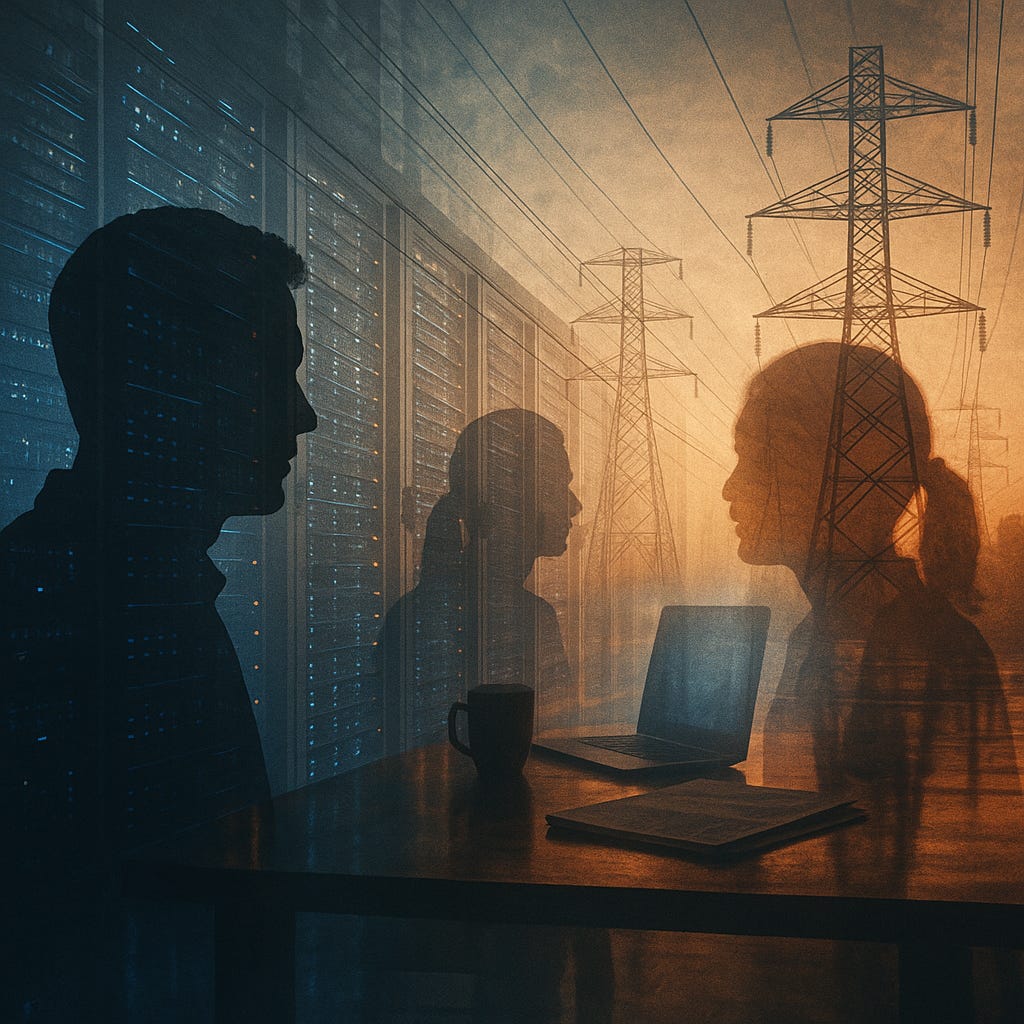
Artificial intelligence has been sold to us as efficiency incarnate — the silver thread running through every industry promising to make life faster, smarter, cleaner. But the more we weave it into our world, the more we’re discovering what that thread is really made of: enormous energy demand, vast data dependencies, and a growing social debt that few want to talk about.
AI doesn’t come from the cloud. It comes from somewhere — from water, minerals, power grids, and the quiet labour of people who make the digital world run.
For Canada, the question is no longer whether we’ll use AI, but how we’ll balance the unseen costs of adopting it with the values that built this country: stewardship, fairness, and a sense of the common good.
The Power Behind the Curtain
Training a large-scale AI model is one of the most energy-intensive processes ever created.
Analysts estimate that a single frontier-class model can consume as much electricity as 100,000 Canadian households in a year.
Data centres already account for nearly 3 percent of global power use, and that number is expected to double by the end of the decade. Every query we type, every image we generate, every chatbot conversation taps a physical grid — often powered by fossil fuels.
To meet demand, tech giants are signing multibillion-dollar contracts for future hydro and nuclear output. Some are buying entire wind farms outright. The line between data and energy security is blurring fast.
For Canada — a country rich in clean power but cautious about privatization — this presents both a temptation and a test. Do we rent out our renewable capacity to global AI firms chasing carbon-neutral branding, or do we reserve it to build our own sovereign computing base?
Water, Minerals, and Heat
Energy isn’t the only input.
Cooling a single hyperscale data centre can require millions of litres of water per day. Meanwhile, the chips that make AI possible depend on rare minerals mined under conditions that often contradict the ethics the technology claims to advance.
From Quebec’s rivers to Saskatchewan’s lithium fields, the resource map of the AI era is starting to look familiar: extraction at the edges, processing elsewhere, profits offshore.
If Canada wants to avoid repeating the pattern of shipping raw resources for others to refine, it must act early — establishing environmental and labour standards for every layer of its AI supply chain.
The Social Bill
Every revolution carries its winners and losers. AI’s promise of productivity hides a troubling paradox: as machines learn to replicate white-collar and creative tasks, displacement is creeping upward.
Economists estimate that up to 40 percent of current knowledge-sector jobs will be reshaped or replaced within the next decade. The result isn’t mass unemployment but a quieter erosion — contract work, downgraded benefits, vanishing middle-tier salaries.
When those transitions are unmanaged, inequality grows. The same technology touted as democratizing access can concentrate wealth faster than any tool before it.
And while private firms reap efficiency gains, governments inherit the fallout: retraining costs, income supports, the frayed fabric of community life.
Paying the Interest on Innovation
The global AI surge has been financed largely on credit — venture funds, stock valuations, and speculative expectations of near-term payoff. When capital moves at that scale, failure isn’t just a business risk; it’s systemic.
If those expectations fall short, the shock won’t stop at Silicon Valley. It will flow through pension funds, public markets, and the tax bases of nations like ours that depend on stable global demand.
That’s why digital sovereignty can’t be reduced to data policy alone. It’s economic risk management.
Canada needs transparent accounting of its exposure:
How much of our public pension investment is tied to speculative AI growth?
How dependent are our universities on foreign cloud credits?
What happens to our grid, and our currency, if the AI boom stumbles?
These aren’t hypothetical questions. They’re fiscal prudence dressed in new language.
Learning from 2008 — Before It’s Too Late
When the housing bubble burst, the world learned what happens when enthusiasm outpaces oversight. Financial products became so complex that even their creators couldn’t see the risk until the collapse came.
AI carries a similar danger. Its complexity cloaks its costs. Investors chase efficiency the way bankers once chased liquidity. And the models, like mortgages, are bundled into portfolios few regulators fully understand.
The difference is scale. If this bubble bursts, it won’t be houses left empty — it will be factories, classrooms, and healthcare systems dependent on software that suddenly costs too much to run.
Canada’s safeguard must be foresight: independent auditing of AI investments, public mapping of infrastructure ownership, and policy designed not just to foster innovation but to contain fallout.
A People-Centred Path Forward
The point isn’t to slow progress but to steer it.
Just as the environmental movement taught us to price pollution, we need to start pricing digital extraction — the energy, water, and data that fuel AI growth.
That means:
Carbon and water accounting for data centres.
Fair labour standards for annotation and content moderation work.
A public registry of AI projects that use taxpayer-funded research or infrastructure.
Transparency isn’t anti-business; it’s pro-trust. And trust is the only renewable energy democracy has ever run on.
Closing Reflection
Every generation faces its own version of the industrial revolution. The challenge isn’t the machinery; it’s the governance.
Canada can lead — not by racing to outspend or outscale others, but by building a model grounded in stewardship.
Our strength has always been moderation, collaboration, and a sense that prosperity means little if it can’t be sustained.
AI will shape the next century as surely as railroads and hydro shaped the last. But if we build wisely — if we count the true costs and keep people at the heart of the ledger — this new engine can power something enduring.
Progress isn’t free. But it can still be fair.
If you’ve been following this series, you know each chapter builds on the last — Canada’s bridge, the kitchen table, and now the hidden costs.
Paid subscribers can download the full “AI & Sovereignty” trilogy as a single, beautifully formatted PDF — all three essays together, with a short reflection guide at the end. The link’s waiting just below the paywall.
🗂️ Download the Full Series
☕ Closing Note
Thanks for reading — and for being part of this growing community of readers who care about how Canada moves forward in a changing world.
If this piece resonated, please share it with someone curious about where technology meets policy — it helps more than you might think.
You can also subscribe to get future essays straight to your inbox, or, if you’d like to fuel the next one, buy me a coffee.
Every share, note, and cup of coffee keeps Between the Lines independent and grounded around the kitchen table — right where good conversations start.
💬 If this gave you something to think about, tap the 💚 or drop a comment below.
"Transparency isn't anti-business; it's pro-trust. And trust is the only renewable energy democracy has ever run on."
This might be the most important sentence in the entire essay.
What we're witnessing with AI is a perfect storm -
Technology moving faster than regulation
Massive capital concentration
Decisions made in private by unelected actors
Impacts felt by everyone
Accountability deferred or absent entirely
When trust collapses, everything becomes more expensive. Transaction costs skyrocket. People opt out of systems. Political extremism fills the vacuum.
Your proposal for "a public registry of AI projects that use taxpayer-funded research or infrastructure" should be non-controversial, but it will be fought tooth and nail. Because transparency is only welcomed when you have nothing to hide.
Happy Tuesday Leni :)