
The Global Table | A Quiet Reckoning Chapter 10 #SundayRead
Where Canada Sits — and Why It Matters

Canada has never been absent from the world. But it has often mistaken presence for influence.
For much of the postwar era, Canada believed that showing up — to summits, to alliances, to peacekeeping missions — was enough. That goodwill, reputation, and reliability would naturally translate into leverage. For a time, it did.
But the world Canada learned to navigate in the late 20th century no longer exists.
In Chapter 9, Strategic Sovereignty, we explored what it means for Canada to function when assumptions fall away — when supply chains fracture, alliances strain, and autonomy becomes something that must be built, not presumed.
This week, we zoom out.
Because sovereignty doesn’t end at the border. It is tested — and expressed — at the global table.
The question is no longer whether Canada belongs there.
It’s whether we arrive prepared — with something to offer, something to protect, and a clear sense of who we are.
Author’s Note
This chapter is part of A Quiet Reckoning — a longform civic series tracing how Canada built capacity, allowed it to drift, and is now being forced to decide what kind of country it wants to be in a reordered world.
Chapter 10
The Global Table
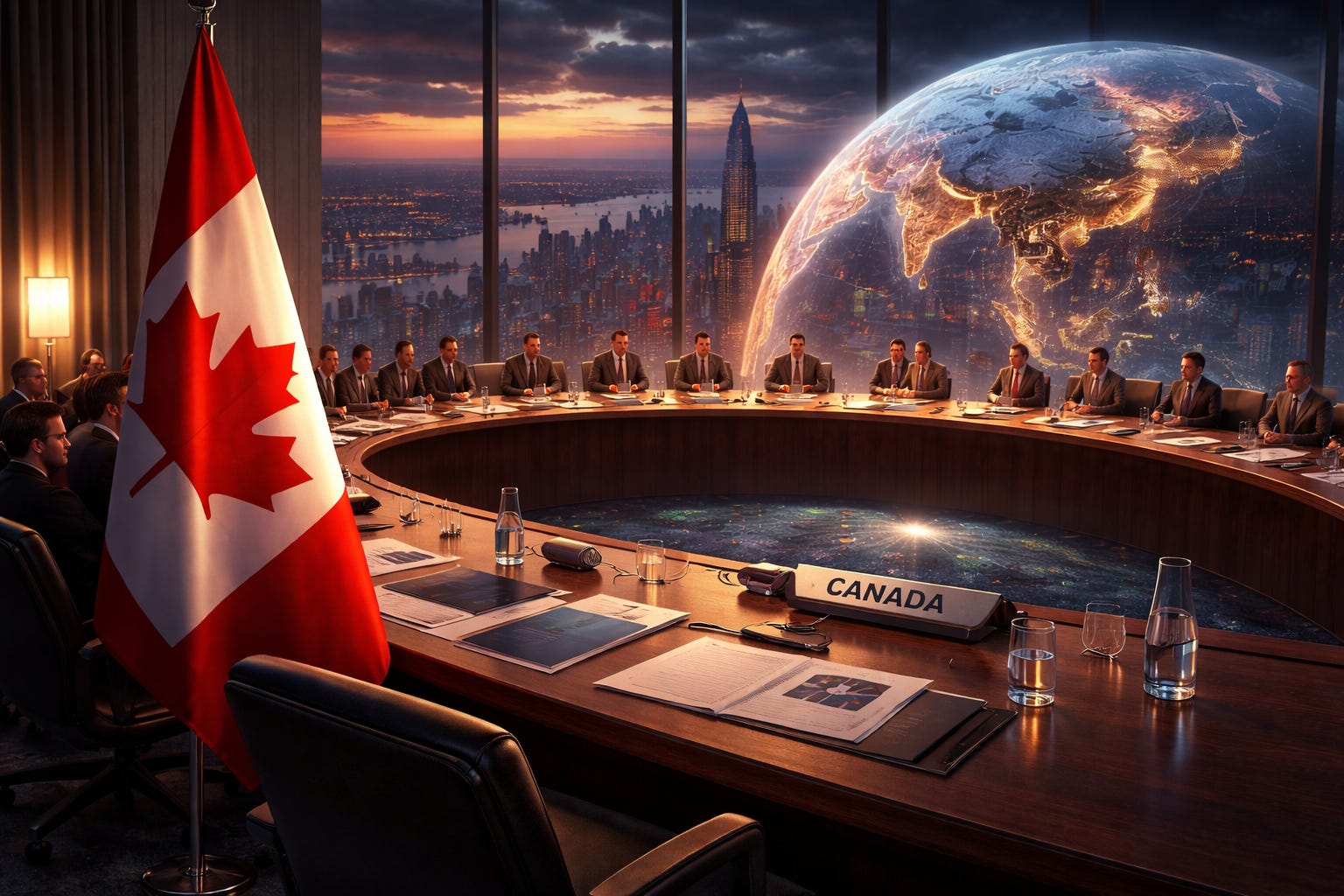
Where Canada Sits — and Why It Matters
Canada has long relied on a comforting story about itself: a middle power, principled and polite, trusted by allies and respected by adversaries. A country that doesn’t dominate, but convenes. Doesn’t threaten, but persuades.
That story isn’t wrong. But it’s no longer sufficient.
Power is shifting. Rules are fraying. Institutions that once anchored global cooperation — the UN, the WTO, even NATO — are under pressure from within and without. Conflict is no longer confined to battlefields. It moves through supply chains, data centres, energy grids, and migration routes.
In this environment, influence is not granted by reputation alone.
It is earned — through capacity, consistency, and credibility.
1. From Joiner to Stakeholder
For decades, Canada’s foreign posture was shaped by alignment. We joined alliances early. We supported multilateral institutions faithfully. We assumed that stability would be maintained through shared rules and shared restraint.
But the global order has shifted from rules-based to risk-based.
China is reshaping trade and infrastructure through strategic investment. Russia has converted its economy into a long-term war footing. The United States is increasingly inward-looking, transactional, and politically volatile. Europe is rearming. The Middle East remains combustible.
In this world, Canada is no longer just a participant.
It is a stakeholder — whether it chooses to act like one or not.
2. Influence Now Has a Price
There was a time when Canada’s contributions were primarily diplomatic: mediation, monitoring, peacekeeping, development aid. Today, those tools still matter — but they are no longer enough on their own.
Influence now demands capacity:
The ability to move goods and people quickly
The ability to secure digital systems
The ability to sustain commitments over time
The ability to absorb shocks without retreating inward
Countries that cannot deliver on these basics are increasingly sidelined — not out of hostility, but irrelevance.
Showing up is no longer the hard part.
Staying credible is.
3. Trade, Security, and the Cost of Exposure
Canada’s economy is deeply exposed to global turbulence. We are a trading nation by necessity, but not always by design. Supply chains that once seemed efficient now appear fragile. Dependencies that felt benign now look strategic.
The looming renegotiation of CUSMA, instability in global shipping routes, and growing competition for critical minerals all underline the same truth: economic policy is now security policy.
At the global table, Canada is judged not just by its values — but by its preparedness.
Can we guarantee supply?
Can we protect infrastructure?
Can we support partners under strain?
These questions increasingly determine whether Canada is listened to — or politely ignored.
4. Middle Powers in a Fractured World
Middle powers like Canada face a paradox. We are too small to dictate outcomes — but large enough that our choices still matter.
In a world of polarized blocs, middle powers can either become buffers — or bridges.
Bridges require work.
They require consistent presence, investment in diplomacy, and domestic alignment between what we promise abroad and what we can sustain at home. They require a willingness to lead quietly — not through dominance, but through reliability.
Canada’s strength has never been spectacle.
It has been steadiness.
5. Showing Up, Reimagined
To remain relevant at the global table, Canada must rethink what “showing up” means.
Not just speeches — but systems.
Not just commitments — but follow-through.
Not just values — but the infrastructure that allows those values to endure.
That means reinvesting in diplomacy. Treating digital security as foreign policy. Linking climate adaptation, migration, and trade into a coherent strategy. And understanding that global credibility begins at home.
A country that cannot house its people, move goods, or protect its data will struggle to persuade others — no matter how eloquent its case.
6. Why This Chapter Matters
The global table is not a metaphor. It is a place where decisions are made that shape food prices, energy access, migration flows, and security risks — often with or without us.
Canada does not need to be louder.
But it does need to be clearer.
Clear about what it can do.
Clear about what it will commit to.
Clear about where cooperation ends and sovereignty begins.
Because in a world that is no longer stable by default, the countries that endure are not those that wait to be invited — but those that arrive prepared.
Chapter Close
🧭 This is Chapter 10 of A Quiet Reckoning — examining where Canada sits in a reordered world, and why influence now depends as much on domestic capacity as diplomatic intent.
Next Sunday: Chapter 11 — What We Choose to Build
The decisions that will shape Canada’s next generation of resilience.
Start the series from the beginning → link to Series Page
💬 Share your thoughts in the comments — your insights help shape future chapters.
💚 Become a paid subscriber to support independent Canadian writing.
📘 Paid subscribers can download full PDF chapters from the Subscriber Resources Page.
☕ Buy me a coffee: https://buymeacoffee.com/lenispot
Quiet work takes time.
Reader support makes it possible.
— Leni 💚
Between the Lines is the canonical home for this work. All essays published on Substack are archived and maintained in full at between-the-lines.ca.
Your comment about how we need to be —not louder— but clearer, gives me a clue as to why Carney is so popular with Canadians. I think we sense, as citizens, the gist of what you are saying in this chapter: we need to be prepared, committed, with an understanding that the world has changed. Carney epitomizes that clarity and focus, that capacity to deal with change. I like to think that Canadians have the good sense to choose the kind of leader we require right now. Not perfect. Who could be? But determined and up to the task.
Good points on how the global order has tilted toward risk and capacity.
Influence does come with a bill now. Take NATO: the Parliamentary Budget Officer's October 2024 report figured annual defence spending would need to hit $81.9 billion by 2032-33 to reach the 2% of GDP target Canada committed to.
Our North, Strong and Free sets out the path there, with new investments ramping up capital spending to record levels this year. It's progress, but the timeline leaves room for doubt on speed.