


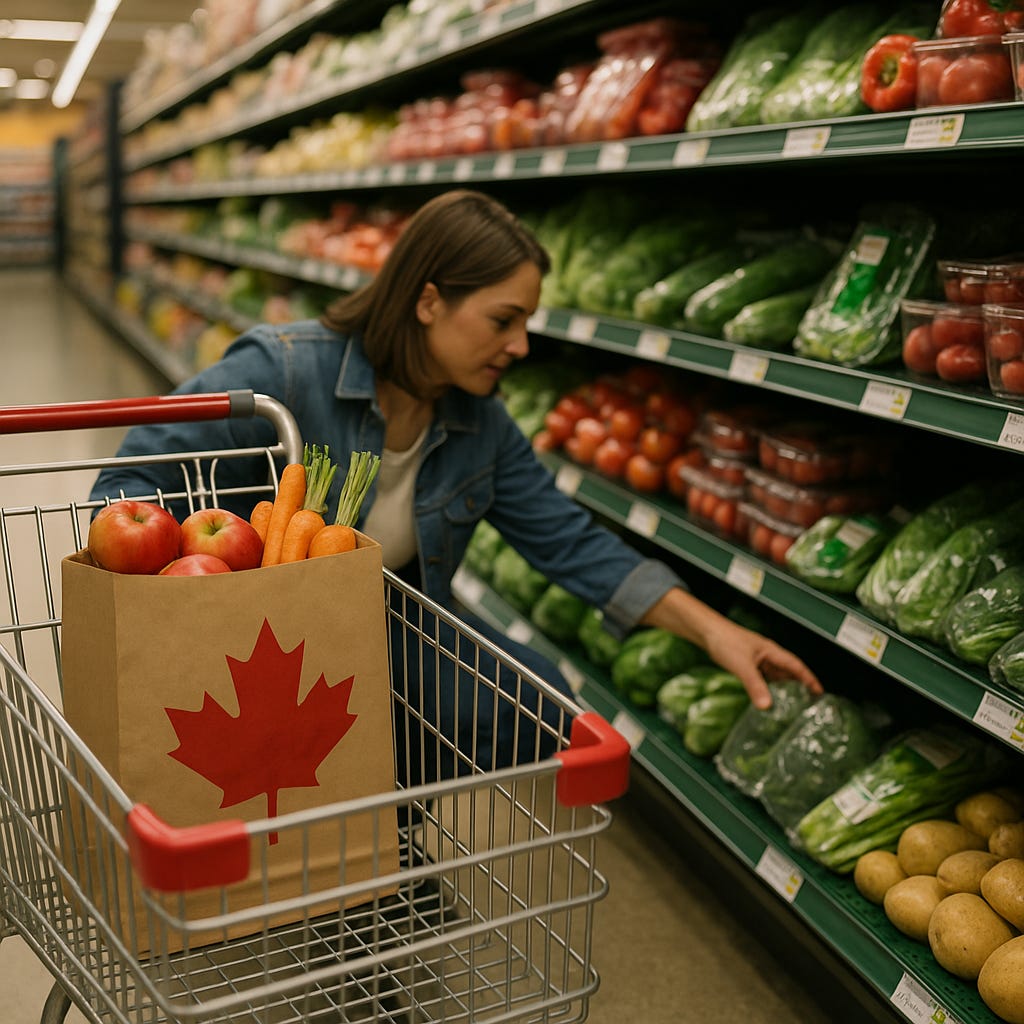
We proved it with #ElbowsUp. When tariffs and “51st State” rhetoric threatened to drown out Canadian producers, shoppers didn’t wait for a government program. They acted—one purchase at a time.
That moment wasn’t just a flash of national pride. It was a pressure campaign. And it worked.
It wasn’t immediately obvious, but big food retail took notice. Some grocers quietly pushed back—leaning into consumer fatigue, slapping “Canada” on packaging while hiding fine print on the back. Others made sure you had to walk past skids of American produce to reach Canadian-grown goods or products from fairer trading partners.
The fatigue is real. And justified.
So how about a little gamification to the rescue?
Now is the perfect time to raise the stakes in the grocery dollar wars—right when so many Canadians are quietly motivated to act together. It’s the moment to push back against the invisible hand that decides what shows up at eye level, and to double down on food sovereignty.
Because shelf space isn’t neutral. And neither is your cart.
Your shopping cart is your superpower. And when used collectively, it can tilt the whole system. The stars are aligning in a way that could genuinely benefit everyday Canadians.
👀 What’s Really Going On Up There (and Down Below)
Next time you walk into a grocery store, look at what’s sitting at eye level.
Chances are, those products paid to be there.
Shelf space—especially the middle rows and endcaps—isn’t just prime real estate. It’s sold space. Big brands buy it because they know that’s where you’re most likely to reach. It’s marketing baked into infrastructure.
And here’s what that means: the small-batch Canadian pickles, the co-op-made cereal, the organic oats from Saskatchewan—they’re often pushed to the bottom shelf, or left out entirely, simply because they can’t afford to pay for visibility.
What looks like choice is actually curation. And too often, what’s curated out is the Canadian and the affordable.
Every time you toss a premium-priced product into your cart, you’re helping pad the profit margins of big food retail. That’s fine—sometimes it’s worth it. But our job, as consumers, is to stretch our dollars further and ensure we’re getting more real choice for that money—not less.
🇨🇦 From Tariffs to Tactics: What #ElbowsUp Proved
#ElbowsUp wasn’t about nostalgia. It was about sovereignty.
In response to trade disruptions and the threat of foreign control over key food systems, Canadians chose to support their own: local farmers, independent processors, and small grocers. That shift didn’t go unnoticed. Grocers scrambled to reframe sourcing and rebrand loyalty programs. “Local” went from niche to necessary.
📈 Proof in the Patterns: What Canadians Are Already Doing
This isn’t speculation—it’s measurable.
At the CPMA trade show (April 2025), industry leaders reported that 69% of Canadians actively avoided U.S. produce during the tariff standoff.
Retailers like Loblaw, Metro, Sobeys, and Longo’s began highlighting Canadian-grown goods more prominently by February.
A Bank of Canada survey from April confirmed that more than half of consumers planned to prioritize domestic goods over U.S. imports.
And as of July, RBC analysts noted that this “Made-in-Canada” movement was driving down sales of American brands in key categories.
This isn’t a fringe trend. It’s a quiet groundswell. And grocers are absolutely paying attention.
We didn’t need to march or boycott. We just bought smarter. And that changed the conversation.
🧠 Grocers Are Watching (and Adapting)
Every scan of your loyalty card, every item in your basket—it’s all tracked.
Major chains use SKU-level analytics to see what sells, what repeats, and what gets ignored. That’s where the opportunity lies: by consistently choosing Canadian, asking for it, and celebrating it, we start to change what shows up on the shelf.
Some independents and co-ops already highlight local products with shelf tags or in-store flyers. Larger chains are slower—but they’re not immune. They just need enough data-driven nudges to care.
🧭 The Quiet Pressure Campaign: Five Small Acts That Matter
This isn’t about purity or perfection. It’s about patterns. About holding your grocery dollars like you would cards in a game of poker—or euchre or whist.
Here’s how to apply quiet pressure where it counts:
🧾 Start from the Bottom
Lower shelves often hide the real gems—local products, new brands, small-batch foods that couldn’t afford premium placement.🗣️ Ask for What’s Missing
Most chains have product request forms online. Use them. If your favourite Canadian salsa is missing, ask why.📸 Make It Seen
Snap a photo of a Canadian product you love and tag the retailer. Visibility signals demand.🔁 One-Swap Challenge
Swap one weekly staple—bread, pasta, jam—for a domestic or co-op-made version.🛍️ Split Your Cart
Start your grocery trip at a farmers’ market or small-format grocer. Even if you finish at a chain, you’ve already made a difference.
📊 Why Grocery Dollars Matter for GDP
Canada’s agri-food economy runs both ways. Every imported strawberry or bag of rice that could have been grown or packaged here represents a missed opportunity to build GDP.
Top food imports: fruit and veg (esp. off-season), coffee, sugar, processed snacks
Top food exports: wheat, canola, beef, pork, lentils, oats, frozen seafood
💡 Exports add to GDP. Imports subtract. So when we buy imported foods that we could have sourced from Canadian producers—or fair trading partners—we’re essentially cancelling out our own economic progress.
Even one small switch—local oats instead of foreign cereal—keeps more value circulating here. That’s not just feel-good shopping. That’s quiet nation-building.
📱 Want to put your cart where your values are?
From finding Canadian-grown produce to scouting budget-friendly bulk buys, five simple apps can make smarter grocery shopping easier—and even a little more fun.
👉 Download the “There’s an App for That” mini guide now
🌾 This Is Economic Citizenship
Every time you reach for a low-shelf Canadian-made product, you’re doing more than making a purchase—you’re making policy.
It’s not loud. It’s not flashy. But it’s real.
Grocers adapt to patterns. Governments read trade data. Producers survive—or don’t—based on shelf access. And shelf space shifts when we shift.
So let’s shift.
For Between the Lines subscribers I’ve started a list on how to grocery shop Canadian Style
The Canadian Staples List Is Here — Local, Seasonal & Budget-Friendly

The Canadian Staples List: Seasonal, Budget-Friendly & Local
💬 If this gave you something to think about, tap the 💚 or drop a comment below:
What’s one Canadian product you go out of your way to buy?
Have you ever picked something because it wasn’t at eye level?
Your grocery cart is a quiet vote. Cast it carefully.
Every loonie and toonie should work harder for your best interests—and Canada’s.
☕ Enjoying this kind of work?
If this gave you something to think about—or something to act on—consider buying me a coffee. It’s a small gesture that helps me keep Between the Lines thoughtful, ad-free, and reader-focused.
➤ Support with a coffee or become a paid subscriber here.
And if you know someone who’d enjoy it — pass it along.
Amazing tips. Thank you!
I personally always aim for lower shelves in the coffee aisle. There are some delicious Canadian gems hiding down there. ☕