
From Monroe to “Donroe”: Why Old U.S. Doctrines Matter Again — and What Canada Should Watch
The Monroe Doctrine Is Back. This Time, Canada Can’t Ignore It.

This piece was written in response to renewed U.S. discussion of the Monroe Doctrine, recent actions in Venezuela, and growing attention to the Arctic. It’s an explainer, not a prediction — meant to clarify what’s changing, and why Canada is right to pay attention without overreacting.
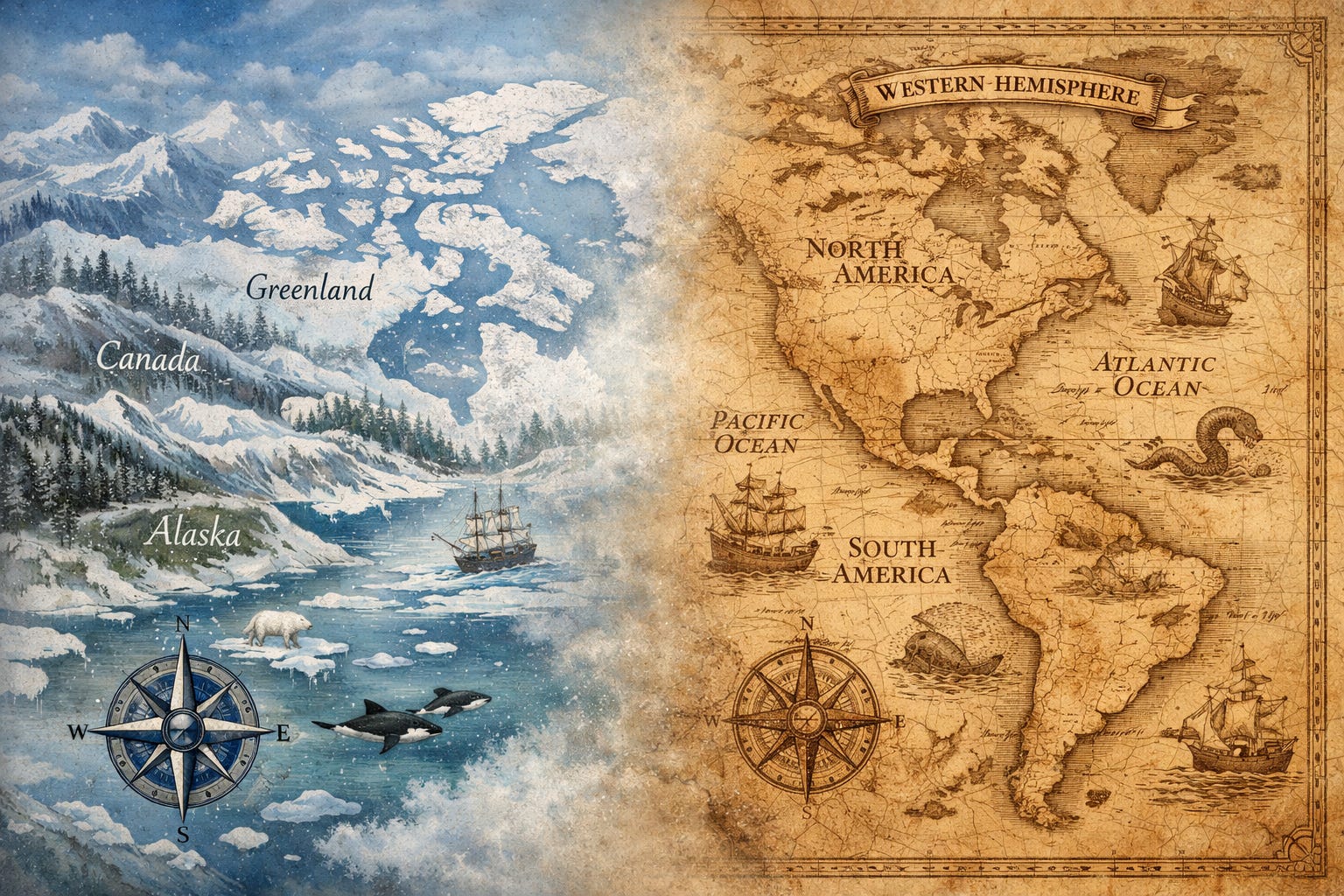
How the U.S. revival of hemispheric doctrine intersects with Arctic security, resource scarcity, and Canada’s reliance on international rules
Canada’s relationship with the United States has always been shaped less by sentiment than by proximity. A 9,000-kilometre land border means American policy shifts do not stay theoretical for long. Whether the change is diplomatic, economic, or security-driven, it presses directly on Canadian decision-making. That is not a criticism of the United States. It is a reminder that attentiveness — not complacency — has always been the price of stability.
Canada’s challenge is not sovereignty in principle, but readiness in practice. Compared to Alaska and Russia, Canada is significantly behind in Arctic defence infrastructure, year-round presence, and rapid response capacity. That gap is not lost on Washington. In a security framework increasingly driven by speed and resilience, absence reads as vulnerability — even when intentions are friendly.
The Arctic concern does not exist in isolation. It intersects with a broader set of material realities: water security, critical minerals, energy transition inputs, and agricultural resilience. From a U.S. national security perspective, Canada’s abundance increasingly mirrors American scarcity.
Potash is a clear example. Canada controls the majority of global supply, while alternative sources are either geopolitically fraught or logistically difficult for the United States to access at scale. In an era where food security is increasingly treated as national security, that asymmetry matters — not as a grievance, but as a planning reality.
When security planners begin to think this way — in terms of proximity, capability gaps, and access to essential resources — they tend to reach for familiar frameworks. In Washington, that framework has a long history. It has shaped U.S. thinking about the Western Hemisphere for two centuries, often quietly, sometimes forcefully. That history begins with the Monroe Doctrine — and it helps explain why the current administration is now openly invoking what it has begun calling a “Donroe Doctrine.”
What the Monroe Doctrine Was — and Wasn’t
The Monroe Doctrine dates back to 1823, when it was articulated by U.S. President James Monroe and largely shaped by his Secretary of State, John Quincy Adams. At its core, it was a warning to European powers: the Western Hemisphere was no longer open to new colonial claims, and interference from across the Atlantic would be treated as a hostile act.
What the doctrine was not is just as important. It was not a claim of U.S. ownership over the hemisphere. It was not a promise of military enforcement. In fact, the United States in the early nineteenth century lacked both the naval capacity and the global reach to impose such a rule on its own. The doctrine functioned more as a diplomatic signal — a statement of intent — than as an operational policy.
In its original form, the Monroe Doctrine was defensive, reactive, and limited. It assumed restraint on all sides and was framed as a stabilizing measure rather than a mandate for intervention.
How the Doctrine Quietly Evolved — and Traveled
Although the Monroe Doctrine was written as a hemispheric policy, its underlying logic was never confined to the Western Hemisphere. At its core was a simple claim: that the United States reserved the right to exclude rival powers from regions it deemed vital to its security. As American power expanded, that principle proved portable.
Over time, U.S. policymakers applied Monroe-style thinking well beyond the Americas — sometimes explicitly, more often without invoking the doctrine by name. Historians and strategists have occasionally described these extensions as “regional Monroe Doctrines” or “global Monroeism”: informal terms that capture how the principle of exclusion migrated geographically even as the language surrounding it changed.
One of the clearest examples came in 1980, when President Jimmy Carter declared that any attempt by an outside force to gain control of the Persian Gulf would be regarded as an assault on vital U.S. interests. Issued in the wake of the Soviet invasion of Afghanistan, the Carter Doctrine applied Monroe-style logic to the Middle East: a defined region, a named external rival, and an explicit warning that interference would trigger a response. In practical terms, it treated the Persian Gulf as a U.S. security perimeter — much as the Caribbean had been treated a century earlier.
Earlier still, similar thinking shaped U.S. policy in the Pacific. At the turn of the twentieth century, the “Open Door” approach toward China warned European powers against carving Asia into exclusive spheres of influence. While framed as a trade policy, it reflected a broader concern that rival empires not be allowed to dominate regions central to U.S. economic and strategic interests. After the Spanish–American War, American naval strategists argued that no other power should be permitted to establish bases that could threaten U.S. communication lines across the Pacific — a logic sometimes described at the time as a de facto “Pacific Monroe Doctrine.”
Even President Woodrow Wilson, often associated with internationalism, attempted not to discard the Monroe Doctrine but to universalize it. He argued that its underlying principle — opposition to domination by external powers — should apply globally, with the United States playing a central role in upholding that order. In this framing, Monroe ceased to be a regional warning and became a moral justification for intervention in the name of collective stability.
During the Cold War, Monroe-style reasoning became embedded in U.S. global strategy. The Truman and Eisenhower doctrines asserted a U.S. right to intervene wherever external pressure threatened regions deemed strategically vital. The language of hemispheres and doctrines faded, but the structure remained intact: identify a critical region, define an unacceptable external influence, and justify action as defensive rather than expansionary.
By the late twentieth century, the Monroe Doctrine no longer needed to be named to be effective. Its logic had been absorbed into planning assumptions, alliance structures, and security institutions. The doctrine survived not by remaining regional, but by becoming structural — an approach to power that could be applied wherever U.S. interests were judged to be at stake.
What Changes When It Is Named Again
For much of the twentieth century, Monroe-style logic functioned best when it was implicit. It lived inside alliances, planning assumptions, and quiet understandings about where rival powers should not tread. Its power came from ambiguity — from the fact that it did not need to be declared to be enforced.
That is why the decision to name it again matters.
When a doctrine that has long operated in the background is explicitly invoked, it signals a shift from habit to intention. Naming a doctrine narrows uncertainty. It tells allies, competitors, markets, and domestic audiences how future actions will be justified — and where the lines are being drawn.
In this sense, the emergence of what has been dubbed the “Donroe Doctrine” is not a departure from past U.S. behavior, but a clarification of it. The underlying logic — exclusion of rival powers from regions deemed vital — is familiar. What is new is the decision to re-anchor that logic openly to the Western Hemisphere at a moment of renewed great-power competition.
Explicit doctrines tend to do three things.
First, they compress decision-making time. When a framework is named, responses that once required lengthy justification can be presented as doctrinal consistency. What might previously have been debated as case-by-case policy becomes framed as adherence to an established rule.
Second, they reorder priorities. By defining a region as a strategic perimeter rather than a diplomatic space, doctrine elevates security considerations over political nuance. Economic ties, development partnerships, and multilateral processes become secondary to questions of access, alignment, and control.
Third, they signal durability. Doctrines are meant to outlast administrations. By giving a policy posture a name, leaders imply continuity — not just of action, but of worldview. That signal matters as much to allies trying to anticipate expectations as it does to rivals assessing resolve.
What distinguishes the current moment is not that the United States is asserting influence close to home — it has always done so — but that it is doing so openly, at a time when scarcity, speed, and strategic competition are reshaping security. The hemisphere is no longer treated primarily as a zone of assumed alignment, but as one that must be actively secured.
In that context, naming the doctrine is less about nostalgia than about consolidation. It reflects a judgment that the Western Hemisphere — long taken for granted — must now be managed with the same explicitness once reserved for the Persian Gulf or the Cold War frontiers of Europe and Asia.
And it is this consolidation — rather than the doctrine itself — that pulls attention north.
Why the Arctic and Resources Pull the Doctrine North
The renewed emphasis on hemispheric doctrine is not evenly distributed across geography. It is being pulled north by a convergence of factors that are difficult for U.S. security planners to ignore.
The Arctic has shifted from a peripheral concern to a central strategic theatre. Retreating ice has transformed the region from a natural barrier into an emerging corridor — for shipping, surveillance, undersea infrastructure, and military movement. Routes that were once seasonal or theoretical are becoming operational realities. From a security perspective, the Arctic is no longer remote. It is exposed.
In this context, comparison matters. Alaska hosts extensive U.S. radar, missile defense, and forward-operating capabilities. Russia has spent years investing in Arctic bases, airfields, icebreakers, and rapid-response forces. Canada, by contrast, has consistently asserted Arctic sovereignty — but has lagged in year-round presence, infrastructure, and readiness.
From a doctrine-driven security lens, absence is never neutral. It is read as vulnerability, even when intentions are aligned. This does not imply hostility toward Canada; it reflects how modern security planning works when speed and redundancy are prioritized.
The Arctic concern is inseparable from resource security. As climate, demographic pressure, and geopolitical competition reshape supply chains, resources once treated as commercial inputs are increasingly framed as strategic assets. Water availability, energy transition materials, critical minerals, and agricultural resilience are all being folded into national security calculations.
Potash illustrates this shift clearly. Canada controls the majority of global supply, while alternative sources are either geopolitically unstable, sanctioned, or logistically difficult for the United States to access at scale. In a world where food security is increasingly treated as a strategic concern rather than a market assumption, that asymmetry carries weight. It is not a grievance. It is a planning reality.
Taken together, Arctic access and resource dependence pull Monroe-style logic northward. They make Canada not just a neighbour, but a critical part of the strategic landscape — one whose readiness and capacity increasingly matter to others’ security calculations.
What This Means for Canada’s Choices
For Canada, the re-emergence of an explicitly named hemispheric doctrine does not signal inevitability or confrontation. But it does narrow the margin for complacency.
A shared land border of nearly 9,000 kilometres, deeply integrated supply chains, and long-standing security arrangements mean that shifts in U.S. posture are felt here quickly and directly. When American policy frameworks change, Canada is affected not because of intent, but because of proximity.
The central question for Canada is not whether cooperation will continue — it will — but whether that cooperation rests on assumption or preparedness. Underinvestment in Arctic infrastructure, uneven presence across the North, and slow modernization of surveillance and response capabilities leave gaps that others inevitably factor into their planning.
The same applies to resources. Abundance without strategy invites others to define it for you. Water, energy inputs, and agricultural fundamentals like potash require clear stewardship frameworks that treat them not only as export commodities, but as elements of long-term resilience — both domestic and allied.
Canada retains agency here. Doctrines do not dictate outcomes on their own. But they do shape the range of choices leaders believe are available, and the pace at which decisions are made. Investing in Arctic readiness, articulating resource strategy, and engaging the United States from a position of capacity rather than assumption expand that range.
Attentiveness has always been the price of stability for a country defined by proximity. In a moment when old doctrines are being named again — and scarcity is reshaping security thinking — that attentiveness becomes not a posture, but a necessity.
Steady Feet, Eyes Open
From the outside, Canada’s recent public messaging can look cautious. We keep coming back to international law. We talk about institutions. We reference process when others are talking about power.
That’s not because we’re unaware of how power works. It’s because we are.
When you live next door to a much larger country, you learn early that there’s a difference between what’s said loudly and what actually protects you. For Canada, rules and institutions aren’t window dressing. They’re the frame that keeps the house standing.
Right now, the United States is speaking more openly about acting from a position of strength — naming doctrines, drawing lines, and making it clear that when it decides something is vital, it expects others to adjust. That doesn’t mean Canada should rush to either cheer or condemn. Both reactions shrink our room to move.
So instead, we keep pointing to the rules.
That’s not naïve. It’s practical. We are counting on those norms to hold — not just in Venezuela or the Arctic, but when it comes to our own sovereignty. Our borders, our Arctic claims, our place in the world all rest more on shared expectations than on raw leverage. When rules start to feel optional for the powerful, it’s the rest of us who feel it first.
Which is why restraint has to be paired with watchfulness.
Canada can stand by institutions like NATO and still pay close attention to the signals coming out of Washington. We can talk about international law without pretending it enforces itself. And we can be clear-eyed about the fact that when powerful countries start speaking in terms of “vital interests,” smaller ones are often expected to adapt.
This moment doesn’t call for panic. But it does call for attention.
Old doctrines are being named again, and that’s rarely accidental. Canada’s response so far — steady, institutional, unspectacular — is the right one. Not because it’s comfortable, but because it keeps the ground under our feet firm while we watch what comes next.
Sometimes the most responsible thing a country can do is hold its line calmly, keep the lights on, and stay alert.
If this explainer was useful, you’re welcome to subscribe and stay with Between the Lines.
You can also buy me a coffee to support independent, long-form Canadian writing:
👉 https://buymeacoffee.com/lenispot
Comments and shares are always welcome — this is a conversation, not a broadcast.
Further Reading — from the BTL archives
• Drift Is Not Destiny
A reflection on Canada’s long habit of assuming stability in our politics and institutions. This essay pairs with the Monroe → Donroe piece by exploring how continuity begins to fray when assumptions are left unexamined — and what happens when attentiveness is overdue.
Interlude & Conclusion — Drift Is Not Destiny (A Quiet Reckoning)

In Chapter 11, What We Choose to Build, we reached a hinge point in this series — where decades of building, drift, and underinvestment converged into a single question about responsibility.
• Canada’s Arctic Access and the Choices That Will Shape Our Future (Part II)
An exploration of Canada’s position in the North — geographically, economically, and strategically. This piece gives deeper context to the Arctic dimension of hemispheric doctrine and the practical stakes behind presence, infrastructure, and readiness.
Why Canada’s Arctic Access Will Shape Our Future

Part II — Canada’s Arctic Access and the Choices That Will Shape Our Future
• Canada Can Feed Itself — Food Politics series
An exploration of the paradox at the heart of Canada’s food system: abundance at the national level alongside rising household food insecurity. This piece complements the current article by showing how sovereignty, systems design, and policy choices shape outcomes at the kitchen table.

Originally published on Between the Lines
Why the Monroe–Donroe distinction matters
The original Monroe Doctrine was largely declarative. It drew a line — warning outside powers to stay out of the Western Hemisphere — but for long stretches it operated quietly, shaping expectations more than driving day-to-day action.
What’s now being called the “Donroe Doctrine” is different. It takes the same sphere-of-influence logic and makes it explicit, operational, and enforcement-minded. It’s framed inside national security rather than diplomacy, and we’re seeing it applied openly in current U.S. actions and rhetoric around Venezuela, Greenland, and parts of Latin America.
That shift — from an implicit background doctrine to a named, active posture — is what matters. Old doctrines spoken aloud tend to do more work than those left unspoken. For Canada, living next door, that change is worth watching closely.
The argument that "absence reads as vulnerability" in the Arctic is supported by the federal supply records. The Parliamentary Budget Officer recently estimated that our new Polar Icebreakers likely won't be operational until the early 2030s. When you combine that with the recurring lapsed spending on northern infrastructure in the Public Accounts, it is clear why Washington is getting nervous. They are looking at a ten-year gap in our physical capacity to actually enforce sovereignty.