

The Conservative claim that “Canadians voted for a minority Parliament” is not a civics error. It is a deliberate strategy to brand a legitimate government illegitimate before it can govern. And it is going to work — unless we name it for what it is.
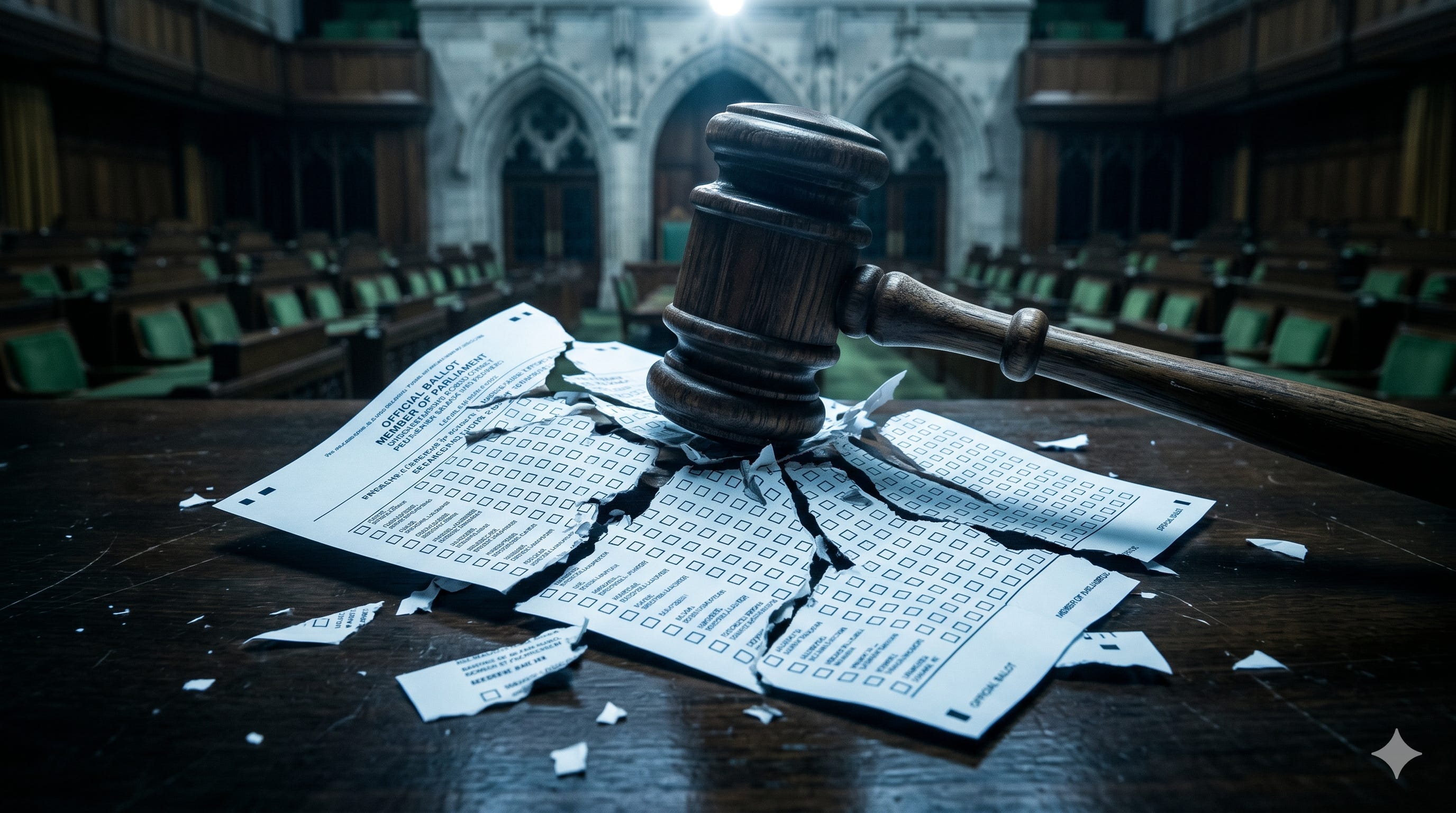
They Know It Is Not True. They Are Saying It Anyway.
On CTV’s Question Period, Conservative MP Shuvaloy Majumdar looked into the camera and stated that “Canadians voted for a minority Parliament.” Pierre Poilievre has said the same thing, in variations, more times than is worth counting. Their caucus has amplified it. Friendly panels have repeated it. Podcasts have treated it as the established backdrop against which all Liberal actions must now be judged.
It is a lie. Not a simplification, not a framing difference, not a matter of interpretation. A lie, built on a fundamental misrepresentation of how Canadian elections work, deployed deliberately to delegitimize a government that came to power through mechanisms that are not just legal but historically routine.
A note on that word. This publication uses it deliberately, and here is why.
“Misrepresentation” and “framing” are accurate but insufficient. They describe errors. What is happening here is not an error. The people making this argument are not confused about how Canadian elections work. They are parliamentarians. They have staff. They have access to the same constitutional texts, the same procedural history, and the same House of Commons records that anyone can read. Pierre Poilievre has sat in the House of Commons since 2004. He knows what a confidence vote is. He knows what floor crossing is. He knows what a by-election is. He knows that none of these things are “backroom deals.”
The claim is being made knowingly, strategically, and repeatedly, in the service of a specific political objective. Canada is facing genuine external pressure — a volatile trade relationship with the United States, a renegotiated economic relationship that is not yet settled, and a domestic political environment that is already strained. Choosing this moment to deliberately manufacture a legitimacy crisis around a functioning government is not just bad politics. It is a form of democratic vandalism. That is what the word “lie” is meant to convey, and this publication will not use softer language to describe it.
The Foundational Falsehood
Start with the basic civics, because the opposition is counting on voters not knowing it.
Canada does not hold a national vote for a government. There is no ballot on which citizens choose a prime minister, select a party mix, or indicate a preference for minority versus majority outcomes. What actually happens on election day is 343 separate contests, one in each riding, each governed by first-past-the-post rules, each returning a single local representative to the House of Commons. The national seat count that emerges is the mathematical byproduct of those individual races. It is not a collective instruction. It is arithmetic.
When a voter in Kitchener-Waterloo marks a ballot for a Conservative candidate, they are not signalling a preference for a minority Parliament. They are trying to get their candidate elected. The same is true of every Liberal, NDP, Bloc, and Green voter in every other riding. Nobody coordinates. Nobody calibrates their local vote against a national seat target. The idea that 18 million Canadians collectively decided they wanted a minority government is not just wrong. It is incoherent. It describes something that could not physically have happened.
To say “Canadians voted for a minority” is to describe an intention that no voter expressed and no ballot could capture. It is fiction dressed as fact.
When the Liberals won 169 seats in April 2025, they did not receive a nation-wide message to stay modest. They received a Parliament that began with that distribution. What happened next — floor crossings, by-elections, a shift to 174 seats — was not an override of that result. It was the result continuing to evolve, as Westminster results always have and always do. The constitutional test of a government’s right to govern is not the seat count on election night. It is whether the government commands the confidence of the House. The Carney government does. Full stop.
The Mechanisms Being Smeared
The Conservative argument does not stop at misrepresenting the election result. It goes further, characterizing the mechanisms by which Parliament changed as corrupt: “backroom deals,” “conniving games,” politicians who “betrayed the people who voted for them.”
Let us be precise about what actually happened.
Five opposition MPs — four Conservatives, one NDP — made the independent decision to join the Liberal caucus. They are constitutionally permitted to do this. In Westminster parliamentary systems, seats belong to members and their constituents, not to party headquarters. MPs are not branded cattle. They are elected representatives who retain the individual judgment to determine where their confidence lies. This is not a loophole or a workaround. It is a foundational feature of how the system is designed.
Then, on April 13, 2026, three by-elections were held. Voters went to the polls. The Liberals won all three, with increased margins, in contests held after the floor crossing controversy had already become national news. Voters in University-Rosedale and Scarborough Southwest knew exactly what had happened. They were offered a direct, recent, fully informed opportunity to register their disapproval and signal that they wanted to restore a minority Parliament. They did not take it. They returned Liberals with stronger support than before.
If the “minority mandate” were a genuinely felt public sentiment rather than a talking point repeated on cable panels, those voters would have sent the opposite message. They did not. The only Canadians who have gone back to the polls since the Spring Shift have, in practice, endorsed the new parliamentary math. That is not a talking point. That is a verdict. It deserves to be treated as one.
The by-election results are the most important evidence in this entire debate. They are also the evidence the opposition would most like you to forget.
Pierre Poilievre has called all of this a “cynical power grab” and demanded that floor-crossers face their constituents. What he has not mentioned is his own voting record. In 2012, Parliament debated Bill C-306, an NDP private member’s bill that would have required MPs who changed parties to vacate their seats and face a by-election. Poilievre voted against it. So did his Conservative colleagues. The argument they made at the time was that mandatory by-elections would give party leaders excessive power over their MPs — that seats belong to elected members, not to parties.
That principle was correct in 2012. It remains correct in 2026. The difference is that in 2012 it served Conservative interests to protect it, and in 2026 it does not. What Poilievre is doing is taking mechanisms the system explicitly permits, that he himself voted to preserve, and rebranding them as corruption the moment they produce an outcome he dislikes. That is not a principled democratic argument. It is opportunism wearing democratic language as a disguise.
How the Lie Spreads: The Science Is Not Flattering
There is a reason Poilievre keeps saying it. There is a reason his caucus keeps saying it. There is a reason it is now the unexamined backdrop of panel conversation after panel conversation about this government’s legitimacy.
Psychologists call it the Illusory Truth Effect. The phenomenon was first documented in research at Villanova and Temple universities in 1977 and has since been replicated in more than 80 published studies. The finding is consistent and alarming: repeated exposure to a statement increases the likelihood that people will judge it to be true, even when the statement is false, and even when they already know it is false.
This is not about low-information voters or credulous audiences. Studies have found that prior knowledge does not protect against the effect. Neither does analytical thinking style, intelligence, or awareness of the phenomenon itself. When a false claim is repeated often enough, the brain’s processing fluency — the ease with which it recognizes a familiar statement — begins to register as a signal of truth. Familiarity feels like fact. One study found the effect persisting even when participants were explicitly warned in advance that some statements they would hear were false.
This matters because it explains something that can otherwise feel baffling: why an argument this logically weak is proving so durable. Poilievre does not need Canadians to believe the claim is true in any considered sense. He needs them to feel, when they encounter it, that it is probably true. The cable panels that repeat the phrase without interrogating it — on Power & Politics, on Power Play, across the podcast landscape — are doing the opposition’s organizing work for free, regardless of intent.
Repetition is the strategy. The media ecosystem is the delivery mechanism. Canadians’ own cognitive habits are the vulnerability being exploited.
It also explains something observed in response to an earlier version of these arguments: that Canadians are deeply focused on parties as the organizing units of political life, while paying far less attention to how the constitutional machinery beneath those parties actually functions. When most of what people know about Parliament comes filtered through the lens of party competition, the false claim that Canadians “chose a minority” slots easily into a mental model that treats elections as contests between party brands rather than the aggregation of 343 individual constituency races. The misunderstanding is structural. The opposition is exploiting it.
What This Will Cost the Country
This matters beyond the partisan score. A government that holds the confidence of the House of Commons has the right to govern. That is the constitutional test, and the Carney government is currently meeting it.
But a government that is meeting the constitutional test while failing the narrative test governs under a permanent shadow. Every piece of legislation gets filtered through the question: do they even have the right to do this? Every committee expansion, every budget, every trade negotiation outcome arrives pre-loaded with the implication of illegitimacy. The Conservatives do not need to win a policy argument. They have already won if enough Canadians feel vaguely uneasy about whether the government’s mandate is real.
That unease does not dissipate. It compounds. It will make governing harder. It will make it easier for the opposition to obstruct without accountability, because obstruction of an “illegitimate” government can be framed as principled resistance rather than partisanship. It will make the 2029 election harder to fight on the merits of what the government actually accomplished, because the frame through which those accomplishments will be judged was set before the government had governed a single day under its new majority.
What we are likely watching is the construction of the interpretive frame that will define this government through to 2029. Not “the Liberals govern well or poorly.” Not “Carney’s trade negotiations succeed or fail.” But: “the Liberals are in power because they cheated, and everything they do with that power is therefore suspect.” That frame, once embedded, is almost impossible to dislodge. The Illusory Truth Effect research is explicit on this point: corrections do not undo repetition. The damage accumulates faster than the fact-checking.
This is also not occurring in a vacuum. Canadians watching the United States should recognize the playbook. The deliberate delegitimization of electoral and parliamentary outcomes, the repeated assertion of fraud or manipulation where none exists, the framing of routine institutional processes as sinister conspiracies — these are not tactics that were invented in Canada. They have been imported. And Canadians have seen, in real time, what happens to a democracy where a significant portion of the population has been successfully convinced that the government it lives under has no legitimate claim to power.
What This Tells Us About the Opposition
There is a legitimate version of opposition that the Conservative Party could be running right now. They could be scrutinizing Canada-U.S. trade negotiations with rigour. They could be holding the government to account on affordability, housing, defence spending, the dozens of policy files where a competent opposition asks hard questions and demands real answers. That is what a government-in-waiting does. That is how a party demonstrates that it is ready to govern.
That is not what is happening.
What is happening instead is a sustained attempt to convince Canadians that their own parliamentary system is being used against them — that the rules everyone agreed to somehow do not apply when they produce an outcome the Conservatives dislike. The message, stripped of its careful language, is: the system is rigged, your vote was stolen, and the only remedy is an election the Conservatives believe they can win.
Here is what that message carefully omits: no party is currently in a position to benefit from an election, and the Conservatives know it. The Carney government has an open trade file with the United States — CUSMA renegotiations that would grind to a halt the moment a writ is dropped, costing Canada leverage at the worst possible time. The NDP, under new leader Avi Lewis, is in the early stages of rebuilding from its worst federal election result in decades. The party carries roughly $13 million in debt, has just six MPs, and its new leader does not yet hold a seat in the House. An election campaign fought tomorrow would be an organizational and financial catastrophe for them. And the Conservatives themselves, despite 8.3 million votes in 2025, do not have the geographic distribution of support needed to translate that vote share into a governing majority. Their strength is concentrated; the seats they need are not.
The parliamentary record makes the Conservative position even harder to take seriously. When the Carney government’s first budget — a confidence matter — came to a vote in November 2025, Conservative House leader Andrew Scheer and caucus chair Scott Reid conspicuously delayed their votes until all their colleagues had finished, appearing on video footage to be waiting behind the curtains of the chamber while the outcome remained uncertain. Conservative MP Matt Jeneroux did not vote at all. The budget passed 170 to 168. A party genuinely committed to triggering an election on a matter of confidence does not lurk behind curtains hedging its bets. It votes.
The call for an election is not a democratic demand. It is a pressure tactic deployed by a party that is not ready to fight one — and knows it.
This is corrosive. Not just to the Liberals, but to the institutions themselves. When floor crossings are called betrayal, MPs lose the independent judgment the system requires them to have. When by-elections are dismissed as insufficient expressions of voter will, the system’s safety valves are delegitimized. When a majority assembled through legal, public, historically routine mechanisms is branded fake, the concept of a legitimate majority begins to lose meaning altogether.
A party that cannot accept the results produced by its own rules, and reaches instead for the language of stolen elections and democratic fraud, is telling you something important about how it would exercise power if it ever actually had it.
That should concern Canadians regardless of their partisan preferences. The Conservative Party is positioning itself as the defender of democratic will while systematically undermining the democratic institutions through which that will is expressed. Those two things cannot both be true. One of them is a performance. Canadians should decide which one.
The Closing Argument
Parliament is not a photograph taken on election night. It is a living institution, designed to evolve as MPs exercise their judgment, as constituents speak in by-elections, as confidence is tested and affirmed and withdrawn. The current majority was not built in a backroom. It was built in full public view, step by step, through mechanisms that have governed Canadian parliamentary life for generations, and that the Conservative Party itself voted to protect as recently as 2012.
You are allowed to prefer a different outcome. You are allowed to believe that floor crossing should be regulated differently, that minority governments force better collaboration, that this particular majority concentrates power uncomfortably. Those are real debates worth having openly, and this publication will engage them.
What you should not accept — what the evidence does not support and what the system does not endorse — is the claim that this government’s existence is a fraud perpetrated on the Canadian public. That claim is false. It is being made by people who know it is false. It is being repeated because repetition, not truth, is how it does its damage. And it is being deployed at a moment of genuine national vulnerability, when Canada can least afford to have its governing institutions undermined from within by the people who want to inherit them.
The next time someone states that Canadians voted for a minority Parliament, ask them the question that dismantles the whole argument:
Which riding, exactly, cast a ballot for it?
There is no answer. There cannot be one. The ballot does not exist. And that, in the end, is the only thing you need to know.
If this piece made you think differently about something, that’s exactly why I write it. Between the Lines is reader-supported — no ads, no sponsors, no axe to grind. If you’d like to keep this going, you can buy me a coffee or share this with one person who’d find it useful. Both mean a lot.
If this clicked, so will these…
How Language Is Being Used to Narrow Democratic Choice

A recent social media post reacting to polling on Chinese electric vehicles in Canada presents itself as plainspoken and decisive. This piece isn’t about agreeing or disagreeing with that policy position, but about how the message is constructed — how distrust of polls and media is established up front, how moral alignment is claimed, and how disagreeme…
The Videos That Are Turning Canada Into America’s Villain

What shows up in the feed isn’t always what’s happening on the ground.
Marilyn Gladu Crosses the Floor — And Redraws the Boundaries of Power

A single vote can stabilize a government.
This article is published on Substack for conversation and sharing. The canonical home for this work is Between-the-Lines Canada (between-the-lines.ca).
“The cable panels that repeat the phrase without interrogating it — on Power & Politics, on Power Play, across the podcast landscape — are doing the opposition’s organizing work for free, regardless of intent.”
That’s what drives me nuts! The lack of critical questioning among most journalists. If they did the job of interrogating, viewers might be better educated. David Cochrane is the exception.
Great teaching piece Lori. Thanks.
Truth. I voted for the adult in the room not the organ grinder’s monkey. However, I am quite happy the Conservatives continue to support him as this helps to keep the far right monsters they invited into their organization far from the levers of power.