


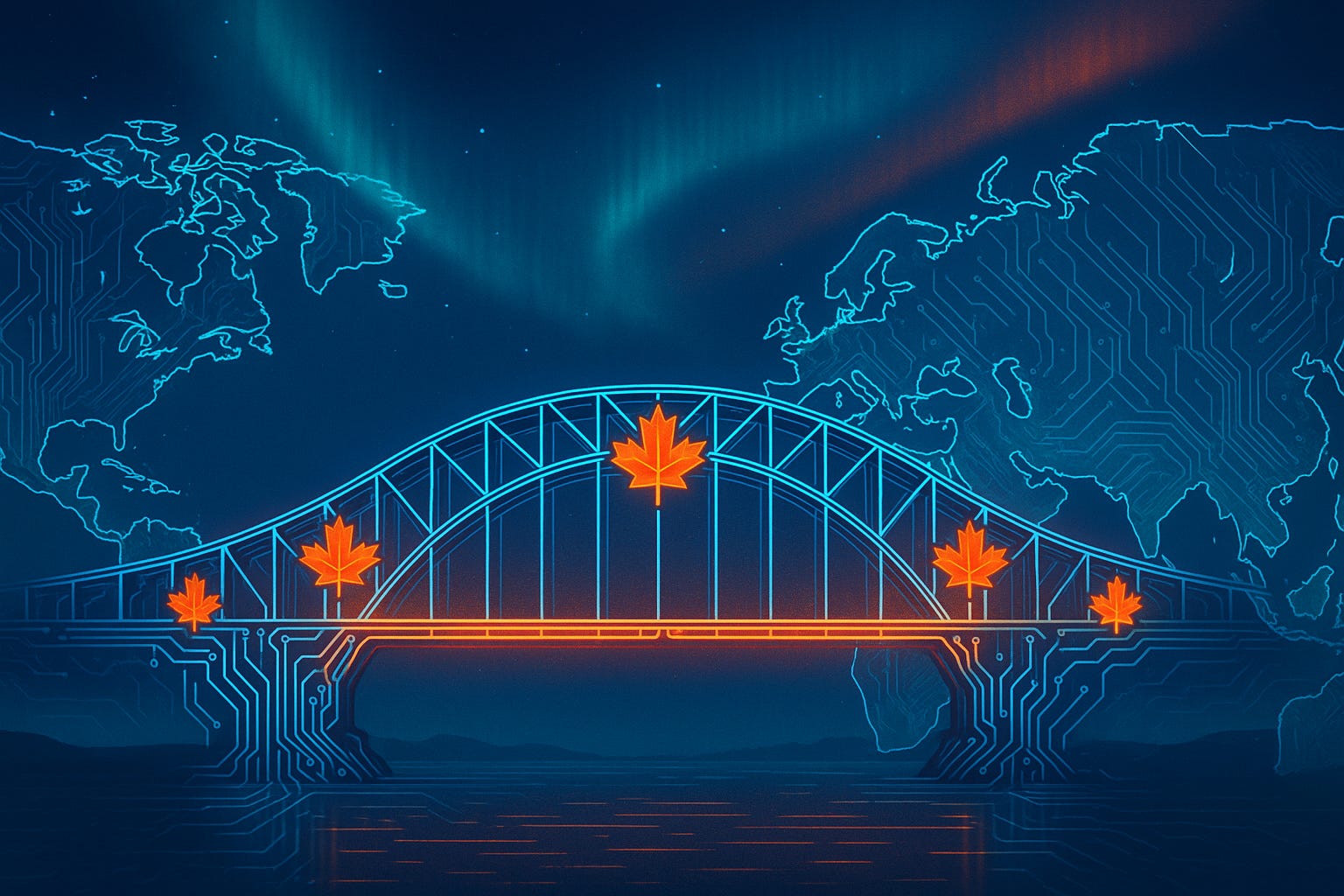
Like most people, I’ve been watching the new frontier rise on the horizon — part fascination, part unease.
Artificial intelligence isn’t a gadget or a passing trend; it’s a shift in how the world works. And the tide is rolling in fast.
AI is quietly weaving itself into our homes, workplaces, and institutions — from classrooms to hospitals to small-town council offices. Yet what’s still missing is a firm federal framework for how this technology will shape Canada’s future — especially when it comes to sovereignty and security.
The truth is, AI isn’t fully tamed yet. It’s learning in real time — absorbing everything from our essays to our emails — while governments scramble to catch up. What began as a research tool has already slipped into classrooms, clinics, and council chambers, reshaping routines before we’ve agreed on any rules.
Why This Isn’t Just About Tech
AI might sound like a technical debate, but underneath, it’s about power and self-determination.
When a country depends entirely on foreign platforms — whether for banking, communication, or data storage — it risks losing more than privacy. It loses leverage. Decisions made in Washington, San Francisco, or Shenzhen ripple into how Canadians live, work, and trade.
We’ve been here before. For generations, Canada exported raw materials while others refined them. We shipped logs instead of furniture, oil instead of finished goods.
Now we risk doing the same with our data — sending raw information abroad for others to process, profit from, and control.
That’s the essence of digital sovereignty: making sure the systems that run our lives answer to our laws, not someone else’s.
The Fine Print of “Sovereign AI”
Many global companies now promise “Canadian-based” data storage — an AI cloud built within our borders. It sounds reassuring.
But privacy experts warn that location isn’t the same as control. Even if the servers sit in Calgary or Montréal, the companies running them still answer to foreign laws — like the U.S. CLOUD Act, which allows American agencies to demand access to data held by U.S. firms anywhere in the world.
And trade agreements such as CUSMA (the successor to NAFTA) make it difficult for Canada to require full “data localization” or to enforce stricter privacy rules. We may be hosting the data, but not necessarily holding the keys.
It’s a subtle but crucial point: cloud location ≠ sovereignty.
True sovereignty means having the legal, technical, and moral authority to decide how data is stored, shared, and used.
If you value independent Canadian writing that connects technology, economy, and civic life, consider supporting Between the Lines.
→ Subscribe now and get 20 % off until November 1st on annual subscriptions.
☕ Buy Me a Coffee — every cup helps keep Canada’s kitchen-table conversations alive.
The High Stakes of the AI Boom
Around the world, AI development has become an investment race measured not in millions but trillions. Analysts estimate over US $5 trillion in infrastructure spending by the end of the decade — an arms race of data centres, chips, and cloud systems that now underpins much of the global stock market.
A single tech giant’s pledge now rivals a small nation’s GDP.
Alibaba is investing US $50 billion in cloud and AI capacity over the next three years. American firms are pouring billions into proprietary models. Europe is subsidizing open-source alternatives.
The risk, as history reminds us, is that financial exuberance can outpace real productivity.
If the expected gains don’t materialize, it won’t just be investors who feel the pinch — it will be taxpayers, workers, and public services built on fragile assumptions of endless growth.
Canada’s opportunity — and obligation — is to build resilience before the bubble bursts.
Building Our Own Bridge
That’s what Ottawa’s AI Strategy Task Force is meant to tackle: how to make AI work for Canada, not just in Canada.
The consultations now underway will shape how we manage governance, commercialization, and infrastructure. Experts and civil-society groups have been clear:
Update privacy law with real teeth.
Invest in public-interest infrastructure — national cloud systems governed by Canadian law.
Create citizen-led oversight so decisions aren’t left to lobbyists and insiders.
In short: build the bridge, don’t lease it.
Canada doesn’t need the biggest bridge, just one that’s ours — sturdy, transparent, and open to partners who respect the rules. Otherwise, we’ll spend the next generation paying digital tolls to cross someone else’s.
Lessons From Past Crises
Canada’s strength has never been brute force — it’s reliability.
When the world fractured, we built bridges. During trade wars, energy shocks, and global pandemics, we offered stability.
We can do the same now in the digital realm.
Imagine universities, hospitals, and startups sharing a home-grown AI infrastructure — a digital grid that protects privacy, rewards innovation, and keeps data here at home.
That isn’t isolationism. It’s resilience.
It means Canada can remain open to global collaboration without surrendering its autonomy.
The Economics of Autonomy
Think of data like electricity.
In the early days, every town built its own small power plant — enough to keep the lights on but vulnerable to failure and inefficiency.
Over time, we learned that shared infrastructure made us stronger: we built provincial and national grids so communities could draw from one another when needed.
Now we face a similar decision with AI.
If we rely entirely on foreign “grids” — massive cloud networks and software owned elsewhere — we trade reliability for dependency. The profits and control flow outward while Canadians pay premium rates to access their own digital power.
Investing in domestic capacity — computing clusters, cloud cooperatives, open-source frameworks — is how we build a national digital grid that serves Canadian needs first.
It’s the 21st-century equivalent of keeping our lights — and our data — on without depending on someone else’s switch.
The bridge we build should not only connect our economy to the world; it should anchor our sovereignty in Canadian law and public trust.
The Civic Clock Is Ticking
Here’s the catch: the window for official public input is closing. Ottawa’s consultations wrap up soon, and by the time the November chill sets in, the Task Force will be drafting its recommendations.
That doesn’t mean the conversation ends. It shifts — from surveys and panels to kitchen tables and constituency offices.
Ordinary Canadians still have a say. Now is the time to tell our Members of Parliament that digital sovereignty isn’t a niche tech issue — it’s a kitchen-table issue, tied to jobs, privacy, and the kind of country we want to be.
Choosing Our Digital Future
In the end, this isn’t a story about computers. It’s a story about control and care — about keeping the public interest at the centre of technological change.
AI can join Canada’s story. But it shouldn’t write it.
If Canada builds wisely, we can once again be that steady bridge — connecting innovation with integrity.
If we don’t, we risk becoming just another digital outpost, where data leaves and decisions return from elsewhere.
The bridge we build should be ours — anchored in Canadian law, powered by Canadian talent, and guided by Canadian values. Anything less isn’t a bridge; it’s a hand-off.
🔜 Next at the Kitchen Table
This piece looks at AI from the national level — the bridges and frameworks Canada needs to build.
Next, we’ll bring the conversation home. “AI Is Becoming the New Kitchen Table — Who Owns It?” explores how these same questions of trust and control are showing up in our daily lives — and what happens when the tools we depend on start making decisions for us.
Stay tuned — it’s a conversation worth having over coffee.
If you’ve been following how I write series, you know each chapter builds on the last — Canada’s bridge, the kitchen table, and the hidden costs.
Paid subscribers can download the full “AI & Sovereignty” trilogy as a single, beautifully formatted PDF — all three essays together, with a short reflection guide at the end. The PDF lives on the Subscriber Resources Page for your convenience.
🗂️ Download the Full Series
☕ Closing Note
Thanks for reading — and for being part of this growing community of readers who care about how Canada moves forward in a changing world.
If this piece resonated, please share it with someone curious about where technology meets policy — it helps more than you might think.
You can also subscribe to get future essays straight to your inbox, or, if you’d like to fuel the next one, buy me a coffee.
Every share, note, and cup of coffee keeps Between the Lines independent and grounded around the kitchen table — right where good conversations start.
💬 If this gave you something to think about, tap the 💚 or drop a comment below.🧭
I see all the promises of domestic AI infrastructure and national clouds, but I worry about the political and regulatory realities. It really keeps me up at night, Leni.
Big tech has already entrenched influence, and international trade agreements constrain how far Canada can go. The question becomes, will Canada actually build an AI ‘bridge’ that isn’t just symbolic? Or will they end up with infrastructure that looks Canadian but still bows to foreign control behind the scenes? Either way, starting the conversation is important, and this article lays it out beautifully. Happy Monday, Leni.
For some of us, this advocacy has been ongoing for over 3 decades.
With policies towards "legal protecting of technological measures" ( Information Infrastructure Task Force, 1996 WIPO treaties, etc), this changed whether owners of computers would hold the keys to locks to it being manufacturers that held the keys. This meant that anyone that "owned" a computer that was locked in this way (running Microsoft Windows, MacOS, or mobile variants) effectively no longer had control over what they believed they "owned".
It has been hard to get governments to understand this -- that the location of the hard-drive and CPU doesn't matter when it comes to who actually controls a computer. The person with physical access may have the ability to unplug or destroy the computer, but otherwise doesn't have any actual control.
Starting in 2004 I was co-founder of a group that called ourselves GOSLING (Getting Open Source Logic INto Governments), and getting owner-controlled computing even into government itself received huge push-back.
I'm not sure there will be an understanding when it comes to AI when the government and the private sector never understood the control issues when it came to basic information and communications infrastructure.