

Blueprints Burned, Lessons Unlearned: The Legacy of Canada’s Defence Dependency
From the Arrow to the F-35: How Canada Became a Buyer—and How We Start Building Again

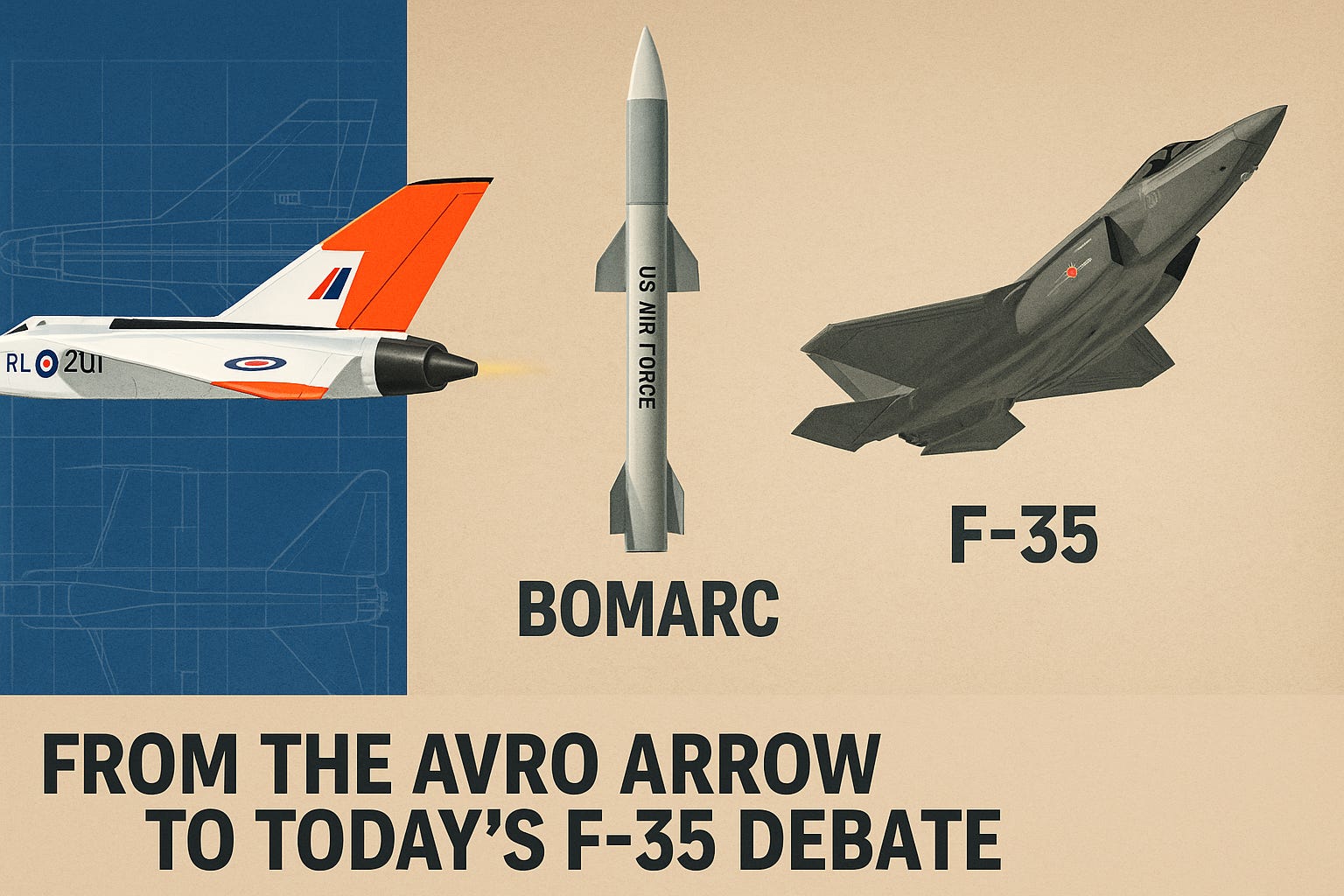
1. 1959: The Turning Point
At its peak, the Avro Arrow was the pride of Canadian innovation. The CF-105 was capable of flying at Mach 2, with cutting-edge avionics, delta wings for high-altitude maneuverability, and weapons systems years ahead of anything else in North America. Built almost entirely with Canadian labour and materials, it was a bold declaration that Canada could not only keep up with the superpowers but lead in aerospace design.
And yet, as several American readers recently noted in response to Between the Lines, the Arrow is virtually unknown outside Canada. Credit where it’s due: some outlets have taken the time to explain that history this week, including a breakdown of what made the Arrow so groundbreaking.
But what really matters—and what most accounts miss—is not just the jet itself, but the moment it marked.
When we destroyed the Arrow, we didn’t just erase blueprints. We erased a future. A path not taken. A deliberate shift away from being a builder of sovereign systems, and toward being a subscriber to Washington's defence doctrine and the U.S. military-industrial supply chain.
In February 1959, the Avro Arrow was abruptly canceled. It wasn’t just a fighter jet—it was Canada’s most ambitious attempt to build a sovereign aerospace and defence industry. The CF-105 Arrow, developed by Avro Canada, was faster, more advanced, and more domestically sourced than anything Canada had built before — or since.
But just as the Arrow reached the threshold of production, Prime Minister John Diefenbaker’s government pulled the plug. The official reasons were cost, changing threat perceptions (from bombers to ICBMs), and the inability to secure foreign buyers. But behind those justifications sat another force: the growing pressure to integrate Canada fully into a U.S.-led continental defence framework.
The Avro Arrow’s cancellation wasn’t just a policy decision. It was a symbolic transfer of autonomy. Instead of defending its airspace with homegrown innovation, Canada signed on to the U.S.-built Bomarc missile program. The missiles were nuclear-capable and functionally dependent on U.S. control. With the Arrow destroyed—blueprints, tooling, and all—Canada became a buyer, not a builder.
2. Continental Integration Over Innovation
That same year, Canada signed the Continental Air Defense Integration North (CADIN) agreement—an extension of NORAD’s mandate, embedding Canadian air defence infrastructure more deeply into American systems. CADIN allocated Canadian funds to build missile sites and radar stations while the U.S. retained control of the warheads and key command systems.
This was framed as efficient cooperation, but the structure was unmistakable: Canada was paying for the privilege of plugging into a system it did not control.
By tying its defence posture to U.S. platforms and nuclear policy, Canada effectively outsourced its sovereignty. From supply chains to strategic doctrine, decisions flowed southward.
This shift away from industrial autonomy toward continental integration hollowed out domestic capabilities. Avro engineers were laid off in the thousands; many moved to NASA and U.S. firms, contributing to the Apollo program. Canada’s opportunity to lead in aerospace innovation evaporated—not because of technical failure, but because of policy deference.
It wasn’t a one-time mistake. It was the start of a pattern.
3. The Drift Years
From the 1960s through the early 2000s, Canada’s defence industry saw slow erosion. While the country remained a reliable contributor to peacekeeping operations and NATO partnerships, it increasingly took on the role of a consumer, not a producer.
Big-ticket military platforms—planes, ships, surveillance systems—were almost always purchased from U.S. suppliers. Domestic shipyards and aerospace manufacturers were relegated to maintenance or low-leverage subcontracting. Procurement policy focused on political compromise and delay rather than long-term industrial strategy.
The result? Canada became a "poorer buyer." By the 1990s and early 2000s, even basic replacement programs (like for naval frigates or fighter jets) were chronically underfunded, delayed, or abandoned. The once-ambitious aerospace sector was now largely reduced to niche component manufacturing, often under foreign license.
The pattern was clear: buy abroad, delay decisions, and settle for interoperability over independence.
4. The F-35 Debacle
The most visible symbol of Canada’s procurement dependence is the F-35 fighter jet program. Originally pitched as a multinational cooperative initiative with economic benefits, the reality has been very different.
Canada committed to purchasing 88 F-35s at a projected cost of C$19 billion. That number has already grown, with some estimates pushing long-term costs toward C$30 billion or more. The country is legally bound to purchase the first 16 aircraft, but the rest remain under review as of summer 2025.
For many, the F-35 represents the worst of what procurement has become: expensive, delayed, poorly matched to Canadian defence needs, and dependent on a supply chain and software ecosystem controlled by the U.S. Department of Defense.
While countries like Sweden, Finland, and South Korea have moved to build their own fighters or co-develop alternatives, Canada remains a buyer of last resort—locked into a platform it cannot influence.
5. The Pivot Opportunity
And yet, the pattern isn’t destiny.
Prime Minister Mark Carney’s recent defence review has opened a window. With 72 of the 88 F-35s still subject to reconsideration, Canada has a rare opportunity to pivot—not just from one aircraft to another, but from buyer to builder.
Sweden’s Gripen E program is offering co-manufacturing deals. The EU-Canada defence pact, signed in June 2025, includes provisions for industrial cooperation, research, and joint procurement. And Canada’s new pledge to raise defence spending to 5% of GDP by 2035 provides the budgetary room to invest in its own capabilities.
If used wisely, that investment could reverse six decades of slow decline. But only if we choose a different approach.
6. Reclaiming the Builder Identity
Canada doesn’t need to build a complete stealth jet overnight. But we do need to rebuild a domestic defence ecosystem that can design, test, produce, and support critical systems.
That means:
Investing in dual-use manufacturing (military + civilian tech)
Prioritizing procurement models that include Canadian work-share and tech transfer
Aligning with allies (EU, Australia, Sweden) who favour cooperation over control
And most of all, it means rejecting the idea that sovereignty is simply about flag decals on imported hardware. True sovereignty is about capacity. About resilience. About being a contributor—not just a consumer.
It’s time to start building Canada again Canada.
Action Tip: Write your Member of Parliament today! Free letter template on our subscriber resource hub page:
Just in case you missed it, the original story about Canada’s Avro Arrow:
How the Avro Arrow Became a Warning—and What’s Replacing It

Canada just hit a 10-year high in military recruitment. But who’s being recruited—and who’s staying—tells a more complicated story.
Like stories like this one? Buy me a coffee…even one cup of java keeps me going!
Join Leni Spooner at Between the Lines for deep dives and small sparks of action.
💬 If this gave you something to think about, tap the 💚 or drop a comment below.