


Over the past few weeks, we’ve explored the pressures shaping Canada’s food system—from loyalty programs and grocery pricing, to supply chain vulnerabilities and corporate consolidation. This post Food Politics: Power, Price & the Plate series piece zooms out to the bigger picture: how food policy, rural economies, and national sovereignty are inseparably linked. If we want a secure, prosperous future, our dinner table has to be part of our nation-building plan.
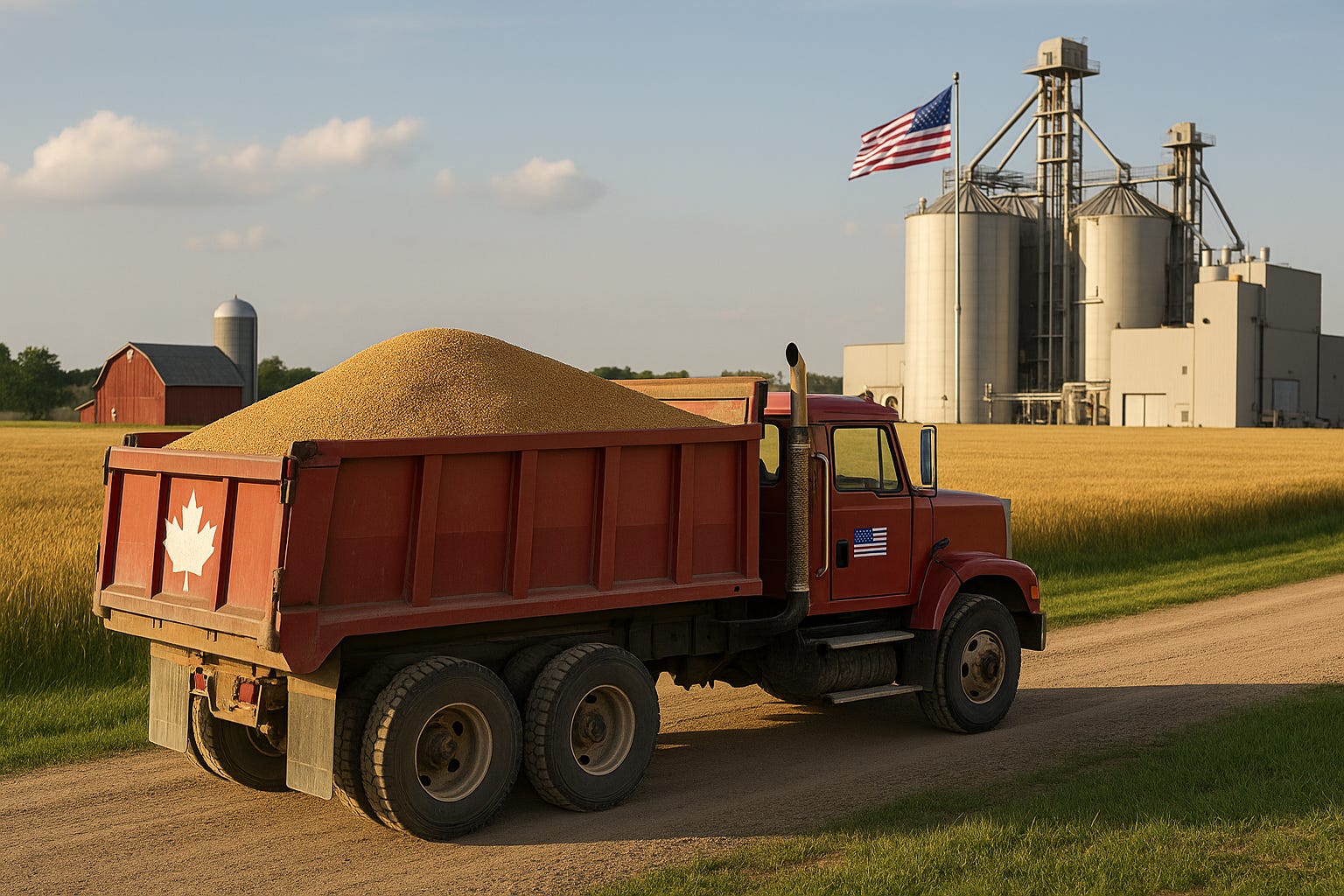
Canada is a land of abundance, a nation of immense agricultural potential that feeds continents. Yet we find ourselves in a peculiar—and increasingly precarious—position: we are profoundly dependent on other countries for the processed foods that fill our grocery store shelves. We export our raw commodities—our wheat, soybeans, and canola—only to import them back as value-added products like pasta and cooking oils.
This isn’t just an economic inefficiency; it’s a profound strategic vulnerability. The fragility of this system became starkly clear during the COVID-19 pandemic, when the closure of a single large meat processing plant led to both a massive oversupply for farmers and bare shelves for consumers. Overnight, producers were dumping livestock while shoppers stared at empty coolers—proof that our food security is only as strong as its weakest link.
Just as we’ve seen in energy and manufacturing, when we outsource critical sectors we weaken our ability to act independently. Food is no different—it is the most fundamental pillar of national sovereignty.
A look at the numbers reveals the scale of the problem. The United States, our closest trading partner, exported $28.3 billion in agricultural products to Canada in 2022, with 70% of that value in high-value, consumer-oriented goods. We are shipping our economic opportunity away and paying a premium to get it back, already packaged and ready to eat.
The Problem: A Chain of Critical Gaps
The root of our food dependency lies in several interconnected issues, each a weak link in our food chain.
1. The “missing middle” in processing.
Small and mid-sized processors, once the backbone of regional food systems, have either closed or been absorbed by a handful of large corporations. In the Canadian beef-packing industry alone, the four largest firms now control about 95% of processing capacity, up from 35% in 1990. This “hourglass” system—many producers at the top, few processors in the middle, millions of consumers at the bottom—means a single disruption can ripple nationwide.
2. A looming labour crisis.
By 2029, the agri-food sector will face a shortfall of roughly 123,000 jobs—a third of the industry. But the crisis is already here: in 2022, agriculture had a 7.4% vacancy rate, leaving over 28,200 jobs unfilled and costing an estimated $3.5 billion in lost sales. This shortage spans farm work, processing, logistics, and research, worsened by an aging workforce, outdated perceptions of agri-food careers, and an overreliance on restrictive temporary foreign worker programs.
3. The silent loss of arable land.
For a country as vast as Canada, it’s alarming how little prime farmland we actually have—and how quickly we’re losing it. Ontario alone is estimated to lose about 319 acres every day, often to urban sprawl on the most fertile ground. Once paved, this capacity is gone forever. This is an urgent national problem that rarely gets the attention it deserves.
4. Infrastructure gaps and lingering trade barriers.
While some interprovincial trade barriers are finally coming down, decades of mismatched standards, inspection regimes, and certifications have made it more difficult to move food across Canada than to import it from the U.S. This fragmentation has long stifled the growth of domestic producers and fractured our national market. Removing the remaining barriers could add $92–161 billion to GDP, according to C.D. Howe Institute estimates. But regulation isn’t the only obstacle: outdated transportation networks, insufficient cold storage, and persistent rural broadband gaps still lock many producers out of modern markets and AgTech adoption.
Each of these weak links leaves us more exposed — but none are inevitable. With intent, Canada can turn fragility into resilience.
The Blueprint: A Strategic Path to Food Sovereignty
This is not about closing our borders. It’s about making smarter choices to build domestic strength. Our blueprint rests on four pillars:
Pillar 1: Invest in the “Missing Middle.”
Targeted investment in small and medium-sized processors, regional food hubs, and cooperatives—everything from local abattoirs to canneries—can shorten supply chains, cut transport costs, and make our system more resilient.
Pillar 2: Build a stronger workforce.
Streamline temporary worker programs, but also launch a national campaign to showcase agri-food as a high-tech, high-opportunity career path. Invest in training, automation, and education to build a skilled domestic workforce.
Pillar 3: Protect farmland and modernize infrastructure.
Enact strong land-use policies to preserve prime agricultural land and push for “smart growth” that doesn’t sacrifice food security. Upgrade transport corridors, expand cold storage, and finish dismantling interprovincial trade barriers. Close the rural broadband gap so every farmer can compete in the digital economy.
Pillar 4: Foster innovation and climate resilience.
Invest in precision agriculture, vertical farming, drought-resistant crops, and sustainable water management. Under moderate climate projections, Prairie yields could drop by 25% for barley, 21% for spring wheat, and 19% for canola by 2050 without adaptation—making innovation not just wise, but essential.
A Call to Action for Food Sovereignty
By addressing the “missing middle,” the labour crisis, the loss of farmland, and infrastructure gaps, we aren’t just making our food system more efficient—we are strengthening Canada’s sovereignty.
Food sovereignty is not isolationism; it’s self-reliance. It’s knowing we can feed ourselves no matter what happens in the world.
For you, that means:
Choosing Canadian-processed and Canadian-grown products whenever possible.
Supporting local farmers’ markets and independent grocers.
Asking your municipal, provincial, and federal leaders what they’re doing to protect farmland and support local processing.
Joining or supporting local food security and sovereignty groups.
Speaking up for policies that keep jobs, skills, and value-added production here at home.
Bringing food sovereignty to the urban kitchen table conversations— and sharing stories like this one.
Food sovereignty belongs at the kitchen table because that’s where everyday choices turn into collective power. Talking about where our food comes from — and who profits from it — closes the gap between city and countryside, between eaters and growers. These conversations lead to action: from the checkout counter to the voting booth, from community gardens to municipal councils.
Your choices are small acts of nation-building. The time for action is now. Let’s stop exporting our opportunity and start building a food system that is truly our own — from our farms to our tables. A food-secure Canada is a stronger Canada for everyone.
We can’t call ourselves a sovereign nation if we outsource our dinner table — it’s time to bring Canada’s food system home. 🍁🥖 #FoodSovereignty
Restart Food Politics: Power, Price & the Plate Series reading from the beginning:
The Great Canadian Grocery Hunt: Why Finding Local Food is So Hard

Every Canadian knows the feeling. It's the daily elbows-up fight for a decent price in the grocery aisle. It’s the creeping cost of basics and the quiet disappearance of products you used to see all the time. But these everyday frustrations are just the tip of the iceberg. They're a sign of something much bigger:…
Eating with Eyes Wide Open

We all eat. But how often do we stop to wonder who really decides what ends up on our plate? It's a curious thing, this food of ours, far less about personal preference and far more about a tangled web of political decisions, economic systems, and cultural tales that str…

Thank you for reading—and for believing that quiet voices can still make a difference. 💚
If a subscription isn’t in the cards right now but you’d still like to chip in, you can always buy me a coffee. Every cup helps keep Between the Lines independent. ☕
Share with a friend: Thoughtful conversations grow stronger with good company.
You mentioned the missing middle. This is an area of complex problems and endless possibilities, I think. The fact that the middle parts of the economic food chain are hollowed out has resulted in blank stares all around when the problem is mentioned.
I wonder what the role of municipalities and school boards could be? I wonder what chambers of commerce and business associations could see as opportunities? How about Rotary and Kiwanis clubs and other socially aware service clubs? You mentioned vertical farming, cold storage, meat processing, and I'll add new greenhouse projects, community farming clubs, municipal farmer's markets, educational initiatives.
I don't know... it just seems to me there are so many missing pieces, and every solution to food independence feels more out of reach than ever.
Another action item for your list is place of origin labeling along with legible fonts (all countries to facilitate ABUS shopping).